FIELD GUIDESource-led reference

P024 / Audio / Connector

TOSLINK connector

TOSLINK and Mini-TOSLINK are optical connection forms, not analog metal-contact audio interfaces.

Also called optical audio SPDIF optical TOSLINK

Optical shape matching still does not establish an audio-format match.

Look for

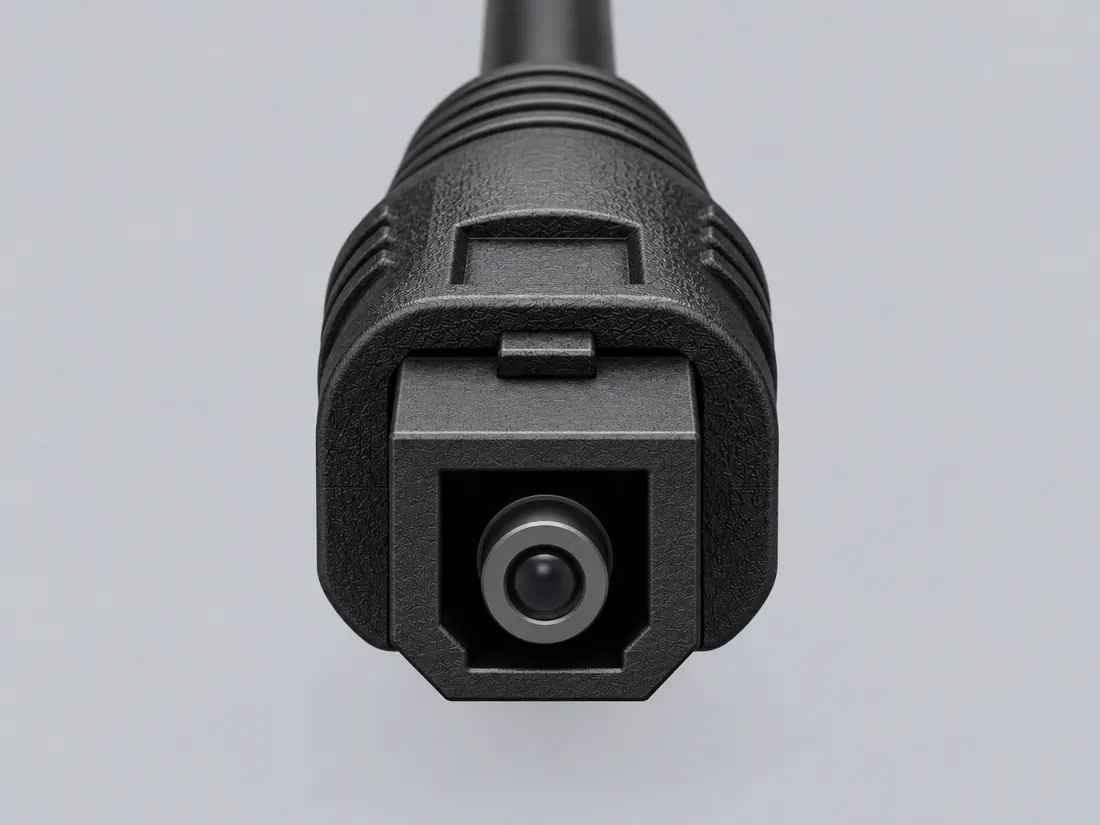
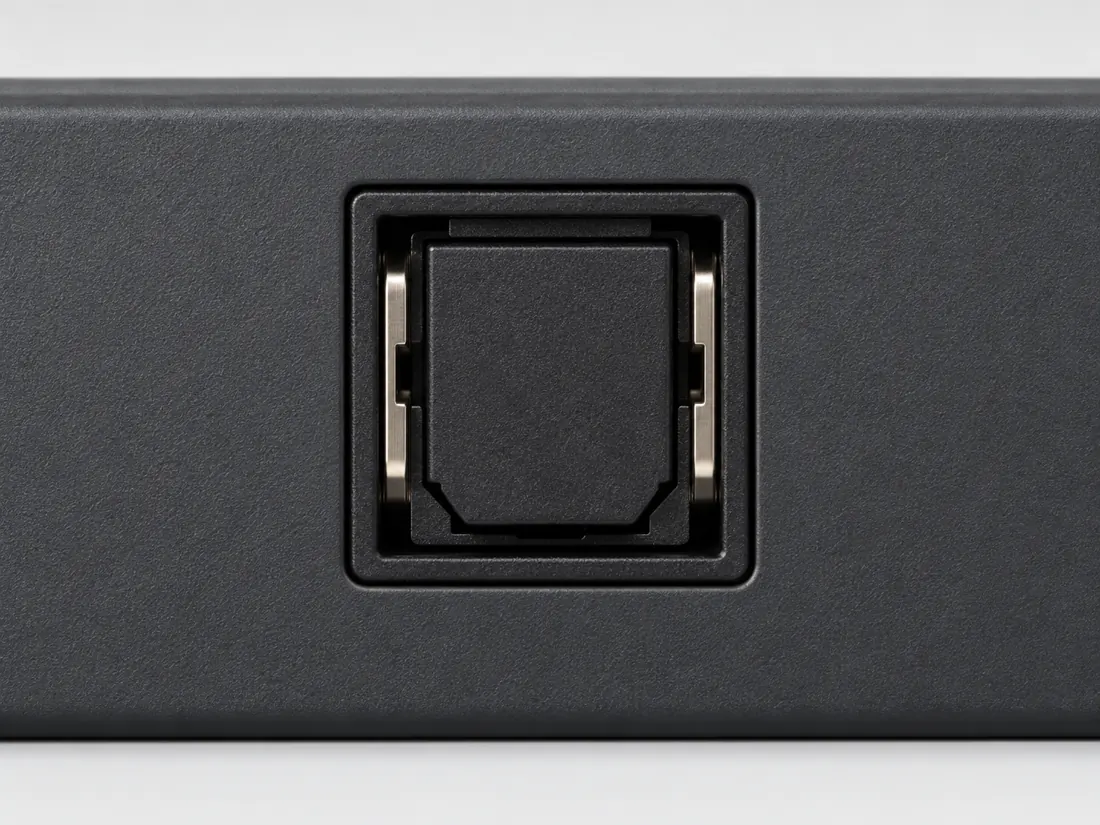
Check for the keyed optical opening and any protective cap. Do not stare into an active optical source; compare the disconnected cable and device documentation.

Claim inspection dates: 2026-10-07, 2026-10-11, 2026-10-21 · Independent review pending

Image inspection / P024

See the view. Check its scope.

3 registered views for this reference. Different part examples are not automatically mates; all remain not to scale and independently unapproved.

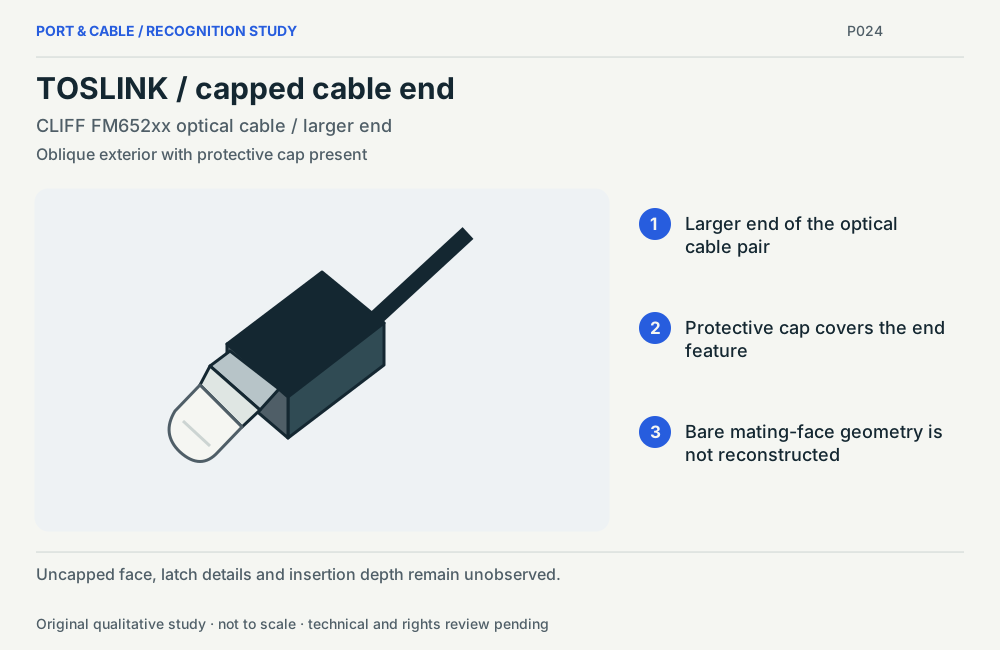
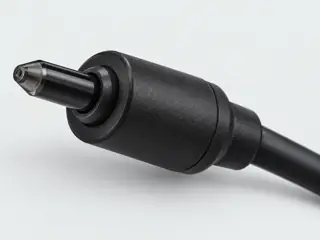
TOSLINK / capped cable end. Larger end of the optical cable pair. Protective cap covers the end feature. Bare mating-face geometry is not reconstructed. Uncapped face, latch details and insertion depth remain unobserved. Not to scale. (private workspace)

P024 / Source-observed physical study

TOSLINK / capped cable end

CLIFF FM652xx optical cable / larger end

Oblique exterior with protective cap present · Cable plug / cable end

Not to scale. Technical and rights review pending.

Inspect view & provenance (private workspace)

Other scoped views

Keep their component sides and part examples separate.

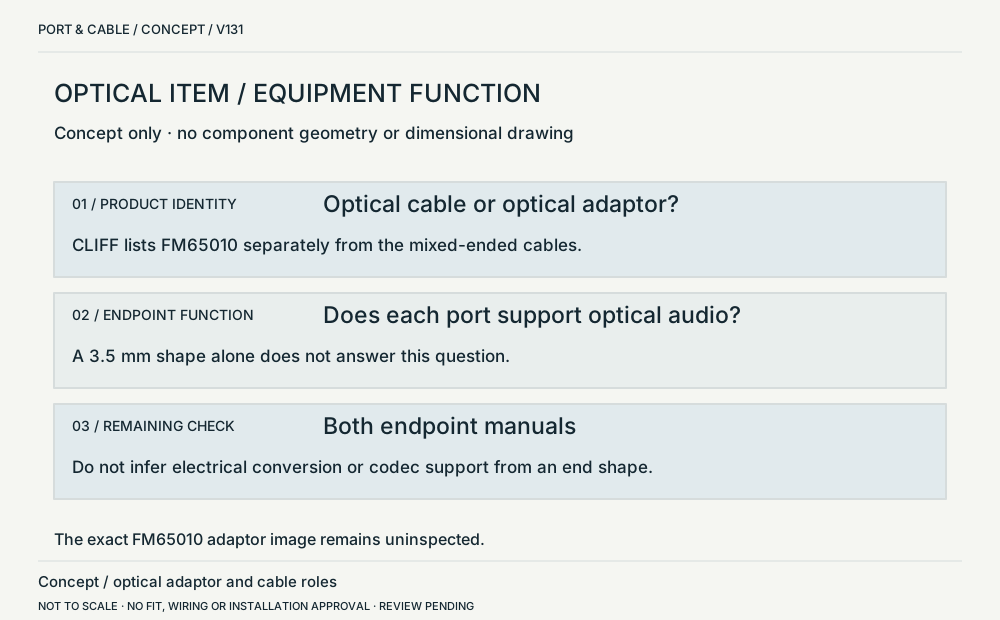
Optical end shapes / signal function. Abstract role diagram, not a drawing of the uninspected FM65010 adaptor. Read from item identity to equipment requirements; no physical interface depicted. No dimensional, wiring or compatibility approval. (private workspace)

P024 / Concept — not physical geometry

Optical end shapes / signal function

Concept / optical adaptor and cable roles

Abstract role diagram, not a drawing of the uninspected FM65010 adaptor. · Concept only

Not to scale. Technical and rights review pending.

Inspect view & provenance (private workspace)
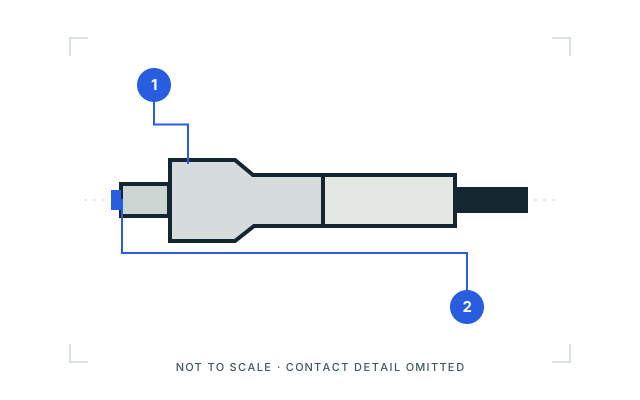
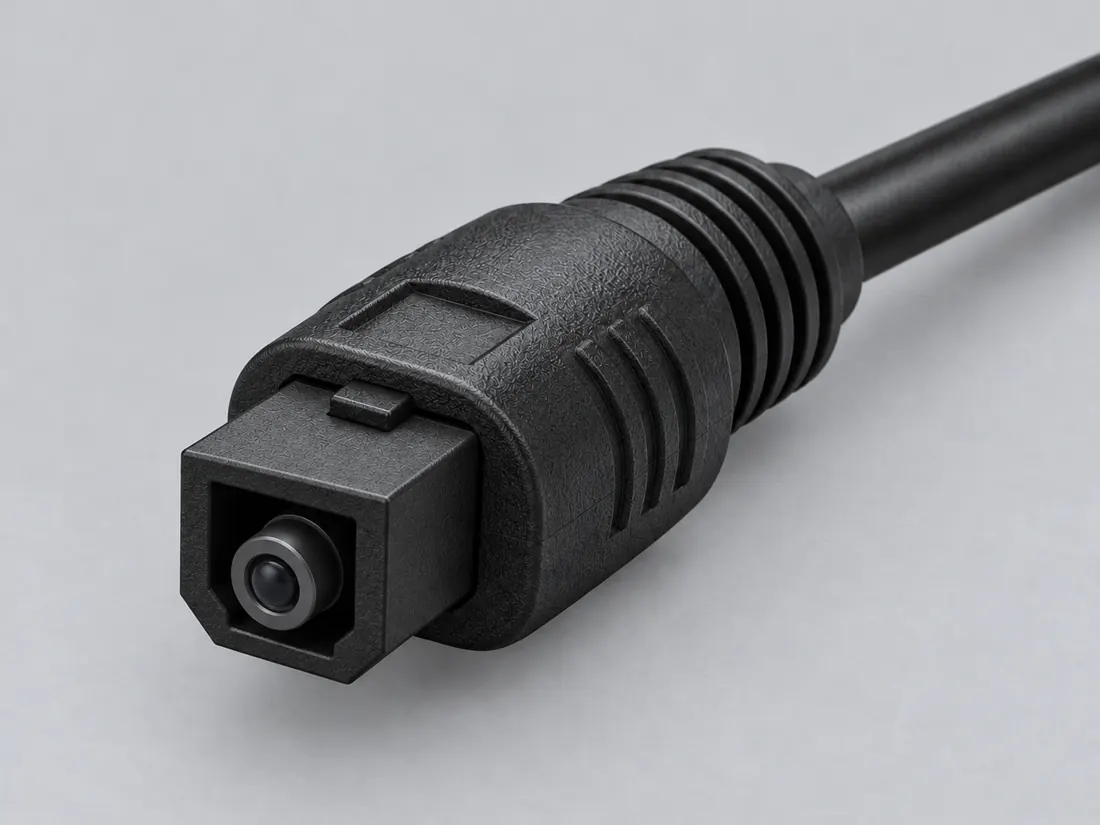
TOSLINK connector: cable-end plug, exterior side study. Keyed, squared plug body; projecting optical nose. Not to scale; no pinout. (private workspace)

P024 / Inherited recognition study

TOSLINK connector

TOSLINK connector / previously depicted manufacturer example

Exterior side study · Cable plug / cable end

Not to scale. Technical and rights review pending.

Inspect view & provenance (private workspace)
V117 / READER FIELD GUIDE / FIBER IDENTITIES

Before you connect or replace

TOSLINK is not a network fiber patch lead

No. TOSLINK is a consumer optical digital-audio connector form, not an LC/SC data-center optic. Light transmission alone does not imply optical interface compatibility.

Three checks and exact source trail ↗

Editorial decision guidance only. A connector identity or nominal pitch does not establish approved mating, safe wiring or a supported device combination.

Visual reference / P024

Optical: compare the exterior only.

PLUG EXTERIOR

Recognition, not measurement. Each drawing is fitted independently: equal boxes do not mean equal sizes. Contact detail is deliberately omitted.

01 / Cable-end plugExterior side study
TOSLINK connector: cable-end plug, exterior side study. Keyed, squared plug body; projecting optical nose. Not to scale; no pinout.

Cable extends to the right; exterior only.

Qualitative recognition study interpreted from the pictured manufacturer example. Inner contacts, exact dimensions and hidden surfaces are omitted.

Two things to notice

  1. Keyed, squared plug body
  2. Projecting optical nose

What the picture cannot tell you

This is an exterior reference, not an instruction to inspect a lit end. No shutter, receptacle geometry or electrical pin pattern is inferred.

No receptacle drawn: a sufficiently clear, role-specific opening was not visually inspected for this pilot. Do not infer it by mirroring the plug.

Sources, drawing scope & rights

Visual references checked 2026-10-09. These are new, source-scoped recognition studies, not approved mechanical drawings, pinouts or compatibility verdicts. Independent drawing review remains pending.

Original Port & Cable vector study. Third-party reference photographs are linked, not copied or bundled.

C2G / Legrand — Audio connector guide
TOSLINK cable-plug photograph. Pictured keyed exterior and projecting optical nose only; no receptacle inferred.

This inspection does not refresh any canonical claim, source-review date or publication approval.

Flagship reference

Practical answers for TOSLINK connector

Start with the answer. Follow the real distinction, then the source-scoped next check. All evidence dates and publication blockers remain unchanged.

V102Q04 Practical reference

Both sockets look optical: why does ADAT not automatically accept optical S/PDIF?

Short answer The optical connector shape does not specify the digital audio format. Focusrite documents generation- and mode-specific differences, including ADAT-only optical inputs on certain older Scarlett models and S/PDIF mode on certain 3rd-generation models.

Which distinction matters?

What you are checkingWhat the cited evidence establishes
TOSLINK-style physical pathA light-carrying connection; not a format guarantee
Scarlett 1st/2nd generation in the cited setupFocusrite distinguishes their ADAT optical input from the S/PDIF TV setup
Specified 3rd-generation Scarlett 18i8 / 18i20Focusrite describes a selectable optical S/PDIF mode

Next checks, in order

  1. Identify the actual audio-interface generation, model and port role.
  2. Read its optical format and clock-source requirements, not just the cable label.
  3. Set the mode only according to the exact manufacturer instructions, then verify the source’s output format.

Still unresolved: No universal channel count, optical codec or cross-model switching feature follows from a TOSLINK-shaped port.

Claim-level evidence, source locators and limits

Existing evidence claims: C024A · C024C. These are editorial field answers over inherited source records, not newly approved specifications.

  • S845 · CLIFF Electronic Components — Opening optical/light transmission description; TOSLINK to Mini-TOSLINK3.5mm lead sets; Mini-TOSLINK optical jack plug; FM65215/FM65220/FM65225 and FM65010 adapter listings.. Recorded inspection 2026-10-21; Product-family optical identification only. The3.5mm similarity warning is editorial caution, not measured user confusion. No dimensional tolerances or source photos were imported.
  • S409 · Focusrite — Updated 7 January 2026: Devices with Digital Optical Audio Outputs; 1st/2nd and 3rd Gen Scarlett sections; PCM and decoder note.. Recorded inspection 2026-10-07; Not a universal TOSLINK format or channel-count ceiling. Optical ADAT-only versus switchable S/PDIF support belongs to the specified interface generation and operating mode.

Neither the source inspection dates nor the evidence dataset has been refreshed. No physical tests, exact-device compatibility approval, pinout or fabrication geometry is implied.

V102Q05 Practical reference

A TV sends optical audio, but the interface is silent: could the encoding be the cause?

Short answer Yes, on the specifically documented Focusrite interface path, an encoded DTS or Dolby Digital output is not the same as supported linear PCM. Focusrite’s connection instructions call for linear PCM instead of those encoded formats.

Which distinction matters?

What you are checkingWhat the cited evidence establishes
Physical fiber connectionProves only the candidate optical path
Receiver input modeMust support the source’s actual optical signal format
Focusrite’s cited TV/interface setupLinear PCM is the instructed source format; DTS/Dolby Digital decoding is not supported there

Next checks, in order

  1. Check both endpoints and which one is optical output versus optical input.
  2. Inspect the source audio-output encoding and the receiver’s required mode for this exact interface.
  3. Follow its documented clock and optical-port settings; changing cables alone will not add decoding support.

Still unresolved: This is not a universal claim that optical cables cannot carry encoded formats or that all receivers lack decoding.

Claim-level evidence, source locators and limits

Existing evidence claims: C024B · C024D. These are editorial field answers over inherited source records, not newly approved specifications.

  • S405 · Toshiba Electronic Devices & Storage Corporation — FAQ explanation: optical transmitter, fiber, receiver and separate module electronic interfaces.. Recorded inspection 2026-10-07; This general fiber-coupler FAQ is not a consumer TOSLINK mechanical standard, module pin assignment, audio-codec specification or universal voltage rating.
  • S409 · Focusrite — Updated 7 January 2026: Devices with Digital Optical Audio Outputs; 1st/2nd and 3rd Gen Scarlett sections; PCM and decoder note.. Recorded inspection 2026-10-07; Not a universal TOSLINK format or channel-count ceiling. Optical ADAT-only versus switchable S/PDIF support belongs to the specified interface generation and operating mode.

Neither the source inspection dates nor the evidence dataset has been refreshed. No physical tests, exact-device compatibility approval, pinout or fabrication geometry is implied.

The useful distinction

Why can an optical cable fit but produce no usable audio?

Check the optical format and the receiving device as well as the connector. An optical cable end is not a module pinout, and a receiver’s format or decoder limits are not a limit inferred from the cable shape. C024B · C024C · C024D

Component or signal: documented distinction and remaining check
CheckDocumented distinctionWhat this does not establish
Optical pathToshiba separates the transmitter, fiber and receiver from electronics inside the modules. C024BDo not assign electrical contacts to an optical cable end.
Input formatThe cited Focusrite article distinguishes ADAT-only inputs on its described older Scarlett setup from optical S/PDIF on specified later models. C024CKeep the exact model/generation; the same opening does not establish its selected protocol.
DecoderThat Focusrite setup calls for linear PCM; the interface does not decode the cited DTS/Dolby Digital input. C024DThis is a receiver limitation, not a claim that the cable cannot carry encoded audio.

Keep this limit: Optical appearance does not establish a channel count, codec, mode or an optical-to-electrical converter requirement for an unidentified device. C024B · C024C · C024D

Before choosing the cable or component

  1. Read the source output and destination input formats in their exact manuals.
  2. Check the model generation and documented input-mode/decoder requirements.
  3. Follow optical-safety instructions; never look into an optical port or fiber to diagnose it.
Original source statements and citation return points

TOSLINK and Mini-TOSLINK are optical connection forms, not analog metal-contact audio interfaces. [C024A]

Toshiba describes a digital optical path from a transmitter through fiber to a receiver, with separate electronic interfaces inside the modules. Those module interfaces are not electrical contacts on the optical cable end. [C024B]

Focusrite states that optical inputs on its 1st/2nd-generation Scarlett interfaces support ADAT rather than the optical S/PDIF setup described in its article; its 3rd-generation 18i8 and 18i20 instead have an optical S/PDIF mode. [C024C]

For the listed interface setup, Focusrite calls for linear PCM and says its interfaces cannot decode DTS or Dolby Digital surround-encoded input. This is a receiver/decoder limitation, not a claim that an optical cable cannot carry encoded audio. [C024D]

CLIFF lists FM65215 as a cable with a TOSLINK end and a 3.5 mm optical-jack end. [C024E]

Source check · 14 October 2026. Toshiba’s module explanation and the selected Focusrite setup were observed. No new model coverage, codec support or module wiring is inferred.

Source-qualified reference, not a wiring, optical-link or compatibility approval. Each linked claim and source carries its own recorded inspection date and review status. Selected source checks do not constitute independent technical or rights approval.

Existing source trail: S405 · S409.

Audio questions · Mini-TOSLINK connector

Identify the documented form

Identify an optical link, then check input/output mode and decoding.

  1. The optical cable end is not an electrical plug-contact bank; module electronic interfaces are a different object. S845 · S405
  2. Focusrite’s ADAT versus optical S/PDIF support differs by named interface generation and mode. S409
Documented identity facts; exact part and variant scope remains with each value
Nominal contactsNot applicableS845 · S405 · S409 · S409 · S533Optical connector end: electrical contact/pin quantities are not applicable. Fiber count and internal transmitter/receiver module terminals are different facts.
Positions / cavity spanNot applicableS845 · S405 · S409 · S409 · S533Optical connector end: electrical contact/pin quantities are not applicable. Fiber count and internal transmitter/receiver module terminals are different facts.
Populated contactsNot applicableS845 · S405 · S409 · S409 · S533Optical connector end: electrical contact/pin quantities are not applicable. Fiber count and internal transmitter/receiver module terminals are different facts.
Connector roleoptical cable plug (FM65015)S533Separate exact examples; retain each value’s source, role, axis and part scope. Exact named example FM65015: TOSLINK cable assembly, standard optical ends. Exact example only; no universal geometry, electrical compatibility, fabrication approval or wiring instruction. Protective caps obscure tips; no mating-face geometry from photograph. Cable length is not connector size and should not inflate geometry target.
Rows, pitch, dimensions, keying and view limits
Additional scoped facts; not a fabrication drawing or a mating approval
Contact rowsNot applicableS845 · S405 · S409 · S409 · S533Optical connector end: electrical contact/pin quantities are not applicable. Fiber count and internal transmitter/receiver module terminals are different facts.
Contact pitchNot applicableS845 · S405 · S409 · S409 · S533Optical connector end: electrical contact/pin quantities are not applicable. Fiber count and internal transmitter/receiver module terminals are different facts.
Dimensions / axisNot recordedNo qualified value remains for this contact/body field. Source context is retained in variant_notes; no value inferred from artwork or names.
Coupling / latchNot recordedNot recorded in a normalized source-scoped field. Consult the exact part/revision; no value inferred from illustrations.
Keying / polarizationNot recordedNot recorded in a normalized source-scoped field. Consult the exact part/revision; no value inferred from illustrations.
View conventionNot recordedNot recorded in a normalized source-scoped field. Consult the exact part/revision; no value inferred from illustrations.
Contact gender / arrangementNot applicableS845 · S405 · S409 · S409 · S533Optical connector end: electrical contact/pin quantities are not applicable. Fiber count and internal transmitter/receiver module terminals are different facts.
MountingNot recordedNot recorded in a normalized source-scoped field. Consult the exact part/revision; no value inferred from illustrations.
Shell / formNot recordedNot recorded in a normalized source-scoped field. Consult the exact part/revision; no value inferred from illustrations.
ManufacturerCLIFF (FM65015)S533Separate exact examples; retain each value’s source, role, axis and part scope. Exact named example FM65015: TOSLINK cable assembly, standard optical ends. Exact example only; no universal geometry, electrical compatibility, fabrication approval or wiring instruction. Protective caps obscure tips; no mating-face geometry from photograph. Cable length is not connector size and should not inflate geometry target.
SeriesTOSLINK optical leads (FM65015)S533Separate exact examples; retain each value’s source, role, axis and part scope. Exact named example FM65015: TOSLINK cable assembly, standard optical ends. Exact example only; no universal geometry, electrical compatibility, fabrication approval or wiring instruction. Protective caps obscure tips; no mating-face geometry from photograph. Cable length is not connector size and should not inflate geometry target.
Exact part / implementationFM65015 (FM65015)S533Separate exact examples; retain each value’s source, role, axis and part scope. Exact named example FM65015: TOSLINK cable assembly, standard optical ends. Exact example only; no universal geometry, electrical compatibility, fabrication approval or wiring instruction. Protective caps obscure tips; no mating-face geometry from photograph. Cable length is not connector size and should not inflate geometry target.
Recorded markingsNot recordedNot recorded in a normalized source-scoped field. Consult the exact part/revision; no value inferred from illustrations.

Keep this limit: The cited receiver’s PCM/decoder restrictions are not universal limits of an optical cable. S409

Make the next check

Check the exact transmitter output, receiver optical mode and supported audio encoding in their manuals.

Existing source inspection and AI review remain distinct from independent technical review. A matching form does not establish a safe connection.

Recorded variant and source limits
  • No connector mating tolerances, insertion depth or fabrication dimensions have been verified.
  • A module PCB pin map or a combination socket’s analog terminals must not be imported as optical cable contacts.
  • Check exact output/input roles, receiver mode and audio decoding; a matching connector does not prove them.
  • No physical sample or hardware connection has been tested.
  • Retained dimensions context (excluded from normalized contact/body field): 1500 mm / complete named cable assembly length. Exact named example FM65015: TOSLINK cable assembly, standard optical ends. Exact example only; no universal geometry, electrical compatibility, fabrication approval or wiring instruction. Protective caps obscure tips; no mating-face geometry from photograph. Cable length is not connector size and should not inflate geometry target. Sources: S533: Issue5 p.1 named item row, descriptive optical-cord text and product photograph; photo visually inspected
Report a correction to this identification or view →

Bounded facts, visible unknowns

Specifications and limits

TOSLINK connector facts and limitations
Transport mediumOptical [C024A]
Audio formatsEndpoint-dependent [C024A]
Mechanical dimensionsNo independently reviewed mechanical drawing in this release; do not use this page for fabrication.
Engineering pinoutSource-checked engineering profile available; independent review pending. Open engineering profile →
Verified device listNot included. Check exact device and accessory documentation.
A boundary, not an omission to guess around.

This record is an identification starting point. It does not provide measured mating tolerances, a wiring pinout, electrical approval, or a list of verified device models. Use the original device and accessory documentation to resolve the remaining requirements.

Before you connect

What to check

  1. Confirm optical output versus input.
  2. Check which audio formats both devices support.
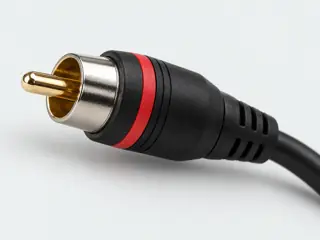
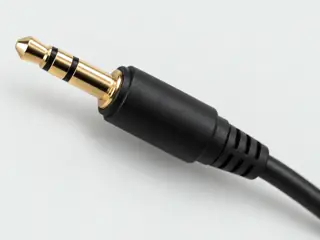
  3. Inspect the exact cable ends; standard TOSLINK and Mini-TOSLINK differ physically.
Trace a supported connection class →

Can I connect…

Common connections for this connector

All connection questions →

Optical reference depth

Read the optical-interface reference and the ADAT/S/PDIF question guide. Connector shape does not identify a receiver mode, codec decoder or module circuit pinout.

Your next step

Move from the form to the requirement.

The source trail

Evidence for this page

AI-assisted inspection is not independent engineering review. Source scope and access limitations are disclosed below. Procedural checklists are editorial requirements, not hardware measurements.

Back to first citation ↑
C024ASource checked · pending review

TOSLINK and Mini-TOSLINK are optical connection forms, not analog metal-contact audio interfaces.

CLIFF Electronic Components · TOSLINK Optical Audio Data Cables ↗

Locator: Opening optical/light transmission description; TOSLINK to Mini-TOSLINK3.5mm lead sets; Mini-TOSLINK optical jack plug; FM65215/FM65220/FM65225 and FM65010 adapter listings.
Access: public page. Product-family optical identification only. The3.5mm similarity warning is editorial caution, not measured user confusion. No dimensional tolerances or source photos were imported.

S845: full source recordInspect review dependencies → (private workspace)

Claim scope: Consumer identification / documented standard or product class only. Next review due 2027-01-19.

Back to first citation ↑
C024BSource checked · pending review

Toshiba describes a digital optical path from a transmitter through fiber to a receiver, with separate electronic interfaces inside the modules. Those module interfaces are not electrical contacts on the optical cable end.

Toshiba Electronic Devices & Storage Corporation · What is a fiber coupler (TOSLINK)? ↗

Locator: FAQ explanation: optical transmitter, fiber, receiver and separate module electronic interfaces.
Access: public page. This general fiber-coupler FAQ is not a consumer TOSLINK mechanical standard, module pin assignment, audio-codec specification or universal voltage rating.

S405: full source recordInspect review dependencies → (private workspace)

Claim scope: General optical-transmission principle only; no consumer connector dimensions, module pin numbers or voltage ratings are asserted.. Next review due 2027-01-05.

Back to first citation ↑
C024CSource checked · pending review

Focusrite states that optical inputs on its 1st/2nd-generation Scarlett interfaces support ADAT rather than the optical S/PDIF setup described in its article; its 3rd-generation 18i8 and 18i20 instead have an optical S/PDIF mode.

Focusrite · Connecting TVs, Consoles, or other devices to your interface ↗

Locator: Updated 7 January 2026: Devices with Digital Optical Audio Outputs; 1st/2nd and 3rd Gen Scarlett sections; PCM and decoder note.
Access: public page. Not a universal TOSLINK format or channel-count ceiling. Optical ADAT-only versus switchable S/PDIF support belongs to the specified interface generation and operating mode.

S409: full source recordInspect review dependencies → (private workspace)

Claim scope: Specified Focusrite generations and operating mode only; this difference is not a property that can be read from the optical connector shape.. Next review due 2027-01-05.

Back to first citation ↑
C024DSource checked · pending review

For the listed interface setup, Focusrite calls for linear PCM and says its interfaces cannot decode DTS or Dolby Digital surround-encoded input. This is a receiver/decoder limitation, not a claim that an optical cable cannot carry encoded audio.

Focusrite · Connecting TVs, Consoles, or other devices to your interface ↗

Locator: Updated 7 January 2026: Devices with Digital Optical Audio Outputs; 1st/2nd and 3rd Gen Scarlett sections; PCM and decoder note.
Access: public page. Not a universal TOSLINK format or channel-count ceiling. Optical ADAT-only versus switchable S/PDIF support belongs to the specified interface generation and operating mode.

S409: full source recordInspect review dependencies → (private workspace)

Claim scope: The article’s listed Focusrite interfaces only; no universal TOSLINK codec, sample-rate or channel-count ceiling is published.. Next review due 2027-01-05.

Back to first citation ↑
C024ESource checked · pending review

CLIFF lists FM65215 as a cable with a TOSLINK end and a 3.5 mm optical-jack end.

CLIFF · TOSLINK optical cables and 3.5 mm optical adaptor — issue 5 ↗

Locator: Issue 5, copyright 09/2023; PDF pp.1–2: FM65010 adaptor and FM65215/20/25 mixed-ended optical cables. Only p.2 photograph visually inspected.
Access: public pdf text. Only those dated item rows and the shared FM652xx photograph. The photograph does not identify a cable length. Caps obscure the optical ends. Ambiguous numerical aperture and material units are not imported.

S533: full source recordInspect review dependencies → (private workspace)

Claim scope: The listed optical cable only. This is not evidence of analog-to-digital, electrical-to-optical or codec conversion.. Next review due 2027-01-09.

Suggest a correction to this field note →
Common questions

Questions this record can help resolve

Put this field note to work.

Add to discovery trayRecord an unsaved candidate (private workspace)

Candidate selection does not confirm the identity or capabilities of your physical item.

SOURCE-QUALIFIED OPTICAL REFERENCE

Identify the item. Keep its role explicit.

CLIFF FM65215 optical cable

Source / component role
Complete cable, not an electronic converter
Documented distinction
One TOSLINK end and one 3.5 mm optical end.
What this establishes
The listed assembly connects optical connector forms; its entry does not establish analog or codec conversion.
Not established
Equipment optical port function, supported formats and the entire connection.
Next check
Read both endpoint manuals before selecting the cable.

No source-observed physical view is selected for this row.

Evidence, observation & limits

Inspected . C024E

TOSLINK optical cables and 3.5 mm optical adaptor — issue 5 ↗
V131 observation: Issue 5, copyright 09/2023; PDF pp.1–2: FM65010 adaptor and FM65215/20/25 mixed-ended optical cables. Only p.2 photograph visually inspected.
Canonical source record S533 dated 2026-10-11. The V131 visit is recorded separately; inherited source dates are unchanged.

No hardware test, independent technical approval or rights clearance is asserted.

Read the optical role chart and field guide →

Evidence behind this page

Scope first. Source second. Approval separate.

4 linked sources · 5 scoped claims · 0 sources with inspection/access flags.

Page scope: consumer_pilot

Assessment 2026-10-22 · earliest scheduled source review 2027-01-05. This is a recorded-date assessment, not a live source check. Page-level independent review is not established by this panel.

Inspect 4 source scopes, access limits and dates

S405 · What is a fiber coupler (TOSLINK)?

Toshiba Electronic Devices & Storage Corporation · Manufacturer / product-owner domain · inspected 2026-10-07 · due 2027-01-05

Within inspection window

Scoped support: Optical transmission principle and separation of the fiber path from module electronics only.

Not established / limitations: This general fiber-coupler FAQ is not a consumer TOSLINK mechanical standard, module pin assignment, audio-codec specification or universal voltage rating.

Locator: FAQ explanation: optical transmitter, fiber, receiver and separate module electronic interfaces.

S409 · Connecting TVs, Consoles, or other devices to your interface

Focusrite · Manufacturer / product-owner domain · inspected 2026-10-07 · due 2027-01-05

Within inspection window

Scoped support: Model/generation-specific optical S/PDIF setup distinctions and the listed interfaces’ inability to decode DTS/Dolby Digital.

Not established / limitations: Not a universal TOSLINK format or channel-count ceiling. Optical ADAT-only versus switchable S/PDIF support belongs to the specified interface generation and operating mode.

Locator: Updated 7 January 2026: Devices with Digital Optical Audio Outputs; 1st/2nd and 3rd Gen Scarlett sections; PCM and decoder note.

S533 · TOSLINK optical cables and 3.5 mm optical adaptor — issue 5

CLIFF · Unclassified publisher domain · inspected 2026-10-11 · due 2027-01-09

Within inspection window

Scoped support: Only those dated item rows and the shared FM652xx photograph. The photograph does not identify a cable length. Caps obscure the optical ends. Ambiguous numerical aperture and material units are not imported.

Not established / limitations: Only those dated item rows and the shared FM652xx photograph. The photograph does not identify a cable length. Caps obscure the optical ends. Ambiguous numerical aperture and material units are not imported.

Locator: Issue 5, copyright 09/2023; PDF pp.1–2: FM65010 adaptor and FM65215/20/25 mixed-ended optical cables. Only p.2 photograph visually inspected.

S845 · TOSLINK Optical Audio Data Cables

CLIFF Electronic Components · Unclassified publisher domain · inspected 2026-10-21 · due 2027-01-19

Within inspection window

Scoped support: The manufacturer explicitly describes the rectangular and3.5mm mini forms as optical. No analog-to-optical conversion or universal audio-format ceiling follows.

Not established / limitations: Product-family optical identification only. The3.5mm similarity warning is editorial caution, not measured user confusion. No dimensional tolerances or source photos were imported.

Locator: Opening optical/light transmission description; TOSLINK to Mini-TOSLINK3.5mm lead sets; Mini-TOSLINK optical jack plug; FM65215/FM65220/FM65225 and FM65010 adapter listings.

Trace 5 claims to their source records

C024A · P024

TOSLINK and Mini-TOSLINK are optical connection forms, not analog metal-contact audio interfaces.

Claim scope: Consumer identification / documented standard or product class only

Source links: S845 · Evidence trail → (private workspace)

C024B · P024

Toshiba describes a digital optical path from a transmitter through fiber to a receiver, with separate electronic interfaces inside the modules. Those module interfaces are not electrical contacts on the optical cable end.

Claim scope: General optical-transmission principle only; no consumer connector dimensions, module pin numbers or voltage ratings are asserted.

Source links: S405 · Evidence trail → (private workspace)

C024C · P024

Focusrite states that optical inputs on its 1st/2nd-generation Scarlett interfaces support ADAT rather than the optical S/PDIF setup described in its article; its 3rd-generation 18i8 and 18i20 instead have an optical S/PDIF mode.

Claim scope: Specified Focusrite generations and operating mode only; this difference is not a property that can be read from the optical connector shape.

Source links: S409 · Evidence trail → (private workspace)

C024D · P024

For the listed interface setup, Focusrite calls for linear PCM and says its interfaces cannot decode DTS or Dolby Digital surround-encoded input. This is a receiver/decoder limitation, not a claim that an optical cable cannot carry encoded audio.

Claim scope: The article’s listed Focusrite interfaces only; no universal TOSLINK codec, sample-rate or channel-count ceiling is published.

Source links: S409 · Evidence trail → (private workspace)

C024E · P024

CLIFF lists FM65215 as a cable with a TOSLINK end and a 3.5 mm optical-jack end.

Claim scope: The listed optical cable only. This is not evidence of analog-to-digital, electrical-to-optical or codec conversion.

Source links: S533 · Evidence trail → (private workspace)

Prepare this page for review → (private workspace)Read the evidence method →

Recorded evidence only. An inspection date, publisher label, source link or generated packet is not independent technical review, hardware testing, fabrication approval or a compatibility verdict.