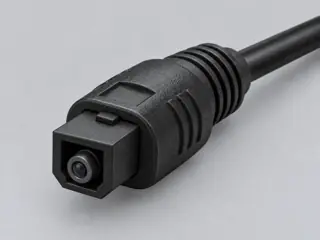
Separate the optical cable interface from the electronics in a transmitter, receiver or combination socket.
The answer
Short answer No. The cable is optical; the pins belong to the transmitter or receiver module.
The represented cable path is optical. Electrical pins shown for a transmitting or receiving module belong to that component, not to the optical cable end.
Toshiba describes a transmitter, an optical fiber and a receiver, with electronic interfaces inside the modules. A module circuit is a different reference object from the cable connector.
2Reasoning step
A combined analog/optical socket needs its own device or component documentation. Its analog terminals are not an optical pin assignment, and an optical role does not establish microphone support.
3Reasoning step
These engineering pages leave electrical contact counts unasserted and publish no terminal map. An original identification sketch is not a view from which wiring, insertion depth or fabrication tolerances can be derived.
Three reference objects that should not share a pinout
Object
What is documented
What is not established
Evidence
Optical transmission path
Digital optical signal through fiber
Electrical cable-contact numbering
C024B (private workspace)
Transmitter / receiver module
Separate internal electronic interface
Universal module voltage or PCB pin layout
C024B (private workspace)
Chromecast Audio combination output
Analog and optical digital output at its 3.5 mm jack
A socket-terminal or microphone map
C025C (private workspace)
Scroll horizontally on narrow screens. The Google example is one named device; the Toshiba explanation is a general transmission principle, not consumer connector geometry.
What to check next
Identify whether the document describes a cable end, a socket or a module.
Keep component identifiers and viewing orientation attached to any electrical table.
Do not apply power or assign circuit pins from an optical identification drawing.
Question pages do not create compatibility verdicts.
They reorganize facts and uncertainty already represented in the atlas. Exact-device, cable, protocol, power, safety and performance requirements remain separate where the evidence says they are separate.
Page scope: Evidence attached to records and cable profiles referenced by this guide; not a sentence-by-sentence editorial approval.
Assessment 2026-10-22 · earliest scheduled source review 2027-01-05. This is a recorded-date assessment, not a live source check. Page-level independent review is not established by this panel.
Scoped support: Optical transmission principle and separation of the fiber path from module electronics only.
Not established / limitations: This general fiber-coupler FAQ is not a consumer TOSLINK mechanical standard, module pin assignment, audio-codec specification or universal voltage rating.
Locator: FAQ explanation: optical transmitter, fiber, receiver and separate module electronic interfaces.
Apple · Manufacturer / product-owner domain · inspected 2026-10-07 · due 2027-01-05
Within inspection window
Scoped support: Apple distinguishes metal 3.5 mm analog plugs from 3.5 mm optical plugs and describes optical input on some Mac computers only.
Not established / limitations: General guide, not an exact-model optical port inventory. Optical input on some Macs must not be treated as output support or as support on every headphone socket.
Locator: Learn about the ports on your Mac: Analog audio out and Audio in table rows.
Apple · Manufacturer / product-owner domain · inspected 2026-10-07 · due 2027-01-05
Within inspection window
Scoped support: Exact Early 2015 13-inch Retina MacBook Pro audio-role wording only.
Not established / limitations: The page says digital/analog; it does not itself specify an optical connector geometry, electrical pin map, sample-rate limit or capabilities of later MacBook models.
Locator: Audio section: 3.5 mm headphone jack and digital/analog line-out support.
Google · Manufacturer / product-owner domain · inspected 2026-10-07 · due 2027-01-05
Within inspection window
Scoped support: Exact Chromecast Audio combination-output role only, not a generic 3.5 mm socket claim.
Not established / limitations: No universal miniplug support, optical input, simultaneous-use guarantee, full codec list or connector mechanical drawing is established by this specification.
Locator: Ports and connectors: 3.5 mm jack with analog and optical digital audio output.
Scoped support: Model/generation-specific optical S/PDIF setup distinctions and the listed interfaces’ inability to decode DTS/Dolby Digital.
Not established / limitations: Not a universal TOSLINK format or channel-count ceiling. Optical ADAT-only versus switchable S/PDIF support belongs to the specified interface generation and operating mode.
Locator: Updated 7 January 2026: Devices with Digital Optical Audio Outputs; 1st/2nd and 3rd Gen Scarlett sections; PCM and decoder note.
Scoped support: Exact GOP-490 optical form adaptation only. No analog/digital signal conversion is represented.
Not established / limitations: Marketing examples such as iMac do not select a model. No pinout, insertion dimensions, direction guarantee, codec decoder, loss budget or universal headphone-jack compatibility is provided.
Locator: Product description and connector labels: male TOSLINK optical cable to 3.5 mm combo jack; GOP-490 identity.
Scoped support: Only those dated item rows and the shared FM652xx photograph. The photograph does not identify a cable length. Caps obscure the optical ends. Ambiguous numerical aperture and material units are not imported.
Not established / limitations: Only those dated item rows and the shared FM652xx photograph. The photograph does not identify a cable length. Caps obscure the optical ends. Ambiguous numerical aperture and material units are not imported.
Locator: Issue 5, copyright 09/2023; PDF pp.1–2: FM65010 adaptor and FM65215/20/25 mixed-ended optical cables. Only p.2 photograph visually inspected.
Scoped support: The manufacturer explicitly describes the rectangular and3.5mm mini forms as optical. No analog-to-optical conversion or universal audio-format ceiling follows.
Not established / limitations: Product-family optical identification only. The3.5mm similarity warning is editorial caution, not measured user confusion. No dimensional tolerances or source photos were imported.
Locator: Opening optical/light transmission description; TOSLINK to Mini-TOSLINK3.5mm lead sets; Mini-TOSLINK optical jack plug; FM65215/FM65220/FM65225 and FM65010 adapter listings.
Trace 12 claims to their source records
C024A · P024
TOSLINK and Mini-TOSLINK are optical connection forms, not analog metal-contact audio interfaces.
Claim scope: Consumer identification / documented standard or product class only
Toshiba describes a digital optical path from a transmitter through fiber to a receiver, with separate electronic interfaces inside the modules. Those module interfaces are not electrical contacts on the optical cable end.
Claim scope: General optical-transmission principle only; no consumer connector dimensions, module pin numbers or voltage ratings are asserted.
Focusrite states that optical inputs on its 1st/2nd-generation Scarlett interfaces support ADAT rather than the optical S/PDIF setup described in its article; its 3rd-generation 18i8 and 18i20 instead have an optical S/PDIF mode.
Claim scope: Specified Focusrite generations and operating mode only; this difference is not a property that can be read from the optical connector shape.
For the listed interface setup, Focusrite calls for linear PCM and says its interfaces cannot decode DTS or Dolby Digital surround-encoded input. This is a receiver/decoder limitation, not a claim that an optical cable cannot carry encoded audio.
Claim scope: The article’s listed Focusrite interfaces only; no universal TOSLINK codec, sample-rate or channel-count ceiling is published.
Apple distinguishes a metal 3.5 mm analog plug from a 3.5 mm optical plug, and describes a TOSLINK miniplug adapter or optical lead for optical digital input on some Mac computers.
Claim scope: General Mac guide terminology and some-model optical input only; not proof of output support, a socket pinout or every Mac model’s capabilities.
Google explicitly lists the Chromecast Audio 3.5 mm jack as providing analog and optical digital audio output.
Claim scope: Exact Chromecast Audio specification only; no optical input, simultaneous-mode behavior or support on unrelated 3.5 mm sockets is inferred.
Apple lists digital/analog line-out support at the headphone jack of the MacBook Pro (Retina, 13-inch, Early 2015). The wording is preserved without adding a connector pin map or extending it to other models.
Claim scope: Exact Apple model and source wording only; the specification does not itself establish optical geometry, input capability or later model support.
The CLIFF FM65215, FM65220 and FM65225 table specifies different cable lengths beside a shared optical-cable photograph.
Claim scope: The photograph supports a named-series view, not identification of one exact cable-length code. The depicted tip remains capped in the original study.
Recorded evidence only. An inspection date, publisher label, source link or generated packet is not independent technical review, hardware testing, fabrication approval or a compatibility verdict.