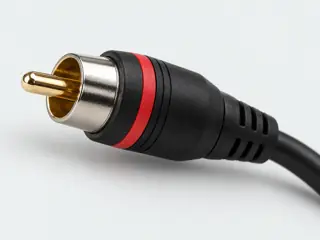
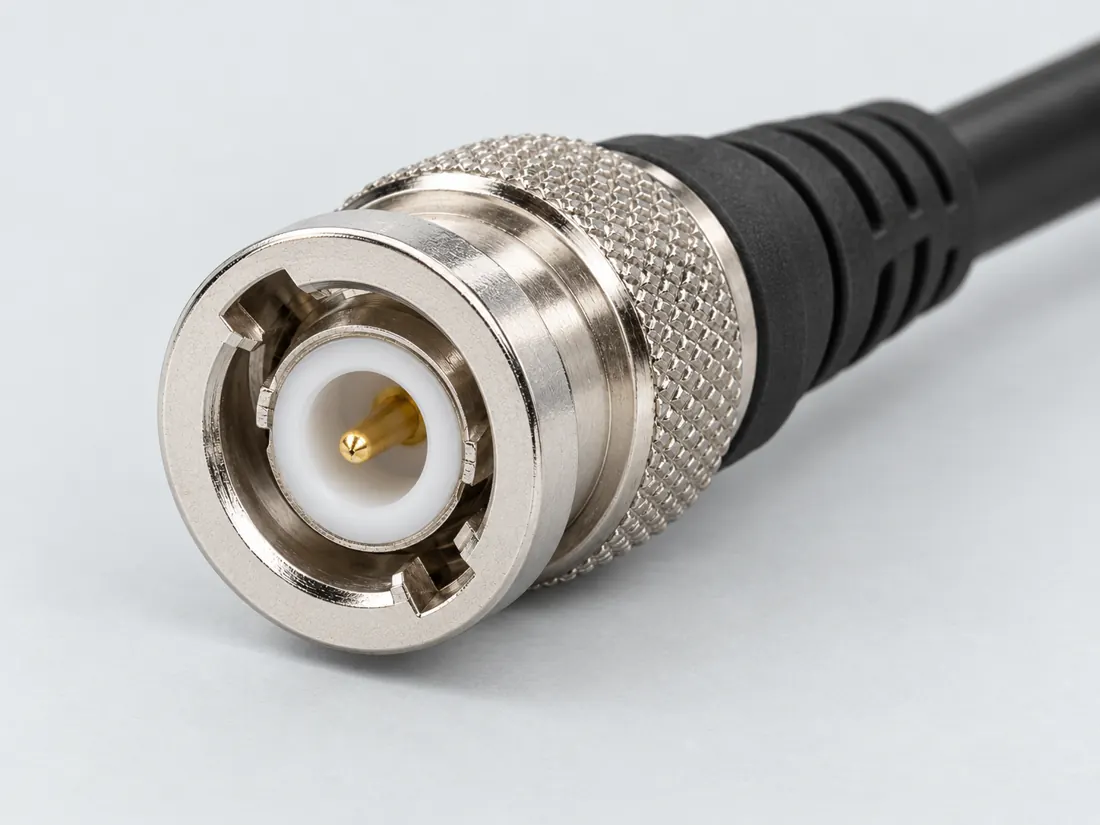
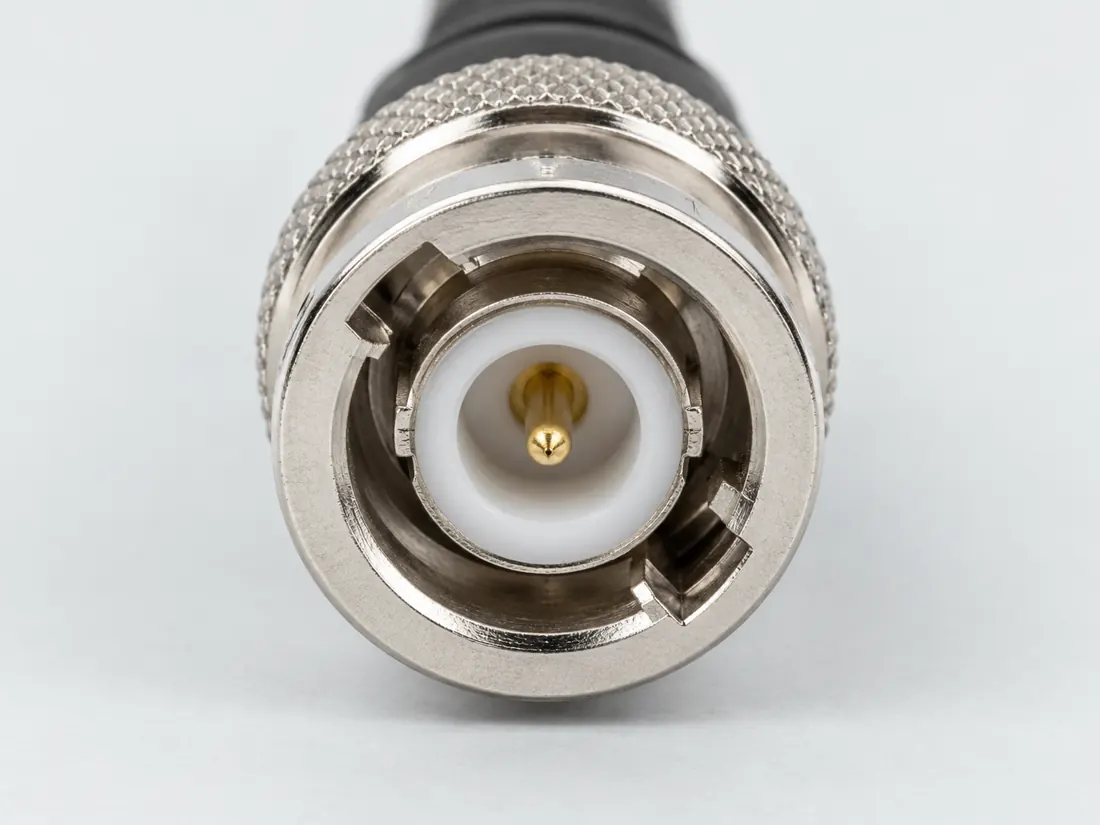
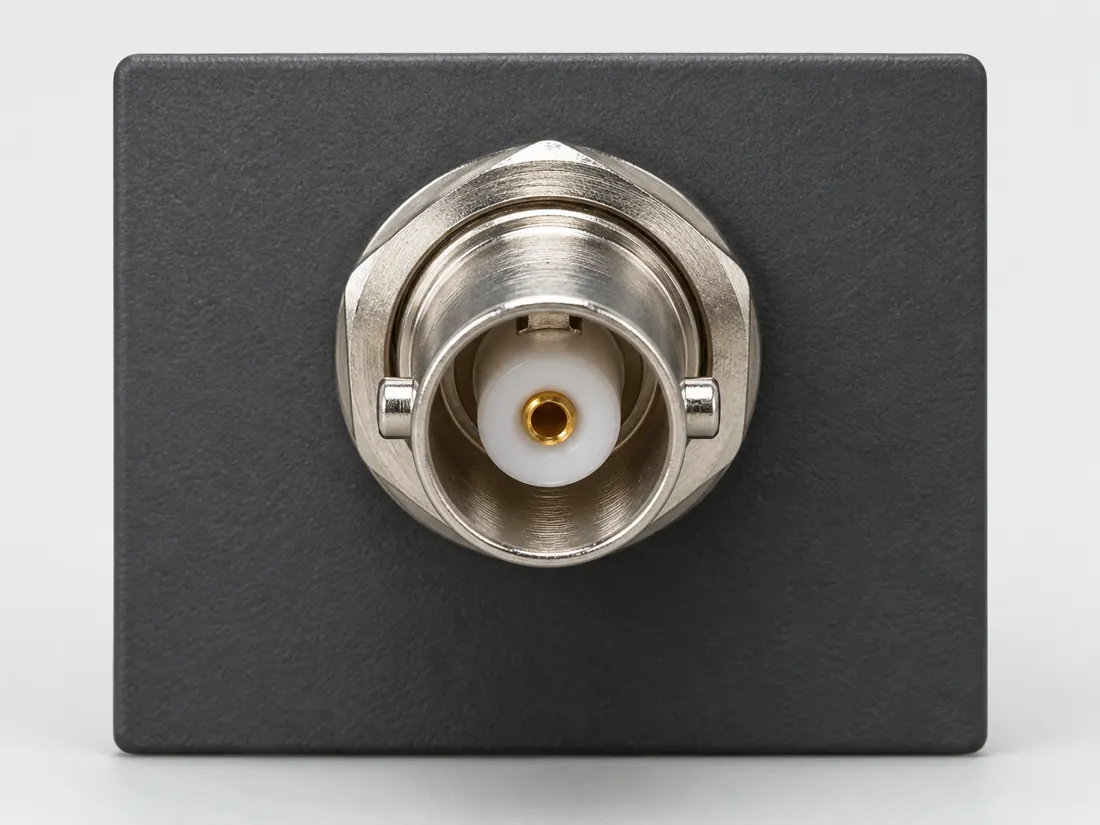
Three-quarter view Computer-generated illustration with prior AI visual review. Not a photograph, measurement or compatibility check. Independent technical and rights review pending.
Mating face Computer-generated illustration with prior AI visual review. Not a photograph, measurement or compatibility check. Independent technical and rights review pending.
Fitted in place Computer-generated illustration with prior AI visual review. Not a photograph, measurement or compatibility check. Independent technical and rights review pending.
Recognition drawing Original schematic, not to scale. Drawing review pending.
Image inspection / P027
See the view. Check its scope.
1 registered view for this reference. Different part examples are not automatically mates; all remain not to scale and independently unapproved.
(private workspace)
P027 / Inherited recognition study
BNC connector
BNC connector
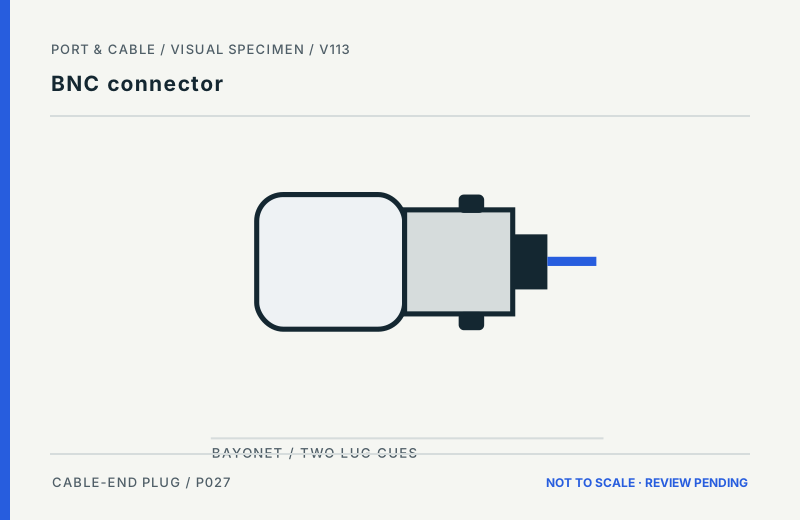
Cable-end plug exterior; qualitative side profile · Cable plug / cable end
Not to scale. Technical and rights review pending.
Inspect view & provenance ↗ (private workspace)
Network notes / RF / coax / P027
Can a BNC connection fit but still mismatch the system?
FIELD NOTES 05
Yes. Where physical mating is possible, mixing 50-ohm and 75-ohm parts still creates an impedance mismatch. Check the system and cable requirements rather than approving a connection from its bayonet exterior. C027A · C027D
Component or signal: documented distinction and remaining check
Check
Documented distinction
What this does not establish
Coupling
Documented distinctionThe BNC family uses bayonet coupling and includes 50-ohm and 75-ohm variants. C027A
What this does not establishThe coupling description is not proof that every variant physically mates.
Electrical mismatch
Documented distinctionAmphenol warns that an impedance mismatch can increase reflections and degrade the signal. C027D
What this does not establishNo universal numeric loss, frequency threshold or measured failure is claimed.
System requirement
Documented distinctionThe manufacturer directs readers to match connector impedance to the system. C027D
What this does not establishThe cable and endpoints remain separate checks; a fitting adapter is not impedance conversion.
Read the part and the device.
Read impedance from the exact connector, cable and equipment specifications. Do not identify it from the bayonet exterior alone.
Keep this requirement open.
The unidentified cable impedance, termination, frequency range and complete system performance are not established visually.
Keep this limit: Use the documented source, cable and destination specifications; do not infer RF performance from mechanical retention alone. C027D
Explicit source exclusion · named example only
Does mechanical mating approve mixing 50-ohm and 75-ohm BNC systems?
Amphenol warns that an impedance mismatch causes reflections and degrades signal integrity.
Boundary. Not a measured failure threshold for every link; frequency and complete system matter.
Next check. Match the documented system, cable and connector impedance.
Read the source, cable and destination impedance requirements.
Select documented connector/cable parts for the intended system.
Keep coupling, impedance and usable frequency range as separate checks.
Source check · 14 October 2026. The BNC family description and mismatch FAQ were observed. No hardware test, measured RF response or universal mechanical-interchangeability claim was added.
Source-qualified reference, not a wiring, optical-link or compatibility approval. Each linked claim and source carries its own recorded inspection date and review status. Selected source checks do not constitute independent technical or rights approval.
C027D (private workspace) — Amphenol warns that physical mating, where possible, does not remove a 50/75-ohm impedance mismatch; reflections and signal degradation remain concerns.
Full manufacturer FAQ answer; not a claim that every unlike-impedance pair mechanically fits or a numeric loss forecast.
Source interpretation is not independent engineering review, hardware testing, wiring advice or a public-release approval.
V117 / READER FIELD GUIDE / COAX & RF
Before you connect or replace
BNC fit does not establish impedance
Amphenol RF documents both 50-ohm and 75-ohm BNC variants. Mechanical attachment does not by itself mean a path is impedance-matched for the signal or frequency.
Editorial decision guidance only. A connector identity or nominal pitch does not establish approved mating, safe wiring or a supported device combination.
Visual atlas / P027 / 2026
Recognize the right physical clue.
FIGURE · REVIEW PENDING
Cable-end plug. Cable-end plug exterior; qualitative side profile.
What to look for
Bayonet coupling with locking ears
What the drawing does not prove
Center conductors are simplified; no impedance, solder or insertion geometry is represented.
Similar coaxial construction does not establish impedance, signal type or fit.
No fabrication dimensions, conductor routing, guaranteed fit or device approval. For electrical, power and optical interfaces, follow the original equipment instructions.
Figure evidence, orientation & usage rights
Uses previously recorded V112 manufacturer claim/source inspections; October 2026 supplementary public-source spot checks are documented separately, not treated as a refreshed approval.
Original Port & Cable interpretive vector, no third-party photo, copied CAD, logo or vendor drawing. Third-party product photos, logos and source drawings are not redistributed. pending independent expert assessment; publication approval remains closed.
Original claim identifiers: C027A (private workspace) · C027B (private workspace) · C027D (private workspace). Legacy evidence dates and rights assessments remain as recorded.
BNC uses a bayonet coupling; both 50-ohm and 75-ohm variants exist. [C027A]
Mechanically mating RF components can still create an impedance mismatch. [C027B]
Amphenol warns that physical mating, where possible, does not remove a 50/75-ohm impedance mismatch; reflections and signal degradation remain concerns. [C027D]
Source-scoped identification facts
Each value retains its exact example, role and measurement axis. Facts from different parts must not be combined into an invented component.
Documented examples; not a mating drawing or compatibility approval
Connector role
plug; socketS029 · S371Recorded source-scoped values; named examples do not describe every family variant or establish compatibility. coaxial plug and jack interface
Coupling / latch
bayonet (Claim C027A); bayonet (Claim C027C); BayonetS029 · S371 · S029Named source examples retain separate role, part, view and axis limits; values are not a universal family specification. Consumer identification / documented standard or product class only BNC coupling, impedance-family and interface-standard context only; no universal frequency or cable-performance claim. Named series only, not every family part: Amphenol RF BNC product family. Family coupling is useful identification context but is not automatically counted as a polarization/keying fact.; No part suffix, row/contact pitch, dimensional axis, physical marking or universal performance limit inferred.
Manufacturer
Amphenol RFS029Named source examples retain separate role, part, view and axis limits; values are not a universal family specification. Named series only, not every family part: Amphenol RF BNC product family. Family coupling is useful identification context but is not automatically counted as a polarization/keying fact.; No part suffix, row/contact pitch, dimensional axis, physical marking or universal performance limit inferred.
Series
BNCS029Named source examples retain separate role, part, view and axis limits; values are not a universal family specification. Named series only, not every family part: Amphenol RF BNC product family. Family coupling is useful identification context but is not automatically counted as a polarization/keying fact.; No part suffix, row/contact pitch, dimensional axis, physical marking or universal performance limit inferred.
Not recorded: Nominal contacts, Positions / cavity span, Populated contacts, Contact rows, Contact pitch, Dimensions / axis, Contact gender / arrangement, Mounting, Keying / polarization, Shell / form, Exact part / implementation, Recorded markings, View convention. Unknown fields stay unknown; illustrations supply no measurements or pin assignments.
Recorded variant and source limits
Exact 50-ohm versus 75-ohm variant and cable/system impedance must be resolved.
Frequency range, return loss, cable construction and termination quality are not universal across BNC products.
Amphenol warns that physical mating, where possible, does not remove a 50/75-ohm impedance mismatch; reflections and signal degradation remain concerns. [C027D]
Mechanical dimensions
No independently reviewed mechanical drawing in this release; do not use this page for fabrication.
Not included. Check exact device and accessory documentation.
A boundary, not an omission to guess around.
This record is an identification starting point. It does not provide measured mating tolerances, a wiring pinout, electrical approval, or a list of verified device models. Use the original device and accessory documentation to resolve the remaining requirements.
Before you connect
What to check
Check the system impedance and connector variant.
Verify cable and device requirements together.
Do not infer frequency, data rate or signal function from the BNC shell.
AI-assisted inspection is not independent engineering review. Source scope and access limitations are disclosed below. Procedural checklists are editorial requirements, not hardware measurements.
Amphenol warns that physical mating, where possible, does not remove a 50/75-ohm impedance mismatch; reflections and signal degradation remain concerns.
Locator: Full FAQ answer: physical mating is distinct from impedance matching and signal reflections. Access: public page. Does not assert that every 50/75-ohm connector pair physically mates, quantify a universal loss, or establish the rating of an unidentified connector.
Claim scope: Full manufacturer FAQ answer; not a claim that every unlike-impedance pair mechanically fits or a numeric loss forecast.. Next review due 2027-01-05.
Assessment 2026-10-22 · earliest scheduled source review 2026-12-30. This is a recorded-date assessment, not a live source check. Page-level independent review is not established by this panel.
Scoped support: Manufacturer warning about an impedance mismatch even where unlike-impedance connectors can mate.
Not established / limitations: Does not assert that every 50/75-ohm connector pair physically mates, quantify a universal loss, or establish the rating of an unidentified connector.
Locator: Full FAQ answer: physical mating is distinct from impedance matching and signal reflections.
Trace 3 claims to their source records
C027A · P027
BNC uses a bayonet coupling; both 50-ohm and 75-ohm variants exist.
Claim scope: Consumer identification / documented standard or product class only
Amphenol warns that physical mating, where possible, does not remove a 50/75-ohm impedance mismatch; reflections and signal degradation remain concerns.
Claim scope: Full manufacturer FAQ answer; not a claim that every unlike-impedance pair mechanically fits or a numeric loss forecast.
Recorded evidence only. An inspection date, publisher label, source link or generated packet is not independent technical review, hardware testing, fabrication approval or a compatibility verdict.


 (private workspace)