
THE FIELD GUIDE / 12 FLAGSHIP SUBJECTS
A better answer than “the plug fits.”
Twelve practical connector studies, each with a decision diagram, source-linked evidence, a false assumption to avoid and three concrete next checks. Every card leads to the permanent canonical connector reference.
01 / DISPLAY + USB
Ports, direction and capability
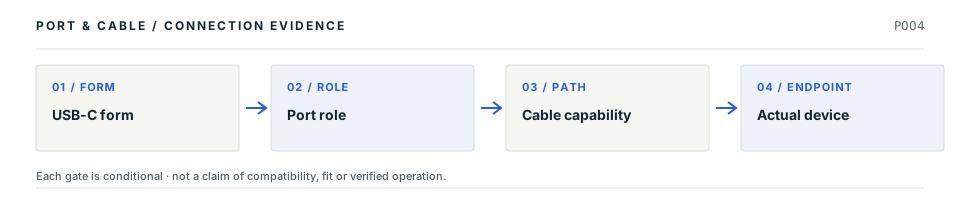
USB Type-C
A reversible USB-C shape is a physical identity. Before buying a cable or adapter, identify which of data, power, display and host/device functions the exact socket actually provides.
Read the field guide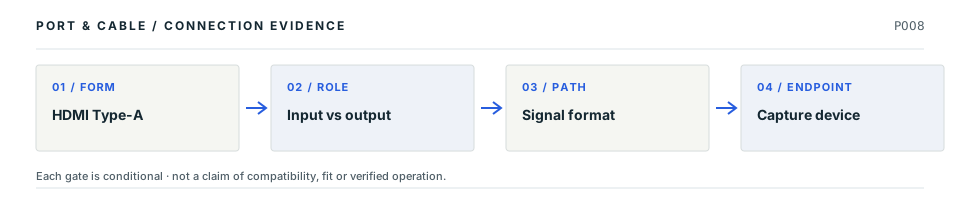
HDMI Type-A
A full-size HDMI socket only identifies Type-A geometry. Even when a monitor shows the source through a capture device, the separately negotiated capture mode might be unavailable.
Read the field guide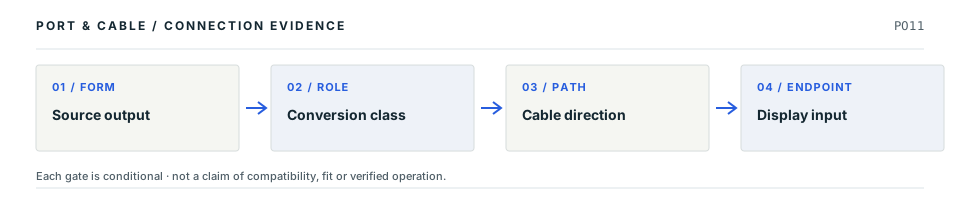
DisplayPort connector
When a DisplayPort source meets an HDMI display, converter direction and the source’s DP++ capability can determine which adapter class works. Reversing the cable does not reverse its conversion.
Read the field guide02 / NETWORK + AUDIO
Same shell, different signal
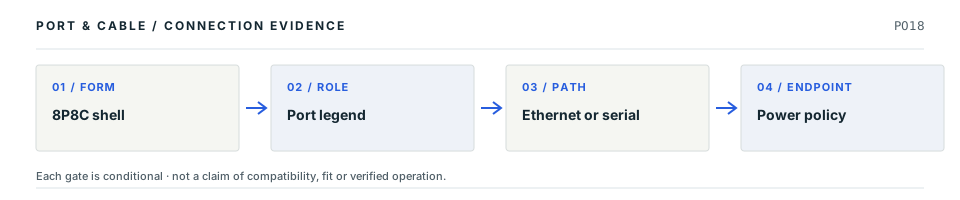
8P8C modular connector (commonly called RJ45)
An eight-contact modular opening is a physical connector form. It may be an Ethernet port, serial-management console, or another documented interface—never treat the shape as proof of Ethernet or PoE.
Read the field guide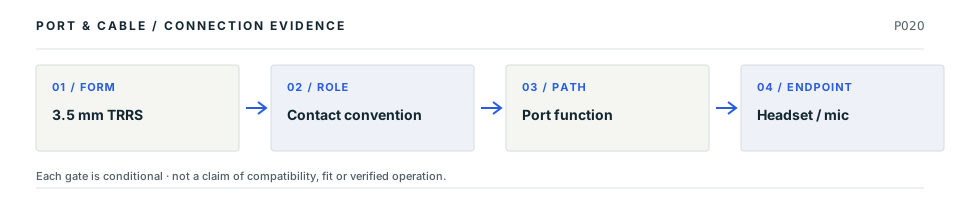
3.5 mm TRRS connector
A four-contact 3.5 mm headset plug does not uniquely identify the microphone/ground arrangement. CTIA and OMTP equipment may need a wiring-standard-specific adapter.
Read the field guide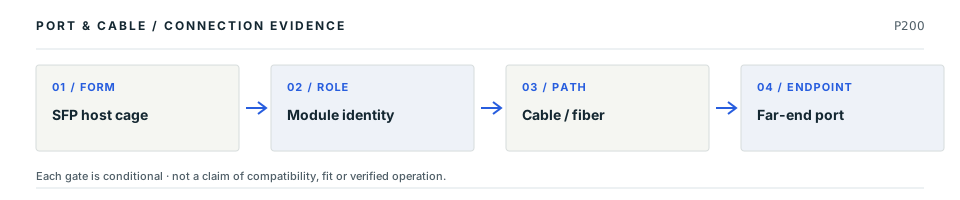
SFP / SFP+ / SFP28 host connector form
A family resemblance between SFP, SFP+ and SFP28 does not qualify a transceiver for a particular switch or router. The exact port, module part, medium and far-end optics must be supported.
Read the field guide03 / INTERNAL + POWER
Fit, firmware and supply
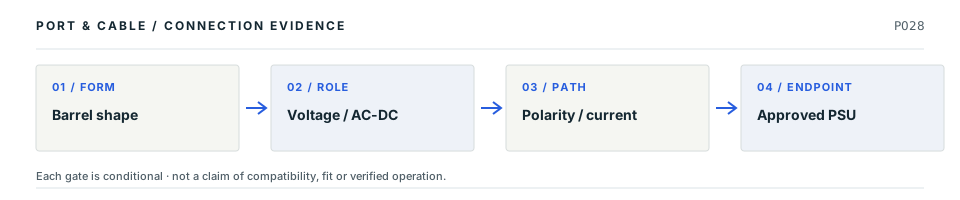
5.5 x 2.1 mm barrel connector: identification only
A barrel plug appearing to fit does not establish compatible voltage, polarity, current, or power-supply safety. Stop at identification and use the exact device’s approved electrical requirements.
Read the field guide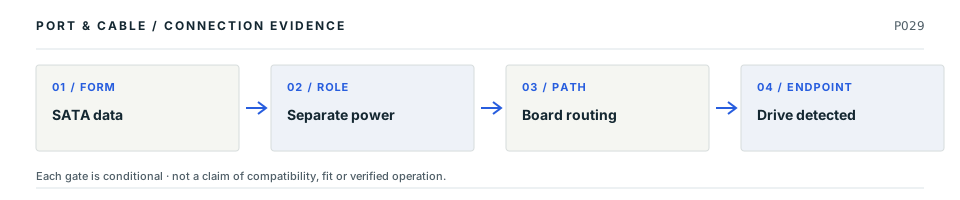
SATA 7-pin data connector
SATA data and power are different connectors. If a SATA drive disappears after installing an M.2 card, check the motherboard’s shared-resource rules before replacing a cable.
Read the field guide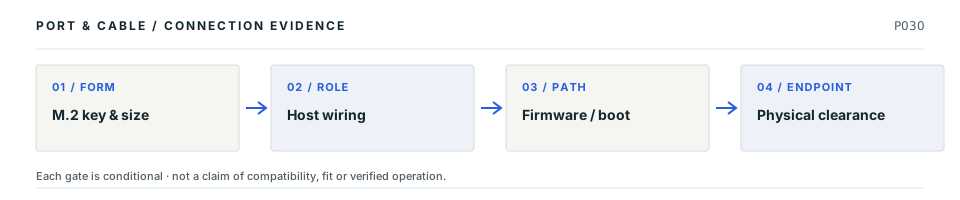
M.2 card edge interface
An M.2 module can match the socket key and length yet be unsupported. The host decides whether SATA or PCIe is wired, whether NVMe boots, and what module height and mounting positions fit.
Read the field guide04 / MEDIA + RF + FIBER
Small interface, big distinction
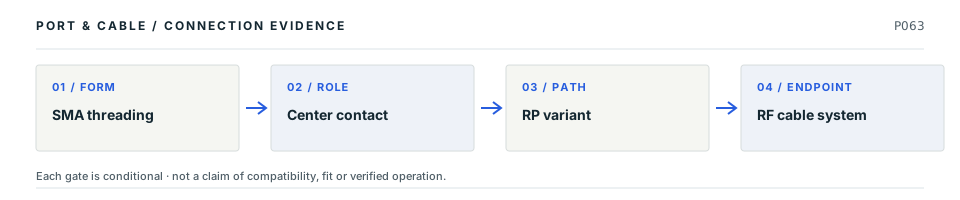
SMA coaxial connector
SMA and reverse-polarity SMA may share similar threaded shells while differing at the center contact. Identify both halves of the interface and their actual part numbers before ordering.
Read the field guide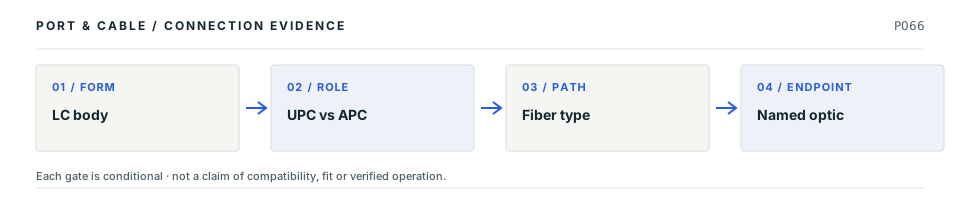
LC fiber connector
Recognizing an LC fiber connector is only the first step. UPC and APC are distinct end-face polish variants; the optical fiber and transceiver specification must also match the intended system.
Read the field guide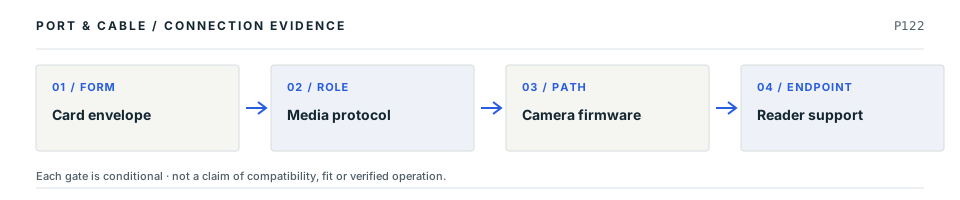
CFexpress Type B card interface
CFexpress Type B and XQD use the same nominal card envelope and connector, but a camera or reader must explicitly support the relevant technology and firmware. Similar form is not a firmware upgrade.
Read the field guideRead the limits before ordering or connecting.
Shape, electrical role, transport, source features and cable properties are different facts. The studies reflect inherited source-checked claims; model-level testing and independent publication review remain outstanding.
Research method and limitations →