17 linked sources · 24 scoped claims · 0 sources with inspection/access flags.
Assessment 2026-10-22 · earliest scheduled source review 2026-12-30. This is a recorded-date assessment, not a live source check. Page-level independent review is not established by this panel.
Inspect 17 source scopes, access limits and dates
SD Association · Standards-organization domain · inspected 2026-10-07 · due 2027-01-05
Within inspection window
Scoped support: SD/microSD physical-form and generation-specific contact-count distinctions; no numbered assignments or fabrication drawing.
Not established / limitations: Counts are scoped to named modes. The overview does not identify an exact card or host, and extra-row count does not establish implemented protocol.
Locator: Conventional-card paragraph and form-factor table: first-row counts and UHS-II / SD Express count ranges
SD Association · Standards-organization domain · inspected 2026-10-07 · due 2027-01-05
Within inspection window
Scoped support: SD capacity/file-system classes and nominal full-size SD and microSD envelopes; not host capacity approval.
Not established / limitations: Nominal card envelopes are identification aids, not mechanical tolerances, socket footprints, pad positions or formatting instructions.
Locator: Capacity ranges, file-system table and Form Factor Size rows
SD Association · Standards-organization domain · inspected 2026-10-01 · due 2026-12-30
Within inspection window
Scoped support: PCIe/NVMe transport and explicit host capability verification.
Not established / limitations: PCIe/NVMe transport and explicit host capability verification.
Locator: Host implementation overview and PCIe-only host distinction
CompactFlash Association · Standards-organization domain · inspected 2026-10-03 · due 2027-01-01
Within inspection window
Scoped support: CF uses PATA; CFast uses SATA; CFexpress uses PCIe/NVMe; Type B and XQD share a form factor but camera support is conditional.
Not established / limitations: No copied tables, logos, numeric throughput promises, exhaustive market status or licensed normative specification. Text-only scope.
Locator: CFexpress Form Factors; Type A versus Type B; Legacy Standards
Sony · Manufacturer / product-owner domain · inspected 2026-10-03 · due 2027-01-01
Within inspection window
Scoped support: Sony CEB-G examples explicitly identify CFexpress Type B and PCI Express.
Not established / limitations: Japanese primary text inspected. Model-specific performance and dimensions are not transferred to every card.
Locator: CEB-G product information; interface row
Sony · Manufacturer / product-owner domain · inspected 2026-10-03 · due 2027-01-01
Within inspection window
Scoped support: MRW-G2: CFexpress Type A and SD; USB Type-C computer interface, SuperSpeed USB 10 Gbps; supplied Type-C and Standard-A connection cables.
Not established / limitations: Documentation-only family and port scope; no physical test, current stock or price check, measured performance, complete card list, or independent approval.
Locator: Product overview and connection features
Sony · Manufacturer / product-owner domain · inspected 2026-10-03 · due 2027-01-01
Within inspection window
Scoped support: MRW-G1: CFexpress Type B and Sony XQD G- and M-series cards; USB 3.1 Gen 2 Type-C computer interface. Other XQD cards are not established by this scope.
Not established / limitations: Documentation-only family and port scope; no physical test, current stock or price check, measured performance, complete card list, or independent approval.
Locator: Product overview and supported media
SanDisk · Manufacturer / product-owner domain · inspected 2026-10-03 · due 2027-01-01
Within inspection window
Scoped support: USB-C interface; SD and microSD UHS-II, UHS-I and non-UHS families, plus CompactFlash up to UDMA 7. CFast and CFexpress are not established by this CompactFlash statement.
Not established / limitations: Documentation-only family and port scope; no physical test, current stock or price check, measured performance, complete card list, or independent approval.
Locator: Specifications and compatibility; model SDDR-A631-GNGNN
Swissbit AG (manufacturer document hosted by Farnell) · Unclassified publisher domain · inspected 2026-10-07 · due 2027-01-05
Within inspection window
Scoped support: Exact Swissbit S-46u conventional microSD pin-label example; native SD-mode assignment and orientation.
Not established / limitations: Distributor-hosted manufacturer PDF, not an independently authenticated original. No universal SPI, SD Express or UHS-II pinout; original 19-page document is linked, not redistributed.
Locator: Page 8, Figure 2 bottom view and Table 11 native SD / SPI pad assignments
SD Association · Standards-organization domain · inspected 2026-10-07 · due 2027-01-05
Within inspection window
Scoped support: Named-version SD Express connector/host context, particularly the different microSD Express and microSD UHS-II second-row geometry.
Not established / limitations: Targeted sections only, not a full licensed specification review. No claim that every legacy, Express or multi-mode host supports another card; no fabrication approval.
Locator: Page 13, sections 4.10.1 and 4.10.2; context in pages 7–8
Sony · Unclassified publisher domain · inspected 2026-10-08 · due 2027-01-06
Within inspection window
Scoped support: MRW-G2 shared-slot alternatives, Sony card-family wording, USB interface and supplied-cable limitations.
Not established / limitations: All cards and computers are not guaranteed. Drawing interpreted for this reader only; no manufacturer artwork copied, no card geometry or current OS certification adopted.
Locator: PDF page 1, English compatible cards, precautions, specifications and illustrations A–C; printed identifier 5-019-283-B1 (1).
Transcend · Manufacturer / product-owner domain · inspected 2026-10-08 · due 2027-01-06
Within inspection window
Scoped support: TS-RDF8K2 / TS-RDF8W2 selected media slots, CompactFlash UDMA7, SD/microSD UHS-I, USB 3.1 Gen 1 description.
Not established / limitations: Concurrent-operation wording is compared with S440 and remains unresolved. Document age or hardware revision is not inferred from a filename. No measured aggregate transfer, exact-card or OS certification.
Locator: PDF pages 1–2 visually inspected; card slots, Compatibility, Performance, Ordering Information and three-card insertion wording. No printed revision identifier.
Transcend · Manufacturer / product-owner domain · inspected 2026-10-08 · due 2027-01-06
Within inspection window
Scoped support: TS-RDF8K2 / TS-RDF8W2 UHS-II cards at UHS-I speeds and contradictory simultaneous-insertion wording.
Not established / limitations: Page 1 allows two-card insertion while page 2 says it is unsupported. Kept as an unresolved documentation conflict, not a chosen device capability. Filename is not treated as a verified revision date.
Locator: PDF pages 1–2 visually inspected: page 1 Additional Features, page 2 Operating Environment Note and Compatibility. Page 3 multi-product comparison not adopted.
Sony · Unclassified publisher domain · inspected 2026-10-11 · due 2027-01-09
Within inspection window
Scoped support: Named reader support only, not all XQD readers, all camera slots or all brands.
Not established / limitations: Named example only. No universal compatibility or publication approval. Raw-byte acquisition status is recorded separately.
Locator: Product description and FAQ: supported Sony CFexpress Type B and Sony XQD G/M series cards.
Delkin Devices · Unclassified publisher domain · inspected 2026-10-14 · due 2027-01-12
Within inspection window
Scoped support: Manufacturer explanation identifying a 24-pin SATA connector/interface for industrial CFast.
Not established / limitations: Only interface/contact-count distinction adopted. No precise dimensions, universal flash technology, uptime, security, speed or card/device compatibility claims adopted.
Locator: Article dated 2022-05-06; What is the difference between CF and CFast?
Transcend Information, Inc. · Manufacturer / product-owner domain · inspected 2026-10-21 · due 2027-01-19
Within inspection window
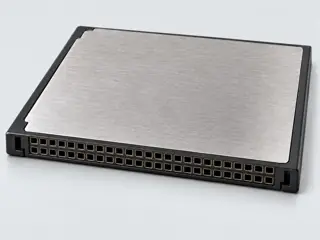
Scoped support: The full manufacturer product page explicitly states the50-pin CompactFlash card interface and TypeI support for this adapter.
Not established / limitations: Adapter's documented support only; no arbitrary device/OS/slot approval, card pinout, measured tolerance, or broad compatibility guarantee. Product photos and certification marks were not copied.
Locator: Key Features:50-pin CompactFlash to68-pin PCMCIA and TypeI; Compatibility: CompactFlash(TypeI); Order Information:TS0MCF2PC.
3M · Unclassified publisher domain · inspected 2026-10-22 · due 2027-01-20
Within inspection window
Scoped support: ExactN7G24-A0B2RA-00-0HT host plug contact-row property only.
Not established / limitations: Contact rows is the explicit manufacturer property; PCB tail description kept separate. No pitch transferred from Kingconn or other3M part; TypeI/II host acceptance is not a CFast-to-CF compatibility approval.
Locator: Full exact part page: NumberofContacts24,ConnectorStylePlug,Number of Contact Rows1,CardTypeI/II. TS2329 technicalPDF link retrieved as text-reference only; direct acquisition403, no drawing pixels claimed.
Trace 24 claims to their source records
C061A · P061
SD and microSD are distinct physical card forms. The form-factor label does not by itself establish capacity class, bus mode or recording performance.
Claim scope: Named standard or manufacturer description only; procedural checks are editorial recommendations, not hardware tests.
Source links: S041 · Evidence trail → (private workspace)
C061B · P061
The SD Association lists a nominal full-size SD card envelope of 32 × 24 × 2.1 mm. Conventional single-row cards for Default Speed, High Speed and UHS-I use nine contacts.
Claim scope: Nominal card identification and conventional first-row contact count only; not a socket footprint, pad drawing, tolerance specification or all-generation pin count.
Source links: S041 · S042 · Evidence trail → (private workspace)
C061C · P061
The SD Association overview distinguishes full-size SD contact counts by interface: High Speed/UHS-I nine, UHS-II seventeen, one-lane SD Express seventeen to nineteen, and two-lane SD Express twenty-five to twenty-seven.
Claim scope: Published overview categories inspected 2026-10-07; count ranges retain implementation variation and do not assign individual pins or identify a host controller.
Source links: S041 · Evidence trail → (private workspace)
C062A · P062
The SD Association treats microSD as a separate, smaller form factor from full-size SD. Capacity, bus interface and speed-class support remain additional distinctions.
Claim scope: Named standard or manufacturer description only; procedural checks are editorial recommendations, not hardware tests.
Source links: S041 · S045 · Evidence trail → (private workspace)
C062B · P062
The SD Association lists a nominal microSD envelope of 15 × 11 × 1.0 mm (length × width × thickness). Conventional single-row cards for Default Speed, High Speed and UHS-I use eight contacts.
Claim scope: Nominal microSD card identification and conventional first-row count; no inference about extra contacts, exact host support or fabrication dimensions.
Source links: S041 · S042 · Evidence trail → (private workspace)
C062C · P062
The SD Association overview distinguishes microSD contact counts by interface: High Speed/UHS-I eight, UHS-II sixteen, and one-lane microSD Express sixteen to seventeen.
Claim scope: Published overview categories inspected 2026-10-07, not an exhaustive identification method; physical contacts do not establish active bus support.
Source links: S041 · Evidence trail → (private workspace)
C062D · P062
Swissbit S-46u Revision 1.00, page 8, gives this native SD-mode assignment in Figure 2 bottom-view numbering: 1 DAT2, 2 CD/DAT3, 3 CMD, 4 VDD, 5 CLK, 6 VSS, 7 DAT0, 8 DAT1. The same table gives different SPI-mode functions on several pads.
Claim scope: Exact manufacturer-documented conventional microSD example; native SD-mode column only. Not a UHS-II/Express extra-row pinout, socket-terminal map, startup sequence or universal SPI wiring guide.
Source links: S391 · Evidence trail → (private workspace)
C062E · P062
The SD Association SD Express Host Implementation Guideline Version 2 (May 2025), section 4.10.2, states that microSD Express needs different connectors because the second-row pad location and size differ from microSD UHS-II.
Claim scope: microSD second-row mechanical distinction in the named guideline; not proof of compatibility or incompatibility of any complete multi-mode host product.
Source links: S392 · Evidence trail → (private workspace)
C119A · P119
Transcend describes a 50-pin CompactFlash card and explicitly lists Type I support.
Claim scope: Identification and explicitly scoped documentation only; not an end-to-end connection approval
Source links: S847 · Evidence trail → (private workspace)
C119B · P119
The CompactFlash Association identifies CompactFlash with the PATA interface.
Claim scope: Identification and explicitly scoped documentation only; not an end-to-end connection approval
Source links: S096 · Evidence trail → (private workspace)
C119C · P119
The RDF8 sheets list CompactFlash UDMA7 separately from SD and microSD UHS-I. The named TS-RDF8K2 / TS-RDF8W2 reader examples do not establish CFast or CFexpress support.
Claim scope: Both sheets PDF page 2 Compatibility and Ordering Information; no Type I/II thickness or electrical assignment adopted.
Source links: S439 · S440 · Evidence trail → (private workspace)
C120A · P120
The CompactFlash Association identifies CFast as a Serial ATA card family.
Claim scope: Identification and explicitly scoped documentation only; not an end-to-end connection approval
Source links: S096 · Evidence trail → (private workspace)
C120B · P120
The same association lists CompactFlash and CFexpress as separate card standards.
Claim scope: Identification and explicitly scoped documentation only; not an end-to-end connection approval
Source links: S096 · Evidence trail → (private workspace)
C120C · P120
Delkin identifies a 24-pin SATA connector and SATA interface as a distinction of its industrial CFast description.
Claim scope: Manufacturer interface-identification passage only. No pin assignment, exact mating dimensions or card-reader support inferred.
Source links: S641 · Evidence trail → (private workspace)
C120W · P120
3M specifies N7G24-A0B2RA-00-0HT as a 24-contact CFast host plug with one contact row. The source separately describes its single-row SMT solder tails.
Claim scope: Exact 3M N7G24-A0B2RA-00-0HT CFast host plug for Type I/II cards; explicit Number of Contact Rows property only.
Source links: S985 · Evidence trail → (private workspace)
C122A · P122
The CompactFlash Association states that Type B and XQD share a form factor and connector, with camera support conditional on implementation.
Claim scope: Identification and explicitly scoped documentation only; not an end-to-end connection approval
Source links: S096 · Evidence trail → (private workspace)
C122B · P122
Sony labels its CEB-G card examples CFexpress Type B with a PCI Express interface.
Claim scope: Identification and explicitly scoped documentation only; not an end-to-end connection approval
Source links: S098 · Evidence trail → (private workspace)
C122C · P122
CFA describes CFexpress Type B as using two PCIe lanes and retaining the same dimensions and connector as XQD. It separately makes camera support conditional on implementation or a manufacturer update.
Claim scope: Card Types public text: form-factor footnote and A/B FAQ; no dimensions or speed table transcribed.
Source links: S096 · Evidence trail → (private workspace)
C122D · P122
Sony lists its CFexpress Type B memory cards for the MRW-G1 reader.
Claim scope: Sony MRW-G1 and the specified Sony card family only. No camera or other reader approval.
Source links: S495 · Evidence trail → (private workspace)
C137A · P137
Sony MRW-G2 documentation lists CFexpress Type A and SD, while MRW-G1 lists CFexpress Type B and selected Sony XQD series.
Claim scope: Exact documented product and family scope; no physical test, exact-card certification or end-to-end approval.
Source links: S105 · S106 · Evidence trail → (private workspace)
C137B · P137
SanDisk ImageMate PRO USB-C lists SD, microSD and CompactFlash; those names must not be collapsed into one card family.
Claim scope: Exact documented product and family scope; no physical test, exact-card certification or end-to-end approval.
Source links: S109 · Evidence trail → (private workspace)
C137C · P137
Sony specifies the MRW-G2 computer interface as SuperSpeed USB 10Gbps (USB 3.2 Gen 2), supplies USB-C–USB-C and USB-C–USB-A cables, and limits its function guarantee to the supplied cable. This interface label is not a measured card-to-computer copy speed.
Claim scope: PDF page 1 English Specifications, connecting instructions and supplied-cable precaution.
Source links: S438 · Evidence trail → (private workspace)
C137D · P137
The RDF8 EN_RDF8_PS_1905 sheet says that UHS-II cards work only at UHS-I speeds in that reader. Reading a card therefore does not establish use of its fastest bus mode.
Claim scope: PDF page 2 Compatibility note; named RDF8 scope, not a rule about all USB readers.
Source links: S440 · Evidence trail → (private workspace)
C137E · P137
Transcend describes RDF8 with a USB 3.1 Gen 1 interface and states that speed varies with host hardware, software, use and storage capacity. No measured read, write or multi-card aggregate rate is adopted here.
Claim scope: PDF page 2 Interface and Performance note; the USB connector subtype is deliberately not assigned in the new device profile.
Source links: S439 · Evidence trail → (private workspace)
Recorded evidence only. An inspection date, publisher label, source link or generated packet is not independent technical review, hardware testing, fabrication approval or a compatibility verdict.