
FIELD REFERENCE 30 / AUDIO & MUSIC
Recognize the form.
Confirm the service.
Contact count is a starting point—not a signal, a pinout or permission to connect. Compare the named part, its exact arrangement and the equipment’s documented role.
01 / KEEP THREE QUESTIONS SEPARATE
A familiar shell can hide a different requirement.
Component
Read the exact part number, connector family and cable or equipment role. Count the documented positions—not a blurred silhouette.
Arrangement
Keep the key, suffix and view direction together. NC6MXX and NC6MSXX have different source-observed layouts despite sharing a pole count.
Service
Read the equipment label and manual. DIN does not establish MIDI, XLR does not establish one signal, and loudspeaker service is not AC mains service.
These are component comparisons, not a proposed mating pair or cable path. Do not trial-fit, rewire or energize equipment to resolve its identity. Neutrik explicitly excludes speakON from AC mains and power-supply use.
Read the evidence and its limits
Neutrik separately lists NC6MSXX with a Switchcraft pin arrangement, alongside the NC6MXX six-pole male cable connector. C207B
Exact variant distinction. The manufacturer’s arrangement description is not a universal claim about all Switchcraft parts, wiring or interoperability.
Neutrik identifies NL8FC as an eight-pole speakON cable connector and excludes the connector family from AC mains use. C208A
V36 catalogue-expansion identification fact only; not independent technical approval, fabrication data, wiring instruction or end-to-end compatibility proof.
02 / FIVE REFERENCES, SIX OBSERVED VIEWS
Keep the exact variant in the picture.
Drawings follow observed primary-source views. They are qualitative and not to a common physical scale. Numbers, wire colors and unknown counterparts are deliberately omitted.
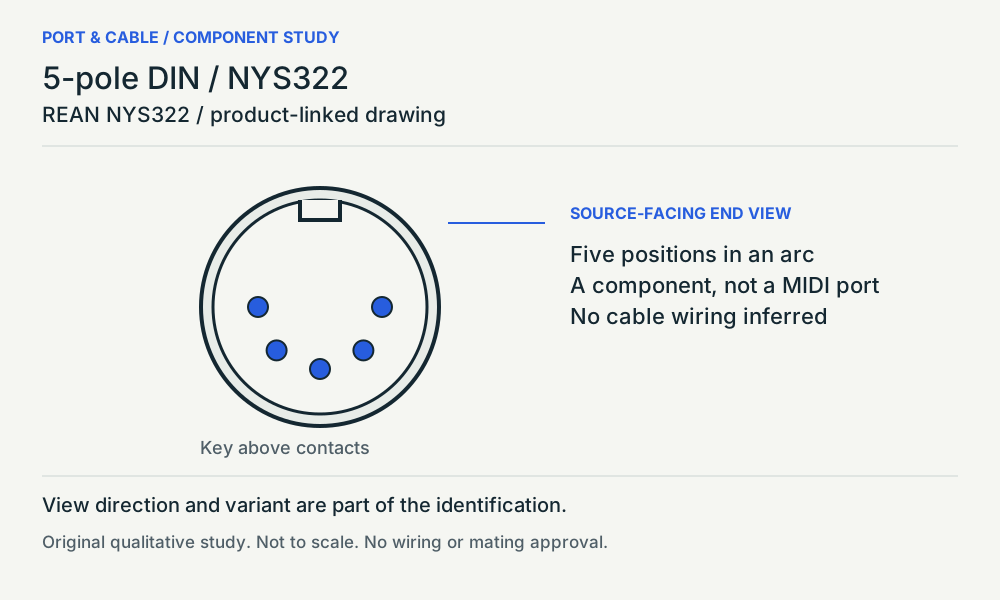
P110 / 5-pin DIN connector: MIDI and legacy uses
A DIN outline does not establish MIDI.
Male DIN cable component · Source, orientation and omissions (private workspace)
NYS322 is a male cable component. Its key and five-position arc are physical cues, not a MIDI port direction or a complete cable specification.
Read the evidence and its limits
REAN identifies NYS322 as a male five-pole DIN cable component; its linked end view places the five contacts in a lower arc below the key. C110C
Named component identity and observed end view only. This does not establish MIDI service, IN/OUT direction or a completed MIDI cable.
The MIDI Association separately specifies a MIDI transport using five-pin DIN. C110B
Identification and explicitly scoped documentation only; not an end-to-end connection approval
P126 / 5-pin XLR connector
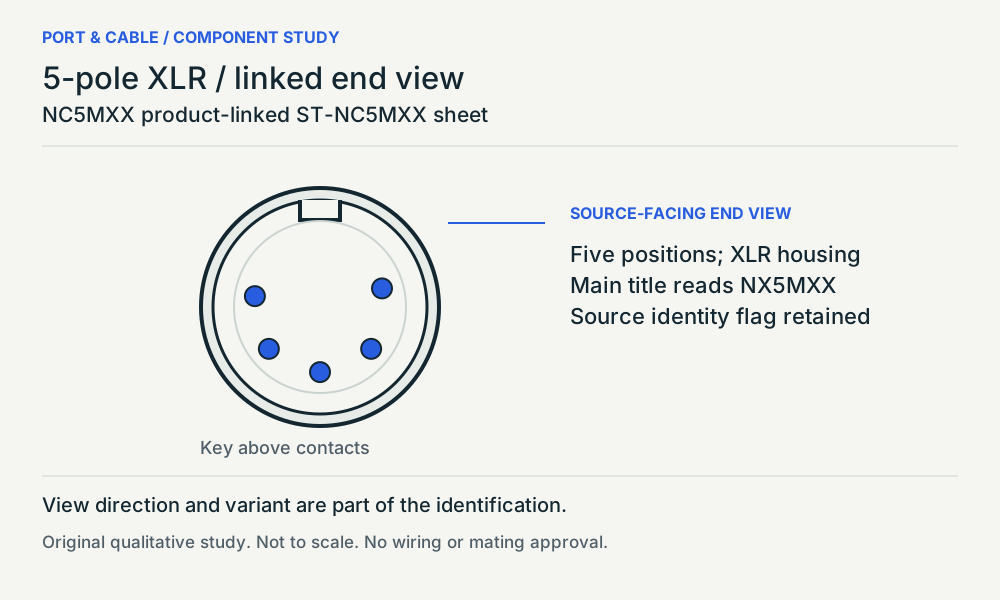
Five pins do not make DIN and XLR alike.
Male XLR cable component / source title conflict · Source, orientation and omissions (private workspace)
The linked ST-NC5MXX sheet shows an XLR end view. Its main title reads NX5MXX; that source discrepancy remains unresolved. No DMX or audio service is assigned.
Read the evidence and its limits
The drawing linked from the NC5MXX product page separates a five-position end view from two longitudinal profiles. Its drawing number is ST-NC5MXX, while the main title field reads NX5MXX. C126C
Source identity discrepancy retained, not corrected by inference. The qualitative study follows the linked end view; no current dimensional certification or DMX/audio wiring claim.
Neutrik NC5MXX is a five-pole XLR cable connector. C126A
Identification and explicitly scoped documentation only; not an end-to-end connection approval
P206 / 4-pin XLR connector
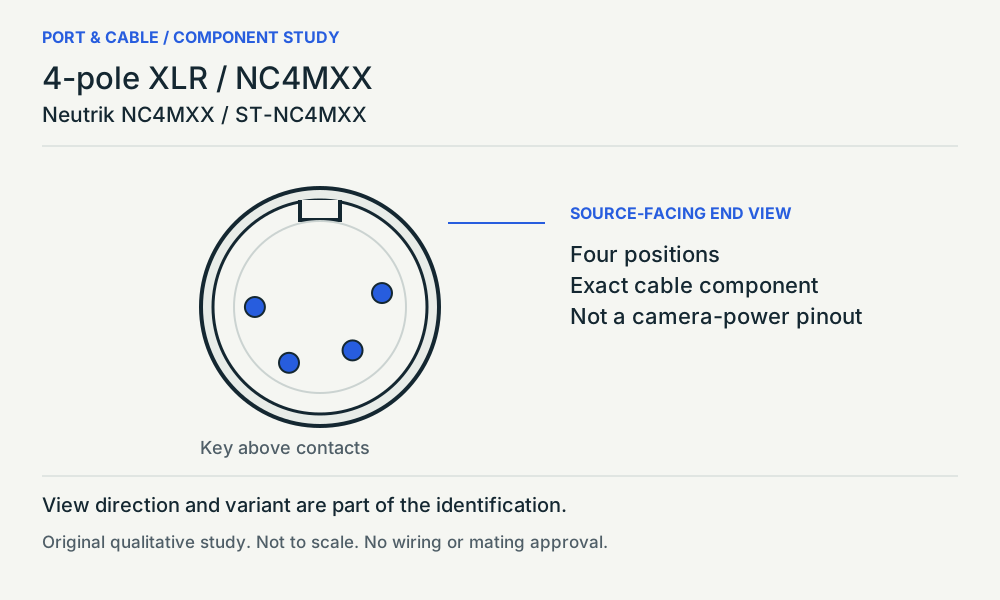
Identify the cable part—not a power port.
Male XLR cable component · Source, orientation and omissions (private workspace)
NC4MXX construction and four-position layout are documented. An equipment manual must establish service, polarity and cable requirements separately.
Read the evidence and its limits
The ST-NC4MXX sheet shows a keyed four-position end view separately from the connector’s longitudinal housing and boot profiles. C206B
Named NC4MXX component view only. Four contacts do not identify an installed port’s service, polarity, voltage or cable wiring.
For NC4MXX, Neutrik specifies solder contacts, latch retention and chuck-type cable strain relief. C206C
Component construction and retention only; not an assembled lead, panel receptacle or camera-power connection approval.
P208 / 8-pole speakON loudspeaker connector
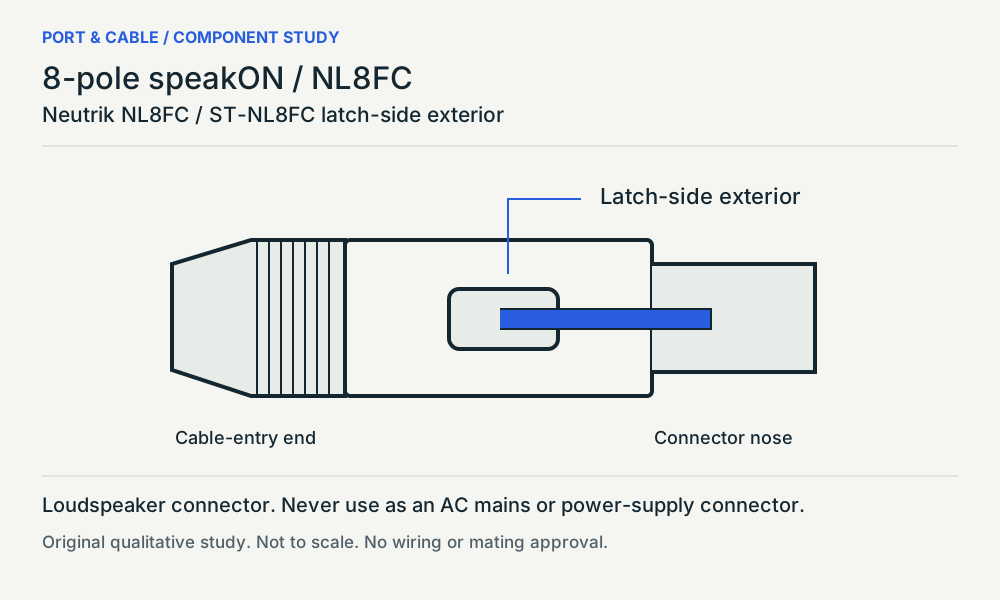
A loudspeaker connector is not a mains plug.
Female loudspeaker cable connector · Source, orientation and omissions (private workspace)
The NL8FC study follows the latch-side exterior. Its drawing’s insert detail is not republished as a mating face. Keep the manufacturer’s no-mains/power-supply warning with this form.
Read the evidence and its limits
Neutrik classifies NL8FC as a female speakON cable connector and specifies a Quick Lock latch; the product is intended for loudspeaker connections. C208B
Exact component role and retention. No amplifier channel allocation, bridge-mode wiring, cable rating or power-supply use is established.
The ST-NL8FC sheet distinguishes two longitudinal exterior views from a separate insert-detail view. The latch is visible on the exterior view labelled Rear side. C208C
View-label interpretation and observed exterior only. The insert detail is not used as an external mating-face drawing; electrical contact layout is not reconstructed.
Neutrik identifies NL8FC as an eight-pole speakON cable connector and excludes the connector family from AC mains use. C208A
V36 catalogue-expansion identification fact only; not independent technical approval, fabrication data, wiring instruction or end-to-end compatibility proof.
P207 / 6-pin XLR connector
Six positions. Two named arrangements.
Variant distinction: These are two male cable components, not matching ends. Preserve NC6MXX versus NC6MSXX; a shared count does not establish an interchangeable layout.
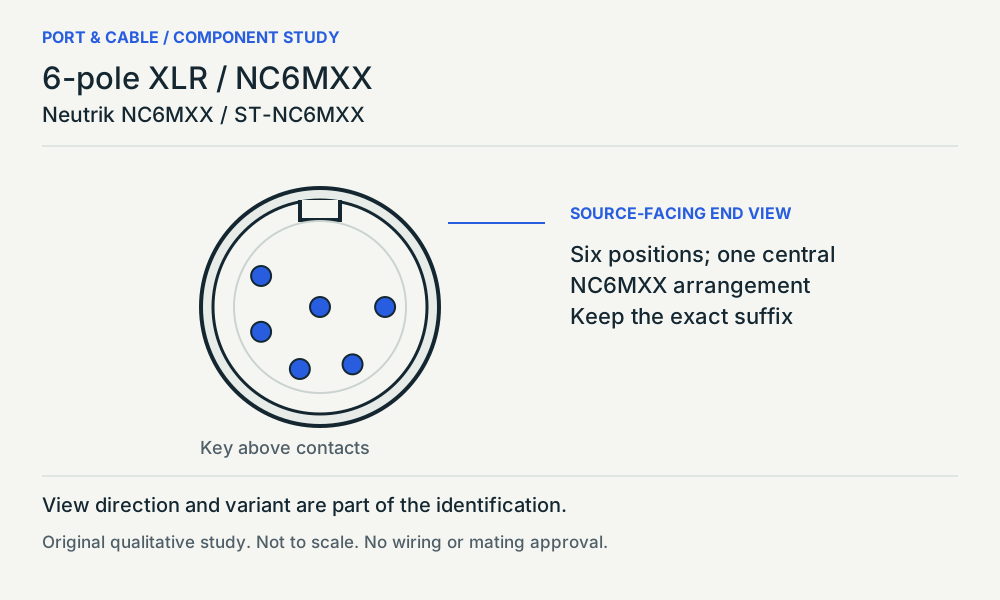
Male XLR cable component / NC6MXX arrangement · Source, orientation and omissions (private workspace)
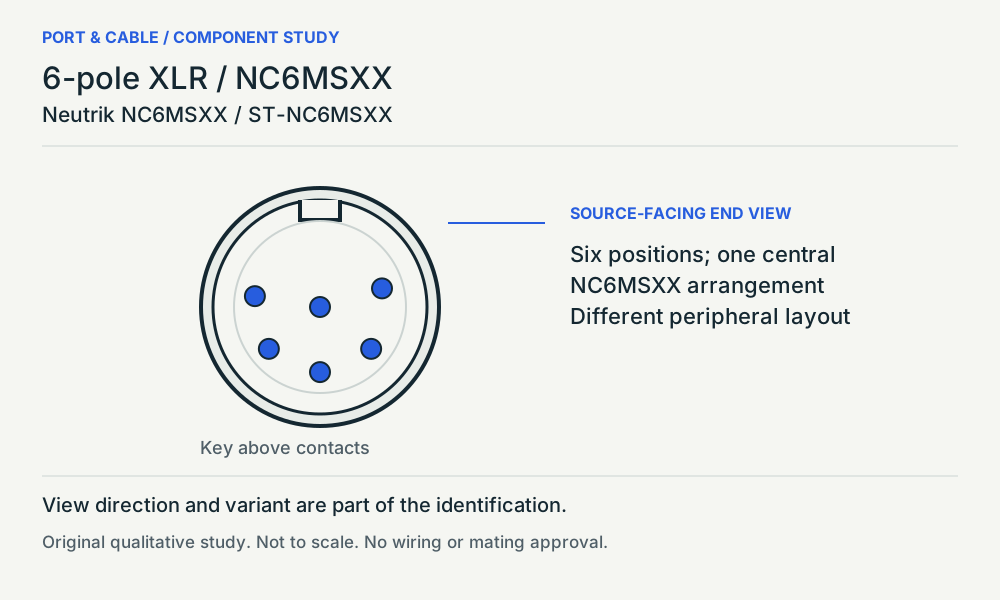
Male XLR cable component / NC6MSXX arrangement · Source, orientation and omissions (private workspace)
NC6MXX and NC6MSXX must keep their suffixes. Their source-facing layouts differ even though both have six positions. These are comparative identification studies, not a proposed mating pair.
Read the evidence and its limits
Neutrik separately lists NC6MSXX with a Switchcraft pin arrangement, alongside the NC6MXX six-pole male cable connector. C207B
Exact variant distinction. The manufacturer’s arrangement description is not a universal claim about all Switchcraft parts, wiring or interoperability.
The ST-NC6MXX and ST-NC6MSXX sheets each show six contact positions, including a central position, but their peripheral arrangements differ. C207C
Visually inspected source-facing layouts only. Do not substitute variants from contact count or use the unnumbered studies as pinouts.
03 / RESOLVE THE QUESTION
Six things the outline cannot decide.
CHECK 01
Is every five-pin DIN connection MIDI?
No service is established by the outline. The NYS322 source identifies a component; the MIDI Association separately describes DIN and TRS transports. Read the equipment label, model and manual before choosing a cable.
Read the evidence and its limits
REAN identifies NYS322 as a male five-pole DIN cable component; its linked end view places the five contacts in a lower arc below the key. C110C
Named component identity and observed end view only. This does not establish MIDI service, IN/OUT direction or a completed MIDI cable.
The MIDI Association separately specifies a MIDI transport using five-pin DIN. C110B
Identification and explicitly scoped documentation only; not an end-to-end connection approval
CHECK 02
Are five-pin DIN and five-pin XLR interchangeable?
Do not select a substitute from contact count. The named sources describe different component families and end views; neither is a device-specific adapter instruction.
Read the evidence and its limits
REAN identifies NYS322 as a male five-pole DIN cable component; its linked end view places the five contacts in a lower arc below the key. C110C
Named component identity and observed end view only. This does not establish MIDI service, IN/OUT direction or a completed MIDI cable.
The drawing linked from the NC5MXX product page separates a five-position end view from two longitudinal profiles. Its drawing number is ST-NC5MXX, while the main title field reads NX5MXX. C126C
Source identity discrepancy retained, not corrected by inference. The qualitative study follows the linked end view; no current dimensional certification or DMX/audio wiring claim.
CHECK 03
Does “six-pin XLR” identify one arrangement?
No. Neutrik separately identifies NC6MSXX with a Switchcraft arrangement. Compare the exact suffix and documented arrangement; six positions alone are insufficient.
Read the evidence and its limits
Neutrik separately lists NC6MSXX with a Switchcraft pin arrangement, alongside the NC6MXX six-pole male cable connector. C207B
Exact variant distinction. The manufacturer’s arrangement description is not a universal claim about all Switchcraft parts, wiring or interoperability.
The ST-NC6MXX and ST-NC6MSXX sheets each show six contact positions, including a central position, but their peripheral arrangements differ. C207C
Visually inspected source-facing layouts only. Do not substitute variants from contact count or use the unnumbered studies as pinouts.
CHECK 04
Does four-pin XLR establish camera power or polarity?
The NC4MXX component sources establish construction and shape, not the service on an installed port. Resolve the exact equipment connection and cable specification without trial fitting, live testing or rewiring.
Read the evidence and its limits
The ST-NC4MXX sheet shows a keyed four-position end view separately from the connector’s longitudinal housing and boot profiles. C206B
Named NC4MXX component view only. Four contacts do not identify an installed port’s service, polarity, voltage or cable wiring.
For NC4MXX, Neutrik specifies solder contacts, latch retention and chuck-type cable strain relief. C206C
Component construction and retention only; not an assembled lead, panel receptacle or camera-power connection approval.
CHECK 05
Can the NL8FC rating make it a mains connector?
No. Its manufacturer explicitly excludes speakON from AC mains and power-supply use. A component rating cannot erase an application restriction. Channel allocation and amplifier wiring remain equipment-specific.
Read the evidence and its limits
Neutrik identifies NL8FC as an eight-pole speakON cable connector and excludes the connector family from AC mains use. C208A
V36 catalogue-expansion identification fact only; not independent technical approval, fabrication data, wiring instruction or end-to-end compatibility proof.
Neutrik classifies NL8FC as a female speakON cable connector and specifies a Quick Lock latch; the product is intended for loudspeaker connections. C208B
Exact component role and retention. No amplifier channel allocation, bridge-mode wiring, cable rating or power-supply use is established.
CHECK 06
Is an insert or termination drawing the mating face?
Not automatically. The NL8FC sheet separates longitudinal exteriors and an insert detail. This reference uses the observed exterior rather than inventing the unseen mating face.
Read the evidence and its limits
The ST-NL8FC sheet distinguishes two longitudinal exterior views from a separate insert-detail view. The latch is visible on the exterior view labelled Rear side. C208C
View-label interpretation and observed exterior only. The insert detail is not used as an external mating-face drawing; electrical contact layout is not reconstructed.
A COMPACT REFERENCE TO KEEP
Three pages. Source limits included.
Letter PDF (legacy download held for current evidence review). Current focused printable references · A4 PDF (legacy download held for current evidence review). Current focused printable references
DIN and XLR identification, a six-pole variant comparison, the speakON application boundary and linked sources. Original review-edition PDF—not wiring instructions.