FIELD GUIDESource-led reference

P126 / Audio / Connector

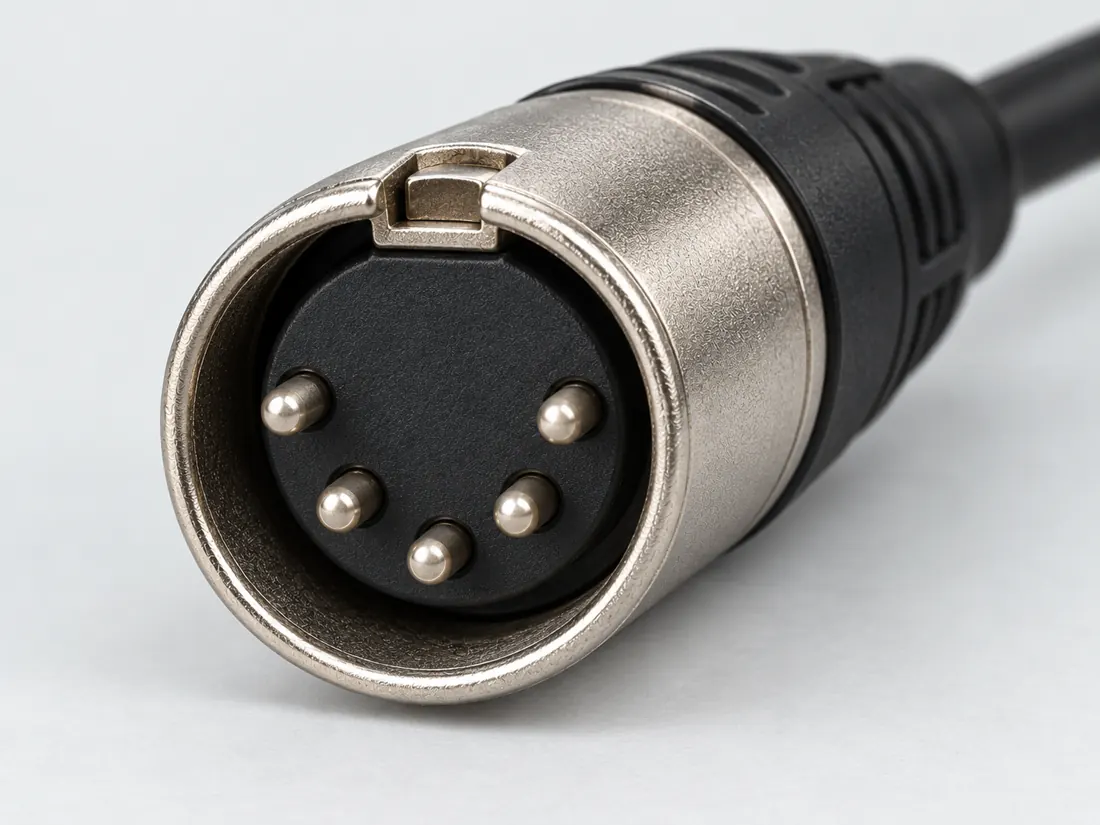
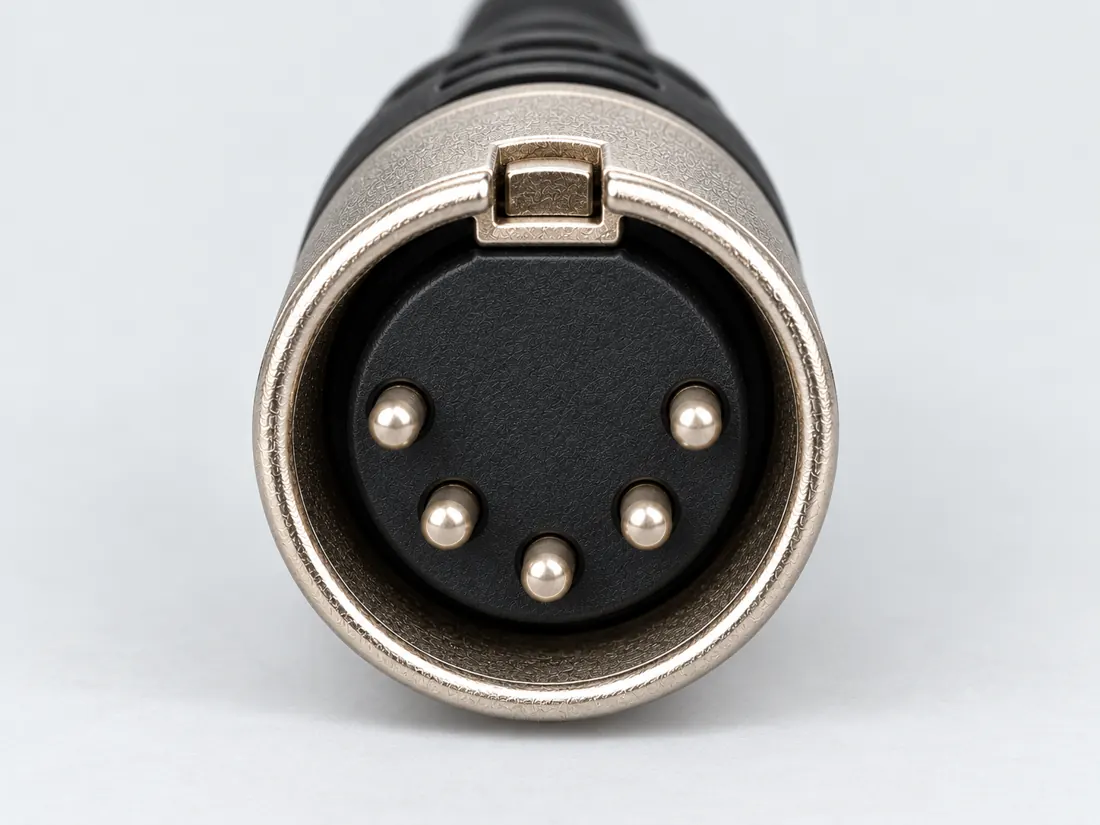
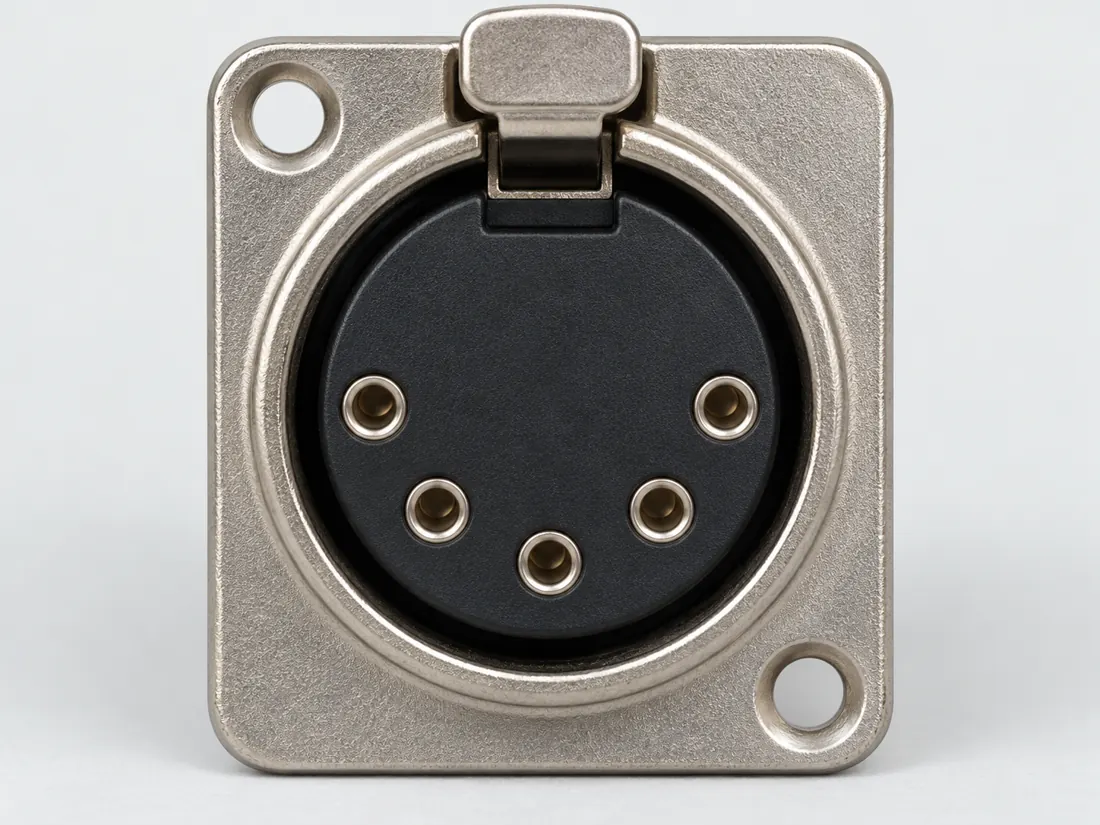
5-pin XLR connector

A five-pole XLR form has its own contact arrangement; the housing does not identify what a device sends through it.

Also called 5 pole XLR XLR5 five pin XLR

XLR names a family, not one signal.

Look for

Compare five contact positions, housing key and latch features with the exact device manual.

Claim inspection dates: 2026-10-03, 2026-10-13 · Independent review pending

Image inspection / P126

See the view. Check its scope.

2 registered views for this reference. Different part examples are not automatically mates; all remain not to scale and independently unapproved.

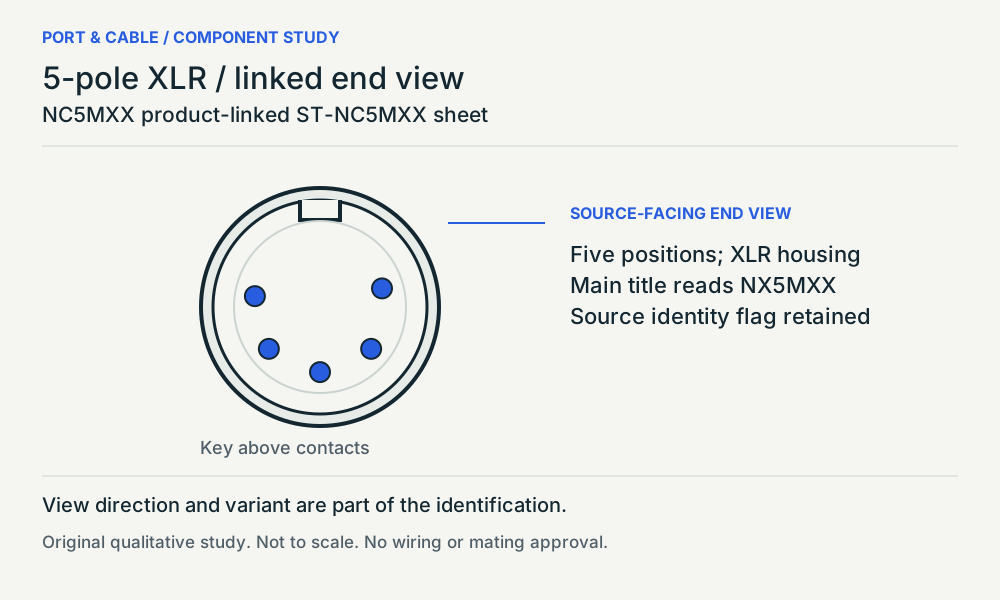
5-pole XLR / linked end view. Left end view / source key above contacts. Five positions in the linked end view; Key above the contacts; ST-NC5MXX versus NX5MXX title discrepancy unresolved. Original qualitative study, not a pinout. (private workspace)

P126 / Source-observed physical study

5-pole XLR / linked end view

NC5MXX product-linked ST-NC5MXX sheet

Left end view / source key above contacts · Cable plug / cable end

Not to scale. Technical and rights review pending.

Inspect view & provenance (private workspace)
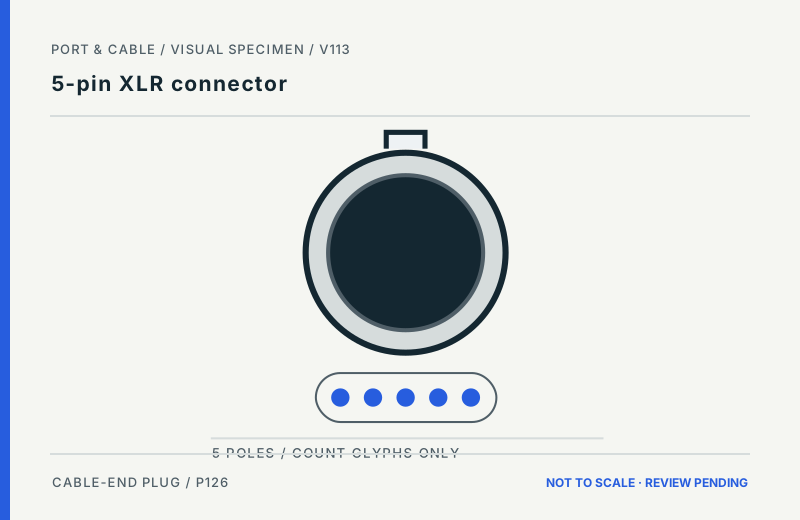
5-pin XLR connector: Five-pole connector designation. Cable-side male XLR body concept; count markers are NOT spatial pin positions. Qualitative source-linked recognition study, not a pinout or a dimensional guide. (private workspace)

P126 / Inherited recognition study

5-pin XLR connector

5-pin XLR connector

Cable-side male XLR body concept; count markers are NOT spatial pin positions · Cable plug / cable end

Not to scale. Technical and rights review pending.

Inspect view & provenance (private workspace)

Visual atlas / P126 / 2026

Recognize the right physical clue.

FIGURE · REVIEW PENDING
5-pin XLR connector: Five-pole connector designation. Cable-side male XLR body concept; count markers are NOT spatial pin positions. Qualitative source-linked recognition study, not a pinout or a dimensional guide.
Cable-end plug. Cable-side male XLR body concept; count markers are NOT spatial pin positions.

What to look for

Five-pole connector designation

What the drawing does not prove

Dots below the body show pole count only; pin location and number are deliberately not drawn.

Pole count, mating gender and device signal assignments must all be confirmed from the exact part.

No fabrication dimensions, conductor routing, guaranteed fit or device approval. For electrical, power and optical interfaces, follow the original equipment instructions.

Figure evidence, orientation & usage rights

Uses previously recorded V112 manufacturer claim/source inspections; October 2026 supplementary public-source spot checks are documented separately, not treated as a refreshed approval.

Original Port & Cable interpretive vector, no third-party photo, copied CAD, logo or vendor drawing. Third-party product photos, logos and source drawings are not redistributed. pending independent expert assessment; publication approval remains closed.

Original claim identifiers: C126A (private workspace) · C126B (private workspace). Legacy evidence dates and rights assessments remain as recorded.

The useful distinction

Recognize it. Then verify it.

A five-pole XLR form has its own contact arrangement; the housing does not identify what a device sends through it. [C126A]

The manufacturer lists latch-lock retention for that connector. [C126B]

The drawing linked from the NC5MXX product page separates a five-position end view from two longitudinal profiles. Its drawing number is ST-NC5MXX, while the main title field reads NX5MXX. [C126C]

Source-scoped identification facts

Each value retains its exact example, role and measurement axis. Facts from different parts must not be combined into an invented component.

Documented examples; not a mating drawing or compatibility approval
Nominal contacts5S101Nominal contact count; some implementations may omit populated positions. It is not a wiring map.
Positions / cavity span5 (Claim C126C)S101 · S620Recorded source-scoped values; named examples do not describe every family variant or establish compatibility. Source identity discrepancy retained, not corrected by inference. The qualitative study follows the linked end view; no current dimensional certification or DMX/audio wiring claim.
Connector roleplug; socket; plug (NC5MXX)S101 · S101 · S101Named source examples retain separate role, part, view and axis limits; values are not a universal family specification. five-pole XLR plug/receptacle interface NC5MXX. Documented role: plug. Exact part layout must control; no NC6MXX versus NC6MSXX intermateability inferred.; Global503forNC4/NC6; official US page/PDF successfully read. No drawing axes or rows proposed.
Mountingcable (Claim C126A)S101Recorded source-scoped values; named examples do not describe every family variant or establish compatibility. Identification and explicitly scoped documentation only; not an end-to-end connection approval
Coupling / latchlatch (Claim C126B); Latch lock; improved locking recess without window (NC5MXX)S101 · S101Named source examples retain separate role, part, view and axis limits; values are not a universal family specification. Identification and explicitly scoped documentation only; not an end-to-end connection approval NC5MXX. Documented role: plug. Exact part layout must control; no NC6MXX versus NC6MSXX intermateability inferred.; Global503forNC4/NC6; official US page/PDF successfully read. No drawing axes or rows proposed.
ManufacturerNeutrik (NC5MXX)S101Named source examples retain separate role, part, view and axis limits; values are not a universal family specification. NC5MXX. Documented role: plug. Exact part layout must control; no NC6MXX versus NC6MSXX intermateability inferred.; Global503forNC4/NC6; official US page/PDF successfully read. No drawing axes or rows proposed.
SeriesXLR XX (NC5MXX)S101Named source examples retain separate role, part, view and axis limits; values are not a universal family specification. NC5MXX. Documented role: plug. Exact part layout must control; no NC6MXX versus NC6MSXX intermateability inferred.; Global503forNC4/NC6; official US page/PDF successfully read. No drawing axes or rows proposed.
Exact part / implementationNC5MXX (NC5MXX)S101Named source examples retain separate role, part, view and axis limits; values are not a universal family specification. NC5MXX. Documented role: plug. Exact part layout must control; no NC6MXX versus NC6MSXX intermateability inferred.; Global503forNC4/NC6; official US page/PDF successfully read. No drawing axes or rows proposed.

Not recorded: Populated contacts, Contact rows, Contact pitch, Dimensions / axis, Contact gender / arrangement, Keying / polarization, Shell / form, Recorded markings, View convention. Unknown fields stay unknown; illustrations supply no measurements or pin assignments.

Recorded variant and source limits
  • Five contacts do not establish DMX, intercom, audio, power or any other device-level wiring convention.
  • No face-view numbering or fabrication dimensions are published.
  • ETC Express console DMX512 output (XLR 5-pin female): Contact numbers only; the page gives no face drawing.
  • ETC 5-pin XLR to RJ45 DMX adapter cable (XLR end): Contact numbers only.
  • ETC Response Mk2 One-Port Gateway DMX In (plug) / DMX Out (socket): XLR contact numbers 1-5 as moulded on the insert; ETC p. 2 shows female socket (DMX Out) and male plug (DMX In) faces with the same numbering.
  • Doug Fleenor Design 2322DMX DMX input/output XLR-5: XLR contact numbers 1-5 as moulded on the insert; ETC p. 2 shows female socket (DMX Out) and male plug (DMX In) faces with the same numbering.
Report a correction to these facts →

Bounded facts, visible unknowns

Specifications and limits

5-pin XLR connector facts and limitations
Documented identificationNeutrik NC5MXX is a five-pole XLR cable connector. [C126A]
Important distinctionThe manufacturer lists latch-lock retention for that connector. [C126B]
Source-observed V148 component scopeNC5MXX-linked five-position end view; source title discrepancy retained. [C126C]
Mechanical dimensionsNo independently approved mechanical dimensions. Do not use this record for fabrication or fit testing.
Engineering pinoutSource-checked engineering profile available; independent review pending. Open engineering profile →
Verified device listNot included. Check exact device and accessory documentation.
A boundary, not an omission to guess around.

Record the exact device model and the label beside the port. Obtain its manual and the accessory documentation. Keep unknown properties unknown instead of filling them from a visually similar item.

Before you connect

What to check

  1. Confirm the equipment signal and connector role.
  2. Count the documented contacts rather than assuming three-pin audio.
  3. Obtain the device-specific cable specification.
Trace a supported connection class →

Pins & wiring

Pinout

Choose the exact wiring. Pin numbers follow its stated view; a schematic does not establish physical positions. Check your exact device before wiring.

What the status labels mean
Confirmed
Recorded research passes agree within this variant; this is not independent human review or hardware validation.
Single source
Only one underlying document, or one pass, supports this assignment.
Device-specific
Supported for the named equipment or wiring only. Check your device’s manual.
Unverified
Missing or conflicting evidence. Do not wire from this row.
Not connected
The source explicitly says NC, no contact or no pin for this wiring.
Wiring variant

ETC Express console DMX512 output (XLR 5-pin female)

Device-specific wiring. Check your device’s manual before connecting or applying power.

View and evidence limits

Contact numbers only; the page gives no face drawing.

  • P126 5-pin XLR (DMX) — **Agree** on 1 common, 2 data −, 3 data + — **Pins 4 and 5 vary by device:** not connected (ETC Express, ETC Response Mk2), second data pair (ETC XLR5–RJ45 adapter) or passed through only (Doug Fleenor). The ANSI E1.11 text was not read (licence click-through). Publish 4 and 5 as device-specific.
  • ESTA lists E1.11 (current 2024 edition) as a free download, but only after accepting an End User Licence Agreement. This pass did not accept the EULA, so the standard's connector clause, gender rules and pin 4/5 wording were not read. Rows rely on ETC manufacturer documents.
  • Fixture manufacturers' manuals, intercom, headset, stereo-microphone and DC-power uses of 5-pin XLR were not established.
5-pole XLR engineering boundaryContact numbers only; the page gives no face drawing.SCHEMATIC · physical positions unconfirmedNot to scale · check the named wiring and device manual1: Common (device_specific)12: Data (-) (device_specific)23: Data (+) (device_specific)34: not connected (not_connected)45: not connected (not_connected)5powergrounddataConfigshieldNCUnknown
Schematic only · physical contact positions unconfirmed. Original drawing · not to scale. Scroll sideways if needed.
ETC Express console DMX512 output (XLR 5-pin female) — source-scoped contact map
PinSignalWhat it doesStatus
1CommonControl, detection or configuration connection; check the source and device.Device-specific
Sources
2Data (-)Signal conductor. Pair, polarity and direction follow this named wiring.Device-specific
Sources
3Data (+)Signal conductor. Pair, polarity and direction follow this named wiring.Device-specific
Sources
4not connectedNot connected or absent in this named wiring.Not connected
Sources
5not connectedNot connected or absent in this named wiring.Not connected
Sources
Sources (1)

ETC 5-pin XLR to RJ45 DMX adapter cable (XLR end)

Device-specific wiring. Check your device’s manual before connecting or applying power.

View and evidence limits

Contact numbers only.

  • P126 5-pin XLR (DMX) — **Agree** on 1 common, 2 data −, 3 data + — **Pins 4 and 5 vary by device:** not connected (ETC Express, ETC Response Mk2), second data pair (ETC XLR5–RJ45 adapter) or passed through only (Doug Fleenor). The ANSI E1.11 text was not read (licence click-through). Publish 4 and 5 as device-specific.
  • ETC notes this adapter is 'a different style of connection than DMX over CAT5 cable'. RJ45 mapping: XLR1->RJ45 7 and 8, XLR2->2, XLR3->1, XLR4->6, XLR5->3; RJ45 4 and 5 unused.
  • ESTA lists E1.11 (current 2024 edition) as a free download, but only after accepting an End User Licence Agreement. This pass did not accept the EULA, so the standard's connector clause, gender rules and pin 4/5 wording were not read. Rows rely on ETC manufacturer documents.
  • Fixture manufacturers' manuals, intercom, headset, stereo-microphone and DC-power uses of 5-pin XLR were not established.
5-pole XLR engineering boundaryContact numbers only.SCHEMATIC · physical positions unconfirmedNot to scale · check the named wiring and device manual1: Data Common (device_specific)12: Data 1 Minus (device_specific)23: Data 1 Plus (device_specific)34: Data 2 Minus (device_specific)45: Data 2 Plus (device_specific)5powergrounddataConfigshieldNCUnknown
Schematic only · physical contact positions unconfirmed. Original drawing · not to scale. Scroll sideways if needed.
ETC 5-pin XLR to RJ45 DMX adapter cable (XLR end) — source-scoped contact map
PinSignalWhat it doesStatus
1Data CommonSignal conductor. Pair, polarity and direction follow this named wiring.Device-specific
Sources
2Data 1 MinusSignal conductor. Pair, polarity and direction follow this named wiring.Device-specific
Sources
3Data 1 PlusSignal conductor. Pair, polarity and direction follow this named wiring.Device-specific
Sources
4Data 2 MinusSignal conductor. Pair, polarity and direction follow this named wiring.Device-specific
Sources
5Data 2 PlusSignal conductor. Pair, polarity and direction follow this named wiring.Device-specific
Sources
Sources (1)

ETC Response Mk2 One-Port Gateway DMX In (plug) / DMX Out (socket)

Device-specific wiring. Check your device’s manual before connecting or applying power.

View and evidence limits

XLR contact numbers 1-5 as moulded on the insert; ETC p. 2 shows female socket (DMX Out) and male plug (DMX In) faces with the same numbering.

  • P126 5-pin XLR (DMX) — **Agree** on 1 common, 2 data −, 3 data + — **Pins 4 and 5 vary by device:** not connected (ETC Express, ETC Response Mk2), second data pair (ETC XLR5–RJ45 adapter) or passed through only (Doug Fleenor). The ANSI E1.11 text was not read (licence click-through). Publish 4 and 5 as device-specific.
  • ANSI E1.11 is offered free by ESTA only under an end-user licence agreement accepted at download; that acceptance was not given in this pass, so the standard was not read. The standard-level meaning of pins 4/5 (optional second data link) is therefore unverified; the two device variants above are verified only for their own use of pins 4/5.
  • Intercom, stereo microphone, power and other proprietary uses were not researched.
5-pole XLR engineering boundaryXLR contact numbers 1-5 as moulded on the insert; ETC p. 2 shows female socket (DMX Out) and male plug (DMX In) faces with the same numbering.SCHEMATIC · physical positions unconfirmedNot to scale · check the named wiring and device manual1: Common (shield) (device_specific)12: Data - (device_specific)23: Data + (device_specific)34: not connected (not_connected)45: not connected (not_connected)5powergrounddataConfigshieldNCUnknown
Schematic only · physical contact positions unconfirmed. Original drawing · not to scale. Scroll sideways if needed.
ETC Response Mk2 One-Port Gateway DMX In (plug) / DMX Out (socket) — source-scoped contact map
PinSignalWhat it doesStatus
1Common (shield)Cable screen or shield connection; check the named equipment.Device-specific
Sources
2Data -Signal conductor. Pair, polarity and direction follow this named wiring.Device-specific
Sources
3Data +Signal conductor. Pair, polarity and direction follow this named wiring.Device-specific
Sources
4not connectedNot connected or absent in this named wiring.Not connected
Sources
5not connectedNot connected or absent in this named wiring.Not connected
Sources
Sources (1)

Doug Fleenor Design 2322DMX DMX input/output XLR-5

Device-specific wiring. Check your device’s manual before connecting or applying power.

View and evidence limits

DFD2322DMX XLR-5 contact numbers only. The ETC gateway face drawing is a different named implementation and does not establish DFD mating-face or termination-side geometry.

  • P126 5-pin XLR (DMX) — **Agree** on 1 common, 2 data −, 3 data + — **Pins 4 and 5 vary by device:** not connected (ETC Express, ETC Response Mk2), second data pair (ETC XLR5–RJ45 adapter) or passed through only (Doug Fleenor). The ANSI E1.11 text was not read (licence click-through). Publish 4 and 5 as device-specific.
  • ANSI E1.11 is offered free by ESTA only under an end-user licence agreement accepted at download; that acceptance was not given in this pass, so the standard was not read. The standard-level meaning of pins 4/5 (optional second data link) is therefore unverified; the two device variants above are verified only for their own use of pins 4/5.
  • Intercom, stereo microphone, power and other proprietary uses were not researched.
5-pole XLR engineering boundaryDFD2322DMX XLR-5 contact numbers only. The ETC gateway face drawing is a different named implementation and does not establish DFD mating-face or termination-side geometry.SCHEMATIC · physical positions unconfirmedNot to scale · check the named wiring and device manual1: Common (device_specific)12: DMX data minus (device_specific)23: DMX data plus (device_specific)34: Connected from input to output only (device_specific)45: Connected from input to output only (device_specific)5powergrounddataConfigshieldNCUnknown
Schematic only · physical contact positions unconfirmed. Original drawing · not to scale. Scroll sideways if needed.
Doug Fleenor Design 2322DMX DMX input/output XLR-5 — source-scoped contact map
PinSignalWhat it doesStatus
1CommonControl, detection or configuration connection; check the source and device.Device-specific
Sources
2DMX data minusSignal conductor. Pair, polarity and direction follow this named wiring.Device-specific
Sources
3DMX data plusSignal conductor. Pair, polarity and direction follow this named wiring.Device-specific
Sources
4Connected from input to output onlyControl, detection or configuration connection; check the source and device.Device-specific
Sources
5Connected from input to output onlyControl, detection or configuration connection; check the source and device.Device-specific
Sources
Sources (1)

What is not established

This field note does not approve a connection, publish a pinout or provide a measured template. Use the linked source scope and the checklist as a documentation starting point.

Five-position XLR source study

The new study follows the end view on the sheet linked from Neutrik NC5MXX. The source drawing number and main title are inconsistent: ST-NC5MXX versus NX5MXX. This discrepancy stays visible and no current mating dimensions are asserted.

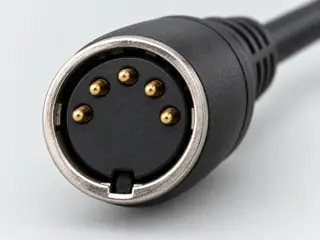
XLR and DIN are different five-position examples

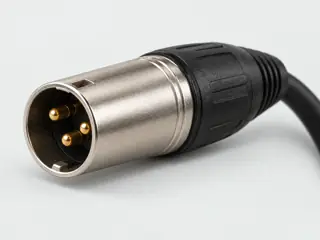
The comparison includes a five-pole DIN part and a five-pole XLR part to show why contact count cannot name the connector family or service. Nothing here designates a particular XLR-equipped device as DMX, audio or an adapter target.

Your next step

Move from the form to the requirement.

The source trail

Evidence for this page

AI-assisted inspection is not independent engineering review. Source scope and access limitations are disclosed below. Procedural checklists are editorial requirements, not hardware measurements.

Back to first citation ↑
C126ASource checked · pending review

Neutrik NC5MXX is a five-pole XLR cable connector.

Neutrik · NC5MXX five-pole XLR connector ↗

Locator: Product description; Mechanical / Locking device
Access: public page. The device signal and wiring are unspecified by connector identity alone; no DMX or audio compatibility approval.

S101: full source recordInspect review dependencies → (private workspace)

Claim scope: Identification and explicitly scoped documentation only; not an end-to-end connection approval. Next review due 2027-01-01.

Back to first citation ↑
C126BSource checked · pending review

The manufacturer lists latch-lock retention for that connector.

Neutrik · NC5MXX five-pole XLR connector ↗

Locator: Product description; Mechanical / Locking device
Access: public page. The device signal and wiring are unspecified by connector identity alone; no DMX or audio compatibility approval.

S101: full source recordInspect review dependencies → (private workspace)

Claim scope: Identification and explicitly scoped documentation only; not an end-to-end connection approval. Next review due 2027-01-01.

Back to first citation ↑
C126CSource checked · pending review

The drawing linked from the NC5MXX product page separates a five-position end view from two longitudinal profiles. Its drawing number is ST-NC5MXX, while the main title field reads NX5MXX.

Neutrik · NC5MXX five-pole XLR connector ↗

Locator: Product description; Mechanical / Locking device
Access: public page. The device signal and wiring are unspecified by connector identity alone; no DMX or audio compatibility approval.

S101: full source recordNeutrik · ST-NC5MXX product-linked drawing; title discrepancy retained ↗

Locator: Single sheet; five-position end view; revision B, changed-date 17.04.07. Drawing number ST-NC5MXX; main title visually reads NX5MXX.
Access: public page. Linked from NC5MXX product page. Title/drawing-number inconsistency remains unresolved; no current dimensional equivalence is certified. Raw document bytes were not obtained in the container; no raw-file hash or archived-source possession is claimed.

S620: full source recordInspect review dependencies → (private workspace)

Claim scope: Source identity discrepancy retained, not corrected by inference. The qualitative study follows the linked end view; no current dimensional certification or DMX/audio wiring claim.. Next review due 2027-01-11.

Suggest a correction to this field note →

Put this field note to work.

Add to discovery trayRecord an unsaved candidate (private workspace)

Compare look-alikes: Five-pin DIN versus five-pin XLR · Three-pin versus five-pin XLR

Candidate selection does not confirm the identity or capabilities of your physical item.

SOURCE-OBSERVED AUDIO COMPONENTS

Five pins do not make DIN and XLR alike.

The linked ST-NC5MXX sheet shows an XLR end view. Its main title reads NX5MXX; that source discrepancy remains unresolved. No DMX or audio service is assigned.

5-pole XLR / linked end view. Left end view / source key above contacts. Five positions in the linked end view; Key above the contacts; ST-NC5MXX versus NX5MXX title discrepancy unresolved. Original qualitative study, not a pinout.
NC5MXX product-linked ST-NC5MXX sheet
Male XLR cable component / source title conflict · Source, orientation and omissions (private workspace)
Read the evidence and its limits
  1. The drawing linked from the NC5MXX product page separates a five-position end view from two longitudinal profiles. Its drawing number is ST-NC5MXX, while the main title field reads NX5MXX. C126C

    Source identity discrepancy retained, not corrected by inference. The qualitative study follows the linked end view; no current dimensional certification or DMX/audio wiring claim.

    S101 · Neutrik ↗ · S620 · Neutrik ↗

  2. Neutrik NC5MXX is a five-pole XLR cable connector. C126A

    Identification and explicitly scoped documentation only; not an end-to-end connection approval

    S101 · Neutrik ↗

Compare the five audio and music references →

Evidence behind this page

Scope first. Source second. Approval separate.

2 linked sources · 3 scoped claims · 0 sources with inspection/access flags.

Page scope: consumer_reference_expansion

Assessment 2026-10-22 · earliest scheduled source review 2027-01-01. This is a recorded-date assessment, not a live source check. Page-level independent review is not established by this panel.

Inspect 2 source scopes, access limits and dates

S101 · NC5MXX five-pole XLR connector

Neutrik · Manufacturer / product-owner domain · inspected 2026-10-03 · due 2027-01-01

Within inspection window

Scoped support: Five-pole XLR cable connector with latch-lock retention.

Not established / limitations: The device signal and wiring are unspecified by connector identity alone; no DMX or audio compatibility approval.

Locator: Product description; Mechanical / Locking device

S620 · ST-NC5MXX product-linked drawing; title discrepancy retained

Neutrik · Manufacturer / product-owner domain · inspected 2026-10-13 · due 2027-01-11

Within inspection window

Scoped support: Linked from NC5MXX product page. Title/drawing-number inconsistency remains unresolved; no current dimensional equivalence is certified.

Not established / limitations: Linked from NC5MXX product page. Title/drawing-number inconsistency remains unresolved; no current dimensional equivalence is certified. Raw document bytes were not obtained in the container; no raw-file hash or archived-source possession is claimed.

Locator: Single sheet; five-position end view; revision B, changed-date 17.04.07. Drawing number ST-NC5MXX; main title visually reads NX5MXX.

Trace 3 claims to their source records

C126A · P126

Neutrik NC5MXX is a five-pole XLR cable connector.

Claim scope: Identification and explicitly scoped documentation only; not an end-to-end connection approval

Source links: S101 · Evidence trail → (private workspace)

C126B · P126

The manufacturer lists latch-lock retention for that connector.

Claim scope: Identification and explicitly scoped documentation only; not an end-to-end connection approval

Source links: S101 · Evidence trail → (private workspace)

C126C · P126

The drawing linked from the NC5MXX product page separates a five-position end view from two longitudinal profiles. Its drawing number is ST-NC5MXX, while the main title field reads NX5MXX.

Claim scope: Source identity discrepancy retained, not corrected by inference. The qualitative study follows the linked end view; no current dimensional certification or DMX/audio wiring claim.

Source links: S101 · S620 · Evidence trail → (private workspace)

Prepare this page for review → (private workspace)Read the evidence method →

Recorded evidence only. An inspection date, publisher label, source link or generated packet is not independent technical review, hardware testing, fabrication approval or a compatibility verdict.