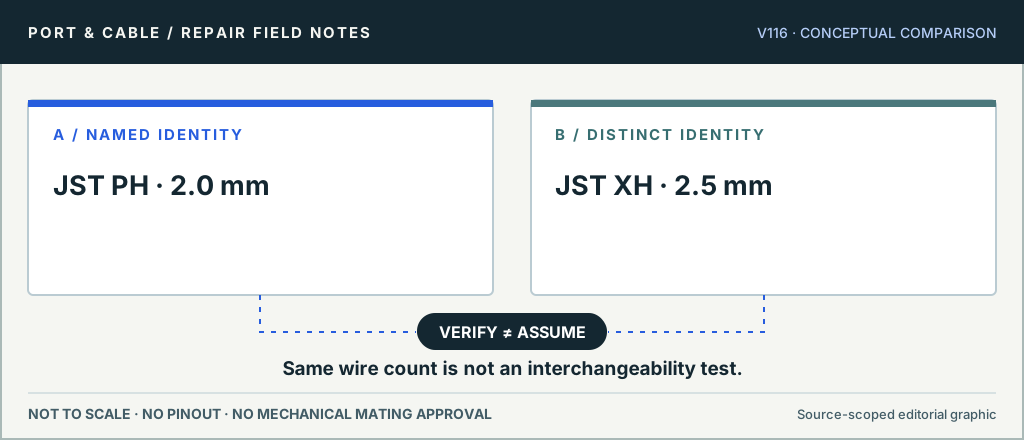
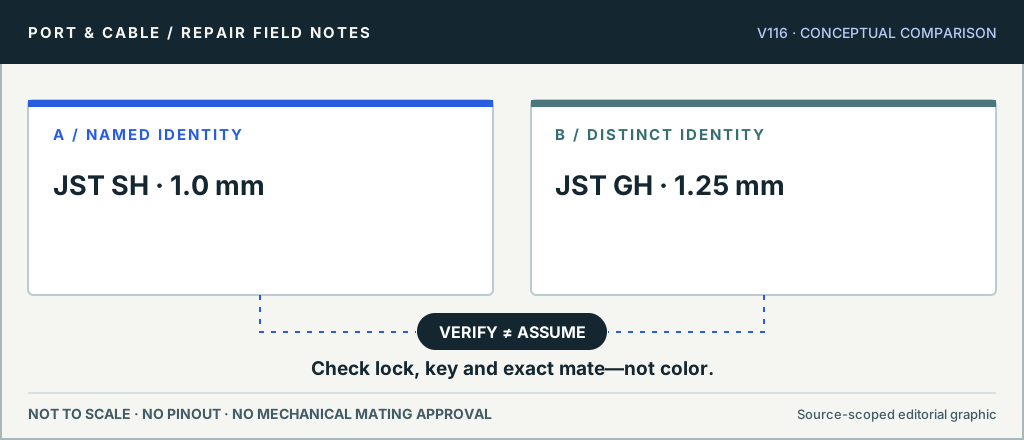
PH, XH, SH and GH are distinct JST series. Hirose DF13 is another manufacturer-defined family. Housing profiles, terminal parts, entry angle and latch design must be matched to the named series, not to a generic "JST plug" description.
A pitch, contact count, board color or drawing silhouette is not proof that two components mate safely. The nominal descriptors apply to the named series or manufacturer example only.
02 / READ THE DIFFERENCE
Visual reminders, deliberately not CAD
PH / XH — one manufacturer, different pitchSame wire count is not an interchangeability test. Original conceptual evidence diagram only, not part-number geometry, a live-circuit test, or manufacturer-approved fit.SH / GH — close looking, different retentionCheck lock, key and exact mate—not color. Original conceptual evidence diagram only, not part-number geometry, a live-circuit test, or manufacturer-approved fit.
03 / REPAIR DECISION GUIDE
8 real identification and replacement questions
01P349 / EXISTING CANONICAL REFERENCE
Recognize JST PH without trusting the battery-label shorthand
THE ANSWER JST PH is the manufacturer’s named 2.0 mm nominal pitch wire-to-board series, not a universal battery-plug standard. The actual header/housing pair, position count, entry orientation and exact cable wiring all need separate confirmation before replacement.
01 / Series
PH is specifically the JST series, not a nickname for any white battery plug.
02 / Mechanics
JST documents shrouded and top/side entry implementations.
03 / Circuit
Neither two positions nor a 2.0 mm pitch establishes polarity.
Before ordering, replacing or connecting
Check markings or the assembly bill of materials for a PH-series housing/header number.
Measure pitch with appropriate equipment without using the stylized illustration as a ruler.
Confirm pin-one placement and the full device-side wire assignment from its schematic.
Source scope · 1 registered reference
These source records support the cited series/role distinctions at their original scope. Some are comparative sources for another series, not claims directly attributed to this record. No listed source certifies a replacement assembly, pinout or safe circuit.
THE ANSWER No. The manufacturer identifies connector shell, contact and header families, but a mating PH assembly can be wired differently by device vendors. Match the original electrical design and crimp/termination specifications; wire color and clip direction alone are insufficient.
01 / Physical
Correct shroud, housing and crimp terminal are separate parts.
02 / Orientation
Top/side-entry and mounting variations affect access.
03 / Electrical
The original device—not the JST series—assigns polarity and signals.
Before ordering, replacing or connecting
Look up both mating manufacturer part numbers in the exact device documents.
Verify the harness pin-by-pin with a qualified service method and the board documentation.
Do not power the replacement until polarity and contacts are checked.
Source scope · 1 registered reference
These source records support the cited series/role distinctions at their original scope. Some are comparative sources for another series, not claims directly attributed to this record. No listed source certifies a replacement assembly, pinout or safe circuit.
THE ANSWER JST documents XH as a nominal 2.5 mm pitch series and PH as nominal 2.0 mm. Both have common shrouded friction-lock implementations, but they are distinct manufacturer-defined identities. Confirm header, housing and contact numbers rather than forcing close-looking parts.
01 / Pitch
XH 2.5 mm versus PH 2.0 mm nominal according to JST.
02 / Retention
Both can be friction-locked, but geometry and mating parts differ.
03 / Usage
The host wiring still must be identified from device documentation.
Before ordering, replacing or connecting
Read the precise board-header number, not just a distributor shorthand.
Check contact count and actual centerline spacing against a manufacturer drawing.
Select the mating housing and crimp terminal from the same supported part matrix.
Source scope · 2 registered references
These source records support the cited series/role distinctions at their original scope. Some are comparative sources for another series, not claims directly attributed to this record. No listed source certifies a replacement assembly, pinout or safe circuit.
THE ANSWER No. JST’s XH family lists top-entry and side-entry mounting variants, with through-hole and surface-mount choices. The series name narrows the family, but you still need an exact header number, board orientation, housing style and clearance check.
01 / Series
XH identifies a JST nominal 2.5 mm family.
02 / Installation
Top/side-entry and mounting choices are specified per header.
03 / Harness
Cable exit and strain relief belong to the actual enclosure layout.
Before ordering, replacing or connecting
Identify the board-mounted header itself.
Check the exact supplier drawing for orientation and clearance.
Confirm replacement terminal and housing series compatibility.
Source scope · 1 registered reference
These source records support the cited series/role distinctions at their original scope. Some are comparative sources for another series, not claims directly attributed to this record. No listed source certifies a replacement assembly, pinout or safe circuit.
THE ANSWER No. JST SH has a nominal 1.0 mm pitch and friction-lock family variants; GH is a distinct nominal 1.25 mm series with secure locking. At small sizes, the difference can be difficult to judge without a documented part number and a manufacturer drawing.
01 / SH
JST identifies SH as 1.0 mm nominal pitch.
02 / GH
JST identifies GH as 1.25 mm nominal pitch with secure lock.
03 / Pair
Different series designation is not a supported mating endorsement.
Before ordering, replacing or connecting
Inspect whether the housing has the documented lock geometry.
Check the exact board header and cable housing identifiers.
Never push an unverified miniature mating pair together.
Source scope · 2 registered references
These source records support the cited series/role distinctions at their original scope. Some are comparative sources for another series, not claims directly attributed to this record. No listed source certifies a replacement assembly, pinout or safe circuit.
THE ANSWER Not automatically. JST’s SH product profile notes related SR and SZ forms and different termination/mounting arrangements. A supplier product description that only says "1.0 mm JST" does not establish compatible housings, headers or assembly processes.
01 / Pitch
Nominal 1.0 mm is one attribute, not a complete designation.
02 / Assembly
Crimp, IDC and board-header forms are not identical workflows.
03 / Verification
Use the exact JST product series catalog and mating-part matrix.
Before ordering, replacing or connecting
Confirm whether the source part is crimped or insulation-displacement terminated.
Read the series and full manufacturer part code.
Use the matching contact/installation tooling and instructions.
Source scope · 1 registered reference
These source records support the cited series/role distinctions at their original scope. Some are comparative sources for another series, not claims directly attributed to this record. No listed source certifies a replacement assembly, pinout or safe circuit.
THE ANSWER No. JST GH is a keyed, secure-lock wire-to-board family nominally 1.25 mm pitch. The lock and key arrangement—and its specified mating parts—are decisive. Another vendor may publish the same nominal pitch with a wholly different interface.
01 / Pitch
GH and Hirose DF13 examples both use 1.25 mm nominal spacing.
02 / Key/lock
JST specifies GH secure locking and series-specific keying.
03 / Wiring
Neither series guarantees a device-level pin assignment.
Before ordering, replacing or connecting
Confirm GH with an actual JST housing/header part number.
Check position count, key/latch and insertion direction.
Verify each conductor function from the equipment service document.
Source scope · 1 registered reference
These source records support the cited series/role distinctions at their original scope. Some are comparative sources for another series, not claims directly attributed to this record. No listed source certifies a replacement assembly, pinout or safe circuit.
THE ANSWER No. The GH manufacturer profile includes both side-entry and top-entry board configurations. That detail affects clearance, harness strain and replacement choice even when the number of positions matches; confirm the exact part drawing.
01 / Family
Secure-lock GH defines the series class.
02 / Mount
Side-entry versus top-entry affects how the harness reaches the board.
03 / Assembly
The crimp contacts and harness retain separate part requirements.
Before ordering, replacing or connecting
Record any header markings or documentation part code.
Review the manufacturer view for mating direction, latch and package clearance.
Compare the replacement to the existing assembly without forcing the latch.
Source scope · 1 registered reference
These source records support the cited series/role distinctions at their original scope. Some are comparative sources for another series, not claims directly attributed to this record. No listed source certifies a replacement assembly, pinout or safe circuit.
Manufacturer series awaiting formal claim ingestion
These are manufacturer product pages and editorial research leads, not approved replacements. They are not entries in the registered source or claim ledger. A manufacturer product page may describe a family or one part number rather than every available variant.
SOURCE CANDIDATE / Hirose Electric
DF13 series — SignalBee 1.25 mm miniature crimp connectors
Hirose DF13 is a separately identified Hirose crimp connector series; exact header/socket/contact numbers define the mating pair.
Hirose lists 1.25 mm DF13 pitch and header, socket and contact families. Matching nominal pitch does not constitute interchangeability with JST GH.
Unknown or unverified mating part, pin assignment, polarity, device pinout or actuation method means stop and consult manufacturer documentation. This is an educational and source-scoped reference, not a pin assignment, repair procedure, safety certification, or permission to force a connector.