Guide note · not an individual product specification
The useful distinction
Understand the requirement.
Identify who supplies power, who receives it and what is actually documented for each selected port. [C144A]
The workflow models af and at only. Its Ubiquiti profiles interpret PoE and PoE+ using that publisher's terminology, not an assumption applied to every product labeled PoE. A shared documented standard is a reference match, not confirmation that a device will power correctly. [C144B]
The Ethernet Alliance distinguishes IEEE standards-based PoE from proprietary powering. Its certification program helps reduce interoperation risk for certified powered devices and power sources, but the presence of an Ethernet connector or the word PoE is not evidence that an arbitrary pair is certified or power compatible. [C144C]
Bounded facts, visible unknowns
Specifications and limits
PoE: distinguish the source from the powered device facts and limitations
Workflow boundary
Copper Ethernet / af and at documentation only [C144A][C144B]
Standards-based powering
Distinguish IEEE PoE from proprietary power; do not infer exact PSE/PD compatibility from the jack. [C144C]
Verified device list
Not included. Check exact device and accessory documentation.
A boundary, not an omission to guess around.
The workflow models af and at only. Its Ubiquiti profiles interpret PoE and PoE+ using that publisher's terminology, not an assumption applied to every product labeled PoE. A shared documented standard is a reference match, not confirmation that a device will power correctly.
Keep passive and unidentified equipment outside the path
Passive supplies do not use the same standards-based detection model. When passive or unidentified power equipment is present, the worksheet stops the modeled power path. Consult the exact equipment documentation; do not experiment with unverified adapters, pinouts or voltage settings.
Do not infer negative evidence
A product page that describes Ethernet rates but says nothing about PoE does not establish a powered-device role or a no-power guarantee. The directory distinguishes unknown, documented data-only, PSE and PD port groups.
AI-assisted inspection is not independent engineering review. Source scope and access limitations are disclosed below. Procedural checklists are editorial requirements, not hardware measurements.
C144ASource checked · pending review
Ethernet data flows both ways over a link. PoE has a distinct power-sourcing role (PSE) and powered-device role (PD). A connector outline does not identify those roles. Some products have device-level PoE input without a captured physical-port mapping; the worksheet leaves that mapping unknown.
Locator: PSE and PD terminology / Active and passive PoE Access: public page. Manufacturer guidance, not a reproduced IEEE standard. Passive power and bt are outside this worksheet; no voltage or wiring prescription is provided.
Locator: PoE Modes: Type 1 and 2 / Lite family / Physical Security consumption Access: public page. Only af/at rows are modeled; no bt values copied. G5 Bullet consumption conflicts with the exact datasheet's 4 W and remains unresolved.
Claim scope: Dated network reference; exact product scope where named. Documentation only; independent review pending.. Next review due 2027-01-01.
C144BSource checked · pending review
The workflow models af and at only. Its Ubiquiti profiles interpret PoE and PoE+ using that publisher's terminology, not an assumption applied to every product labeled PoE. A shared documented standard is a reference match, not confirmation that a device will power correctly.
Locator: PSE and PD terminology / Active and passive PoE Access: public page. Manufacturer guidance, not a reproduced IEEE standard. Passive power and bt are outside this worksheet; no voltage or wiring prescription is provided.
Locator: PoE Modes: Type 1 and 2 / Lite family / Physical Security consumption Access: public page. Only af/at rows are modeled; no bt values copied. G5 Bullet consumption conflicts with the exact datasheet's 4 W and remains unresolved.
Claim scope: Dated network reference; exact product scope where named. Documentation only; independent review pending.. Next review due 2027-01-01.
C144CSource checked · pending review
The Ethernet Alliance distinguishes IEEE standards-based PoE from proprietary powering. Its certification program helps reduce interoperation risk for certified powered devices and power sources, but the presence of an Ethernet connector or the word PoE is not evidence that an arbitrary pair is certified or power compatible.
Locator: Questions 1, 6, 7; IEEE standards-based PoE, proprietary solutions and certification Access: public page. A general article is not certification evidence for any unidentified port, PSE, PD, injector or supplied cable.
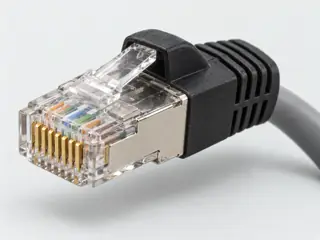
Computer-generated illustration with prior AI visual review. Not a photograph, measurement or compatibility check. Independent technical and rights review pending.
Assessment 2026-10-22 · earliest scheduled source review 2027-01-01. This is a recorded-date assessment, not a live source check. Page-level independent review is not established by this panel.
Scoped support: Publisher guidance distinguishes a power-sourcing device from a powered device and active standards-based PoE from passive power. Its terminology maps PoE to af and PoE+ to at.
Not established / limitations: Manufacturer guidance, not a reproduced IEEE standard. Passive power and bt are outside this worksheet; no voltage or wiring prescription is provided.
Locator: PSE and PD terminology / Active and passive PoE
Scoped support: The Type 1 and 2 rows distinguish source-side limits of 15.4 W and 30 W from device-side values of 12.95 W and 25.5 W. The Lite family table includes af and at. The G5 Bullet consumption row states 5 W.
Not established / limitations: Only af/at rows are modeled; no bt values copied. G5 Bullet consumption conflicts with the exact datasheet's 4 W and remains unresolved.
Locator: PoE Modes: Type 1 and 2 / Lite family / Physical Security consumption
Ethernet data flows both ways over a link. PoE has a distinct power-sourcing role (PSE) and powered-device role (PD). A connector outline does not identify those roles. Some products have device-level PoE input without a captured physical-port mapping; the worksheet leaves that mapping unknown.
The workflow models af and at only. Its Ubiquiti profiles interpret PoE and PoE+ using that publisher's terminology, not an assumption applied to every product labeled PoE. A shared documented standard is a reference match, not confirmation that a device will power correctly.
The Ethernet Alliance distinguishes IEEE standards-based PoE from proprietary powering. Its certification program helps reduce interoperation risk for certified powered devices and power sources, but the presence of an Ethernet connector or the word PoE is not evidence that an arbitrary pair is certified or power compatible.
Claim scope: Standards family and certification concept only; exact ports and roles remain unverified
Recorded evidence only. An inspection date, publisher label, source link or generated packet is not independent technical review, hardware testing, fabrication approval or a compatibility verdict.
Source-qualified next step · P144
Does any Ethernet port marked PoE power any PoE device?
What the evidence saysIEEE-standard PoE power sourcing and powered-device roles are not interchangeable with proprietary power implementations.
What is still unknown
An Ethernet connector, a generic PoE label, and even a standards overview cannot certify an unidentified PSE/PD pair or power budget.
Check before proceeding
Identify the exact switch/injector PSE and the device PD.
Confirm both documented standards/classes and their actual port roles.
Check source power budget, per-port limits and whether any proprietary or passive power mode is involved.
C144C / source-linked claim: The Ethernet Alliance distinguishes IEEE standards-based PoE from proprietary powering. Its certification program helps reduce interoperation risk for certified powered devices and power sources, but the presence of an Ethernet connector or the word PoE is not evidence that an arbitrary pair is certified or power compatible.