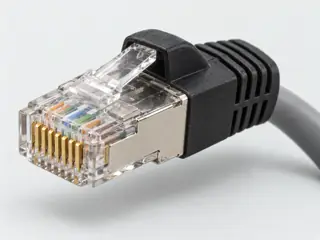
Guide note · not an individual product specification
The useful distinction
Understand the requirement.
Follow the documented data input and powered output instead of treating an injector as an interchangeable coupler. [C146A]
An inserted injector has its own Ethernet interface evidence. The captured TL-POE160S rates are 10/100/1000 Mbps. Two 2.5 Gbps endpoints do not establish 2.5 Gbps across that documented path. The worksheet compares the upstream and downstream segments and the shared end-to-end captured rates separately. [C146B]
Bounded facts, visible unknowns
Specifications and limits
An injector has two different sides facts and limitations
Workflow boundary
Copper Ethernet / af and at documentation only [C146A][C146B]
Verified device list
Not included. Check exact device and accessory documentation.
A boundary, not an omission to guess around.
An inserted injector has its own Ethernet interface evidence. The captured TL-POE160S rates are 10/100/1000 Mbps. Two 2.5 Gbps endpoints do not establish 2.5 Gbps across that documented path. The worksheet compares the upstream and downstream segments and the shared end-to-end captured rates separately.
The power source for the modeled downstream device is the injector output, not the upstream data endpoint. A selected upstream PSE or PD port is outside this simple documented topology; the tool does not silently chain power equipment.
Respect the boundary
No mains work, passive power, splitter design, pin assignment, surge protection, outdoor installation or hardware safety approval is provided. The source report is a documentation checklist, not instructions to energize an unknown device.
AI-assisted inspection is not independent engineering review. Source scope and access limitations are disclosed below. Procedural checklists are editorial requirements, not hardware measurements.
C146ASource checked · pending review
The TL-POE160S version-path 2.6 documentation distinguishes a data input from a power-plus-data output. The worksheet inserts only this exact documented topology. It does not infer that an arbitrary adapter, splitter or power supply works the same way.
Locator: Interface / PoE power / Product diagram labels in accessible text Access: public page. Only the documented data-in / power-data-out topology is modeled. No passive injector, splitter, multi-gig passthrough or mains-work advice.
Locator: PSE and PD terminology / Active and passive PoE Access: public page. Manufacturer guidance, not a reproduced IEEE standard. Passive power and bt are outside this worksheet; no voltage or wiring prescription is provided.
Claim scope: Dated network reference; exact product scope where named. Documentation only; independent review pending.. Next review due 2027-01-01.
C146BSource checked · pending review
An inserted injector has its own Ethernet interface evidence. The captured TL-POE160S rates are 10/100/1000 Mbps. Two 2.5 Gbps endpoints do not establish 2.5 Gbps across that documented path. The worksheet compares the upstream and downstream segments and the shared end-to-end captured rates separately.
Locator: Interface / PoE power / Product diagram labels in accessible text Access: public page. Only the documented data-in / power-data-out topology is modeled. No passive injector, splitter, multi-gig passthrough or mains-work advice.
Locator: PSE and PD terminology / Active and passive PoE Access: public page. Manufacturer guidance, not a reproduced IEEE standard. Passive power and bt are outside this worksheet; no voltage or wiring prescription is provided.
Computer-generated illustration with prior AI visual review. Not a photograph, measurement or compatibility check. Independent technical and rights review pending.
Assessment 2026-10-22 · earliest scheduled source review 2027-01-01. This is a recorded-date assessment, not a live source check. Page-level independent review is not established by this panel.
Scoped support: The US version-path 2.6 page documents one 10/100/1000 Mbps data input and one 10/100/1000 Mbps power-plus-data output, af/at operation and up to 30 W.
Not established / limitations: Only the documented data-in / power-data-out topology is modeled. No passive injector, splitter, multi-gig passthrough or mains-work advice.
Locator: Interface / PoE power / Product diagram labels in accessible text
Scoped support: Publisher guidance distinguishes a power-sourcing device from a powered device and active standards-based PoE from passive power. Its terminology maps PoE to af and PoE+ to at.
Not established / limitations: Manufacturer guidance, not a reproduced IEEE standard. Passive power and bt are outside this worksheet; no voltage or wiring prescription is provided.
Locator: PSE and PD terminology / Active and passive PoE
Trace 2 claims to their source records
C146A · P146
The TL-POE160S version-path 2.6 documentation distinguishes a data input from a power-plus-data output. The worksheet inserts only this exact documented topology. It does not infer that an arbitrary adapter, splitter or power supply works the same way.
An inserted injector has its own Ethernet interface evidence. The captured TL-POE160S rates are 10/100/1000 Mbps. Two 2.5 Gbps endpoints do not establish 2.5 Gbps across that documented path. The worksheet compares the upstream and downstream segments and the shared end-to-end captured rates separately.
Recorded evidence only. An inspection date, publisher label, source link or generated packet is not independent technical review, hardware testing, fabrication approval or a compatibility verdict.