Supported under stated conditions, excluded within a stated scope, or not established. Only 4 cases belong to this desk; none is a universal compatibility approval.
Supported under stated conditions · not hardware tested
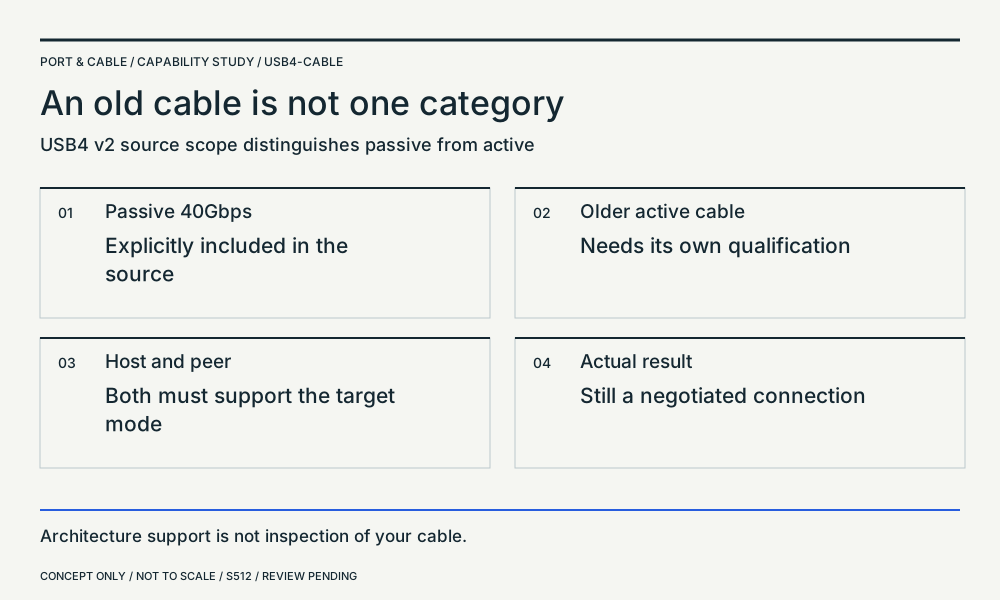
Can a passive 40Gbps cable serve a USB 80Gbps path?
USB-IF explicitly includes existing 40Gbps passive cables in its USB4 v2 architecture statement.
Still unknown. Actual cable condition and negotiated mode are unverified.
Next check. Confirm that the cable is passive and verify both port specifications.
Host, cable, destination, power and evidence
- Host / source
- USB4 v2 endpoint with the required mode.
- Cable / intermediary
- A genuine, suitable passive cable; not merely a sales label.
- Destination / sink
- USB4 v2 endpoint with matching support.
- Power direction / supply
- Charging remains a separate PD negotiation.
Basis: source-scoped interpretation. This classifies only the stated proposition, not an entire equipment pairing.
C034B
USB-IF describes USB4 v2 operation up to 80Gbps over existing 40Gbps passive Type-C cables or newly defined 80Gbps active cables.
Architecture-level statement; do not extend passive-cable reuse to every old active cable or unverified cable.
S512 · USB-IF
S512 · USB-IF
Not established · not hardware tested
Does an older active USB4 cable also support the new rate?
The passive-cable statement cannot be used to qualify an older active cable.
Still unknown. The selected active cable’s high-rate support is missing.
Next check. Obtain the active cable’s own data specification; do not copy a passive-cable conclusion.
Host, cable, destination, power and evidence
- Host / source
- Identify the newer host port mode.
- Cable / intermediary
- Exact active cable model and supported generations required.
- Destination / sink
- Identify the destination’s mode.
- Power direction / supply
- Read cable power separately.
Basis: source-scoped interpretation. This classifies only the stated proposition, not an entire equipment pairing.
C034B
USB-IF describes USB4 v2 operation up to 80Gbps over existing 40Gbps passive Type-C cables or newly defined 80Gbps active cables.
Architecture-level statement; do not extend passive-cable reuse to every old active cable or unverified cable.
S512 · USB-IF
S512 · USB-IF
Excluded in stated scope · not hardware tested
Does 120Gbps asymmetric mean 120Gbps each way?
No. The optional asymmetric configuration is 120Gbps in one direction and retains 40Gbps in reverse.
Still unknown. Application throughput and traffic allocation are not supplied.
Next check. State both directions when recording the link mode.
Host, cable, destination, power and evidence
- Host / source
- Host supports the optional asymmetric configuration.
- Cable / intermediary
- Suitable high-rate link cable.
- Destination / sink
- Peer supports the same configuration.
- Power direction / supply
- Independent of the link-allocation question.
Basis: source-scoped interpretation. This classifies only the stated proposition, not an entire equipment pairing.
C034C
The USB4 v2 announcement describes an optional asymmetric configuration: up to 120Gbps in one direction while retaining 40Gbps in the reverse direction.
Optional transport configuration, not symmetric throughput or a file-transfer guarantee.
S512 · USB-IF
S512 · USB-IF
Not established · not hardware tested
Will a USB4 dock deliver the full link rate to an SSD?
The connection’s transport figure is not a measured disk-transfer figure.
Still unknown. Shared display traffic, controller path and storage performance are missing.
Next check. Identify every stage rather than converting the headline link rate into a promised copy speed.
Host, cable, destination, power and evidence
- Host / source
- Exact host and storage transport support.
- Cable / intermediary
- Cable qualification plus dock upstream path.
- Destination / sink
- Exact SSD, enclosure and dock downstream port.
- Power direction / supply
- Use the dock and storage manufacturer’s power requirements.
Basis: source-scoped interpretation. This classifies only the stated proposition, not an entire equipment pairing.
C033B
USB-IF describes USB4 as a multi-protocol architecture whose common connection can carry different traffic types; capabilities depend on the connected products.
Architecture-level transport summary; application throughput and dock routing remain unspecified.
S522 · USB-IF
S522 · USB-IF