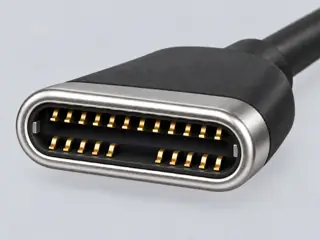
The first USB4 specification generation supports up to 40 Gbit/s signaling.
Also calledUSB4 v1USB 4USB4 40Gbps
USB4 version 1 is not the ceiling of the whole USB4 family.
The useful distinction
Use the documented product performance level rather than assigning the family maximum to a generic Type-C port. Keep this historical generation distinct from the version 2 record.
These are source-qualified distinctions. No complete device pairing, physical fit or operating result is certified here.
Inspect the canonical evidence and scope
C033B
USB-IF describes USB4 as a multi-protocol architecture whose common connection can carry different traffic types; capabilities depend on the connected products.
Architecture-level transport summary; application throughput and dock routing remain unspecified.
The first USB4 specification generation supports up to 40 Gbit/s signaling. [C033A]
USB-IF describes USB4 as a multi-protocol architecture whose common connection can carry different traffic types; capabilities depend on the connected products. [C033B]
Not included. Check exact device and accessory documentation.
A boundary, not an omission to guess around.
This is a scoped requirements guide, not an interoperability certification. It does not test hardware, calculate an arbitrary display timing, or replace the exact product documentation. A missing capability stays unknown.
Before you connect
What to check
Confirm that the port and cable explicitly support USB4.
Record the supported data mode and any display needs.
Check accessory compatibility rather than assuming every Type-C peripheral is a USB4 device.
AI-assisted inspection is not independent engineering review. Source scope and access limitations are disclosed below. Procedural checklists are editorial requirements, not hardware measurements.
C033ASource checked · pending review
The first USB4 specification generation supports up to 40 Gbit/s signaling.
Claim scope: Consumer identification / documented standard or product class only. Next review due 2026-12-30.
C033BSource checked · pending review
USB-IF describes USB4 as a multi-protocol architecture whose common connection can carry different traffic types; capabilities depend on the connected products.
Locator: USB4 Specification overview and architecture characteristics Access: public page. Mutual endpoint capability and shared transport; does not specify a measured file-copy rate. Retrieval locators and observations retained; raw acquisition is recorded separately.
Computer-generated illustration with prior AI visual review. Not a photograph, measurement or compatibility check. Independent technical and rights review pending.
Assessment 2026-10-22 · earliest scheduled source review 2026-12-30. This is a recorded-date assessment, not a live source check. Page-level independent review is not established by this panel.
USB-IF · Standards-organization domain · inspected 2026-10-11 · due 2027-01-09
Within inspection window
Scoped support: Mutual endpoint capability and shared transport; does not specify a measured file-copy rate.
Not established / limitations: Mutual endpoint capability and shared transport; does not specify a measured file-copy rate. Retrieval locators and observations retained; raw acquisition is recorded separately.
Locator: USB4 Specification overview and architecture characteristics
Trace 2 claims to their source records
C033A · P033
The first USB4 specification generation supports up to 40 Gbit/s signaling.
Claim scope: Consumer identification / documented standard or product class only
USB-IF describes USB4 as a multi-protocol architecture whose common connection can carry different traffic types; capabilities depend on the connected products.
Claim scope: Architecture-level transport summary; application throughput and dock routing remain unspecified.
Recorded evidence only. An inspection date, publisher label, source link or generated packet is not independent technical review, hardware testing, fabrication approval or a compatibility verdict.