Cable / adapter note · not an individual product specification
The useful distinction
Understand the requirement.
LC UPC at both ends, OS2 and two fibers, with a source-scoped factory A–B state and A–A change option. [C338A]
Corning describes this reverse-polarity uniboot series as supplied in A–B polarity and changeable to A–A without tools. That factory state and changeability are series-specific, not a statement about an unidentified LC cord. [C338B]
Fluke explains that a two-fiber duplex channel must connect each transmitter to the corresponding remote receiver across all intervening segments. It warns against looking directly into a port to identify a transmitting fiber. [C338C]
Bounded facts, visible unknowns
Specifications and limits
Corning LC UPC OS2 reverse-polarity uniboot series facts and limitations
Not included. Check exact device and accessory documentation.
A boundary, not an omission to guess around.
This is a named-series reference, not a selected SKU, inspected sample, complete link design or a purchase recommendation. No transmitter/receiver pairing, performance, fabrication or installation approval is granted.
Before you connect
What to check
Match the exact manufacturer series and selected variant.
Check each endpoint and its mating polish independently.
Resolve fiber category, organization and any required Tx/Rx map.
Check exact equipment, wavelength, loss budget and safe handling separately.
AI-assisted inspection is not independent engineering review. Source scope and access limitations are disclosed below. Procedural checklists are editorial requirements, not hardware measurements.
C338ASource checked · pending review
Corning lists single-mode LC UPC uniboot code 78 for each end and the G single-mode OS2 fiber option in its reverse-polarity duplex patch-cord family. The uniboot carries two fibers in one cable.
Locator: Revision 2025-03-03; PDF pages 2 and 6 visually inspected. Page 2: reverse-polarity uniboot; page 6: LC duplex Jumper in a Box order options. Access: public pdf text. No inferred SKU, actual order availability, universal duplex polarity, connector dimensions or end-to-end reach. The filename and final-page footer differ from the repeated LAN-3921-AEN heading; the inspected revision and page locators are retained. Numerical return-loss and length-table entries are not republished.
Claim scope: LAN-3921-AEN revision 2025-03-03, page 2; selected 78/78/G family option.. Next review due 2027-01-06.
C338BSource checked · pending review
Corning describes this reverse-polarity uniboot series as supplied in A–B polarity and changeable to A–A without tools. That factory state and changeability are series-specific, not a statement about an unidentified LC cord.
Locator: Revision 2025-03-03; PDF pages 2 and 6 visually inspected. Page 2: reverse-polarity uniboot; page 6: LC duplex Jumper in a Box order options. Access: public pdf text. No inferred SKU, actual order availability, universal duplex polarity, connector dimensions or end-to-end reach. The filename and final-page footer differ from the repeated LAN-3921-AEN heading; the inspected revision and page locators are retained. Numerical return-loss and length-table entries are not republished.
Claim scope: Page 2; Corning calls A–B flipped and A–A straight through. No current state of a used cord or universal LC polarity is inferred.. Next review due 2027-01-06.
C338CSource checked · pending review
Fluke explains that a two-fiber duplex channel must connect each transmitter to the corresponding remote receiver across all intervening segments. It warns against looking directly into a port to identify a transmitting fiber.
Locator: Published 2025-11-12; End-to-End Duplex Polarity and How to Check Duplex Polarity text inspected. Access: public page. No MPO pin numbering, polarity-method table, standards-edition interpretation, detector performance guarantee or installation approval is adopted. Descriptive straight-through/flipped terminology is kept source-specific.
Claim scope: End-to-End Duplex Polarity and How to Check Duplex Polarity; no optical power, detector or complete channel qualification is established.. Next review due 2027-01-06.
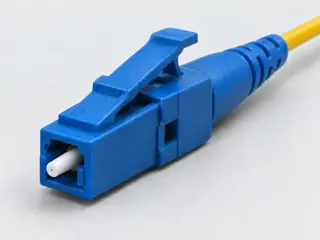
Computer-generated illustration with prior AI visual review. Not a photograph, measurement or compatibility check. Independent technical and rights review pending.
Assessment 2026-10-22 · earliest scheduled source review 2027-01-06. This is a recorded-date assessment, not a live source check. Page-level independent review is not established by this panel.
Scoped support: Selected LC/LC OM4 PC duplex and LC UPC/LC UPC OS2 reverse-polarity uniboot options only.
Not established / limitations: No inferred SKU, actual order availability, universal duplex polarity, connector dimensions or end-to-end reach. The filename and final-page footer differ from the repeated LAN-3921-AEN heading; the inspected revision and page locators are retained. Numerical return-loss and length-table entries are not republished.
Locator: Revision 2025-03-03; PDF pages 2 and 6 visually inspected. Page 2: reverse-polarity uniboot; page 6: LC duplex Jumper in a Box order options.
Scoped support: Two-fiber Tx-to-Rx continuity requirement and the warning against looking into an optical port.
Not established / limitations: No MPO pin numbering, polarity-method table, standards-edition interpretation, detector performance guarantee or installation approval is adopted. Descriptive straight-through/flipped terminology is kept source-specific.
Locator: Published 2025-11-12; End-to-End Duplex Polarity and How to Check Duplex Polarity text inspected.
Trace 3 claims to their source records
C338A · P338
Corning lists single-mode LC UPC uniboot code 78 for each end and the G single-mode OS2 fiber option in its reverse-polarity duplex patch-cord family. The uniboot carries two fibers in one cable.
Corning describes this reverse-polarity uniboot series as supplied in A–B polarity and changeable to A–A without tools. That factory state and changeability are series-specific, not a statement about an unidentified LC cord.
Claim scope: Page 2; Corning calls A–B flipped and A–A straight through. No current state of a used cord or universal LC polarity is inferred.
Fluke explains that a two-fiber duplex channel must connect each transmitter to the corresponding remote receiver across all intervening segments. It warns against looking directly into a port to identify a transmitting fiber.
Claim scope: End-to-End Duplex Polarity and How to Check Duplex Polarity; no optical power, detector or complete channel qualification is established.
Recorded evidence only. An inspection date, publisher label, source link or generated packet is not independent technical review, hardware testing, fabrication approval or a compatibility verdict.