
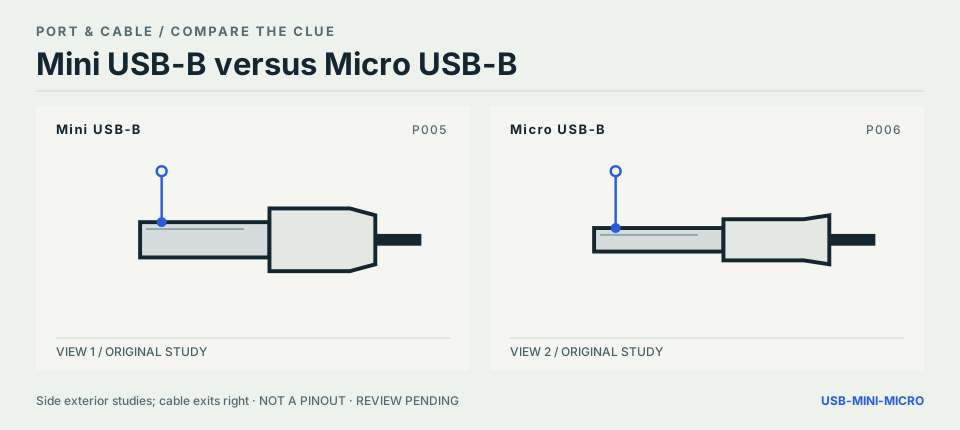
 01 / USB
Mini USB-B versus Micro USB-B
Shell profile is the observation. Both shown from the cable exterior side.
Open the comparisonChoose documented candidate forms and compare their exact source scopes. These choices do not identify the physical connector in front of you.
Nothing has been connected, measured or approved. Choose inputs to continue.
Update the inputs to show current documentation results.
Type-C Mini and Type-D Micro are distinct HDMI connector forms.
Contact arrangement is a visual clue. Signal assignment still needs device documentation.
Compare physical card forms; verify capacity, bus and speed class separately.
The center contact matters as well as the threaded outer shell.
Identify the optical connector family; verify fiber and end-face polish independently.
Compare the end forms; document power and software support independently.
Compare the contact pattern and keying, not only a circular shell.
Five contacts do not establish the connector family or signal.
Positions, populated contacts and port role are separate observations.
Identify the housing without inferring a network or telephone function.
Find the exact documented interface before choosing a cable.
The analog/digital distinction comes before an adapter choice.
External data cabling does not establish the device power arrangement.
Similar names refer to different card families.
Record the type letter and supported reader, not just the family name.
A shared form factor does not establish device or firmware support.
Identify exterior form only; no optical compatibility result.
Pole count does not provide a wiring map or power approval.
Contact count does not determine the device signal.
Which IEC 60320 connector designation is documented for the appliance inlet and environment?
Which appliance-inlet designation is actually present? Similar outlines do not erase the C14/C16 distinction.
Is the item a plug or receptacle, and does the 5-20 form/T-slot cue apply?
What does the PSU cable and motherboard/GPU manual call this connector? Pin count alone is not enough.
Is this the older 2x3/2x4 family or the separate 12+4-contact 12VHPWR form?
Which physical SATA-family variant does the exact device specify?
Which host cage and module family is documented? Form factor does not establish link capability.
What is the pole count and the equipment application? XLR shape alone does not establish signal or power.
Which pole count and equipment wiring does the loudspeaker system document?
Is the cord-side IEC connector the grounded C5 form or the non-grounded C7 form?
Does the equipment use the grounded C6 inlet or the non-grounded C8 inlet?
Which IEC 60320 cord-connector designation is documented for the equipment?
Is the documented locking plug configuration L5-20P or L6-20P?
Which pluggable-I/O host form does the equipment documentation identify?
Is the pluggable host connector the 104-position CFP2 form or the 56-position CFP4 form?
Is the center-contact convention standard N-Type or reverse-polarity N-Type?
Is the threaded TNC interface standard or reverse polarity?
Which miniature snap-on coaxial family matches the documented component?
Which bayonet/coaxial interface family is actually documented for the equipment?
Which M12 coding and position pattern is documented for the Ethernet port?
Is the internal storage connector legacy Mini-SAS SFF-8087 or Mini-SAS HD SFF-8643?
Is the external storage connector SFF-8088 or the higher-density SFF-8644 form?
Which compact cabled storage/PCIe connector family is documented by the host and cable?
Which 2.54 mm two-row position count and keying does the exact header use?
Which Mini Delta Ribbon position count and series does the exact component specify?
Is the 68-contact legacy interface MDR or the narrower VHDCI family?
Is the full-size CHAMP/Centronics-style connector the 36-position or 50-position form?
Which M8 coding is documented: A-coded signal/sensor or D-coded data?
Which M12 coding and intended domain does the equipment documentation specify?
Is the D-coded industrial Ethernet connector M8 or M12?
Which circular shell family and coding does the exact equipment specify?
Is the interface a ruggedized locking etherCON system or a conventional 8P8C modular port?
Does the fiber system specify opticalCON DUO or QUAD, and how many optical channels are documented?
Does the camera link require the SMPTE 304M connector family or the distinct opticalCON DUO SMPTE system?
Which exact GPU auxiliary-power connector family does the PSU and device documentation require?
Is the host interface a card-edge slot or an MCIO/SFF-TA-1016 cabled interconnect family?
Which motherboard front-panel USB header form does the board and case cable specify?
Which exact S-coded position count does the documented M12 power interface require?
Is the documented four-position M12 power interface S-coded or T-coded?
Which keyed M12 power coding and position count does the exact equipment documentation specify?
Does the exact interface require D-coded, X-coded or Y-coded M12 rather than merely an M12 shell?
Is the documented plug the non-grounding 1-15P configuration or grounded 5-15P?
Is the documented receptacle/connector the non-grounding 1-15R configuration or grounded 5-15R?
Does the equipment documentation specify NEMA 6-15P or 6-20P?
Does the equipment documentation specify NEMA 6-15R or 6-20R?
Is the exact grounding plug configuration NEMA 14-30P or 14-50P?
Is the exact grounding receptacle configuration NEMA 14-30R or 14-50R?
Is the documented 30 A-class plug the legacy non-grounding 10-30P form or grounding four-wire 14-30P form?
Is the documented 30 A-class receptacle the legacy non-grounding 10-30R form or grounding four-wire 14-30R form?
Is the documented 50 A-class plug the legacy non-grounding 10-50P form or grounding four-wire 14-50P form?
Is the documented 50 A-class receptacle the legacy non-grounding 10-50R form or grounding four-wire 14-50R form?
Is the documented 30 A-class plug the 125 V TT-30P RV form or the distinct 14-30P form?
Is the documented 30 A-class receptacle the 125 V TT-30R RV form or the distinct 14-30R form?
Does the exact equipment require the L14-20P or L14-30P locking configuration?
Does the exact equipment require the L14-20R or L14-30R locking configuration?
Is the documented SFF-TA-1002 variation 1C/56-contact or 2C/84-contact? Contact count distinguishes these forms but does not establish device protocol or host support.
Is the documented variation 4C/140-contact or 4C+/168-contact? The family label alone is not enough to establish the exact connector or implementation.
Is the slot/form the 36-position x1 or 64-position x4 mechanical variant? Mechanical width does not establish PCIe generation or active lanes.
Is the card-edge form x8/98-position or x16/164-position? Mechanical form does not establish generation, lane wiring or platform support.
Is the host using the older 52-position Mini PCIe/mSATA connector family or an M.2 keyed card-edge form? Similar internal-card roles do not make them physically or electrically interchangeable.
Is the part the C1 cord connector or C2 appliance inlet? Use the exact component identity; this comparison is not wiring or installation guidance.
Is the part the C9 cord connector or C10 appliance inlet? Pair identity does not establish the appliance rating or approved cord set.
Is the cord connector C15 or the distinct C15A very-hot-condition form? Similar naming is not permission to substitute or modify a mains cord.
Is the appliance inlet C16 or the distinct C16A very-hot-condition form? Similar naming is not an installation or substitution verdict.
Is the cord connector C19 or C21? Both occur in the higher-current IEC 60320 family, but exact configuration and equipment requirements remain separate.
Is the appliance inlet C20 or C22? Exact configuration, equipment rating and approved cord set must be resolved from equipment documentation.
Is the part the C23 Class II connector or C24 inlet? This page supports naming/recognition only, not mains wiring or installation.
Does the compact Mini-XLR/Tini-QG form have three or four conductors? Conductor count does not establish the device wiring or signal role.
Does the compact Mini-XLR/Tini-QG form have four or five conductors? Do not infer a pin assignment from count alone.
Are you looking at the compact Mini-XLR/Tini-QG form or a full-size XLR connector? Matching three-pole counts do not make the shells interchangeable.
Is the broadcast triax interface the LEMO 3T or 4A series? Both cited forms are 75-ohm triax, but series identity and exact mating components remain distinct.
Is the documented interface a 75-ohm broadcast triax form or the 50-ohm LEMO 00 NIM-CAMAC form? Impedance and series identity are not interchangeable.
V107 / Three standards / One common scale
This illustration compares only the published outer width and height. All three rectangles use one scale, unlike the earlier independently fitted silhouette drawings. Each face is left blank because exact perimeter/key/contact geometry has not been reproduced.
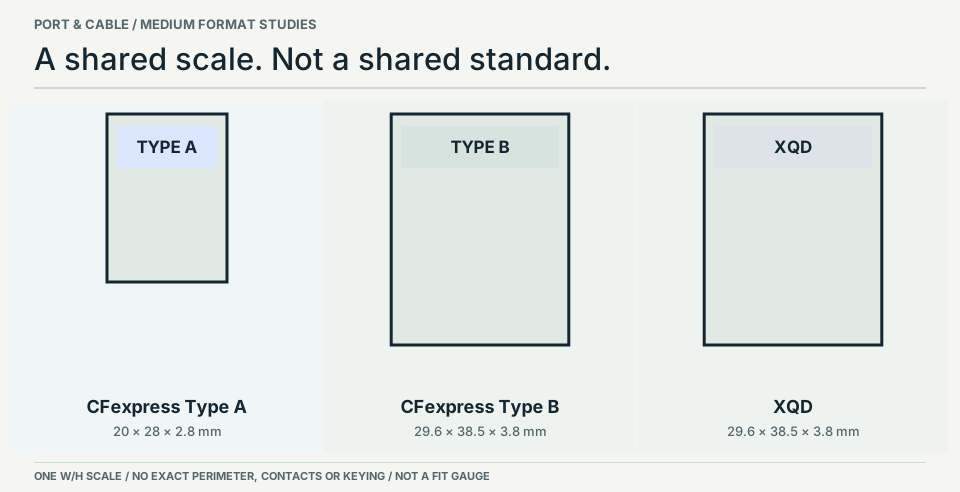
| Card standard | Nominal width × height × depth | Identity check |
|---|---|---|
| CFexpress Type A | 20 × 28 × 2.8 mm | Smaller width-and-height envelope than Type B. The printed Type A designation—not a contact sketch—is the identifying check. |
| CFexpress Type B | 29.6 × 38.5 × 3.8 mm | Larger than Type A. Same outer dimensions and connector family as XQD; the Type B label and camera/reader support remain decisive. |
| XQD | 29.6 × 38.5 × 3.8 mm | Matches Type B in stated physical dimensions. An XQD designation and exact camera/reader documentation are necessary. |
Shared dimensions do not prove compatibility. Type B and XQD are two standards with a shared form factor and connector; check the exact camera, reader, firmware and supported-media list. No actual corner relief, socket key, contacts, tolerances or wiring are depicted.
Every SVG here was authored specifically for this field guide. No third-party graphics, logos, photographs, measurement templates, pinouts or manufacturer CAD were copied. Independent approvals are still open.
Visual desk / Ten field comparisons
These original studies show useful observations, not a relative-size chart or a compatibility verdict. Select a plate to open the existing two-form comparison tool. The drawings and their reading cues remain visible without JavaScript.
01 / USBShell profile is the observation. Both shown from the cable exterior side.
Open the comparison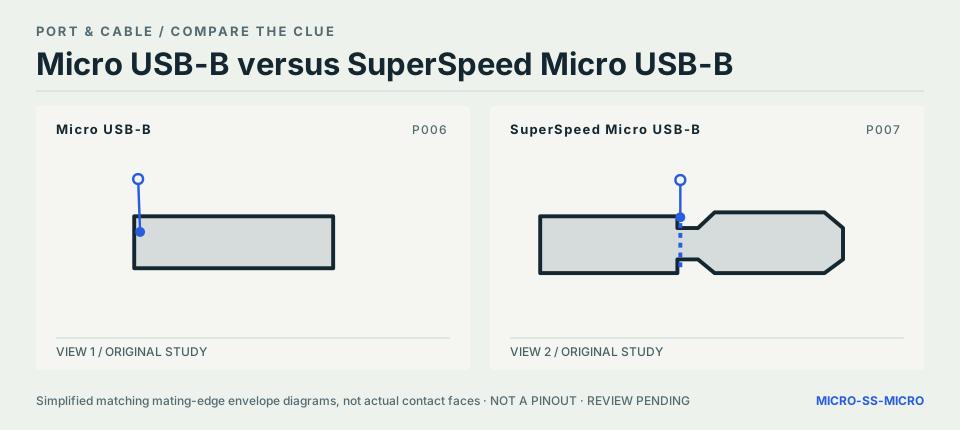 02 / USB
The extra side section distinguishes the SuperSpeed Micro-B plug form; it is not a speed guarantee for any unknown cable or device.
Open the comparison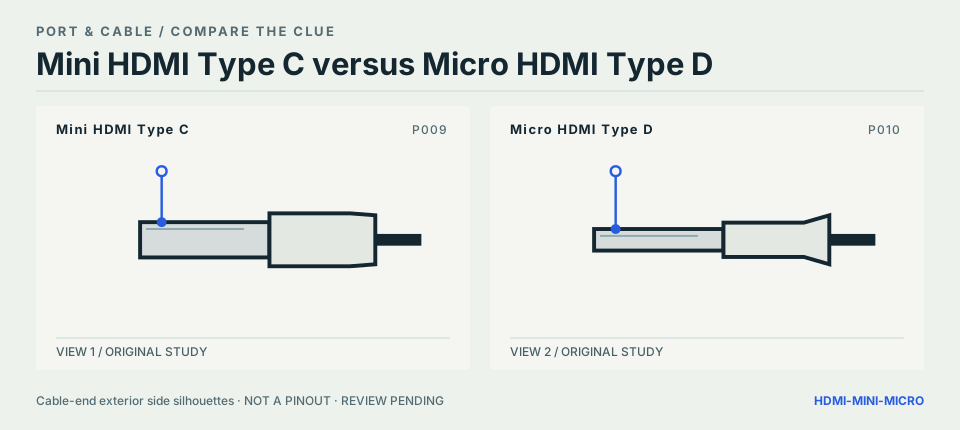 03 / Display
Type C and D name different HDMI shell designs. The visual is a generic side profile, not a gauge.
Open the comparison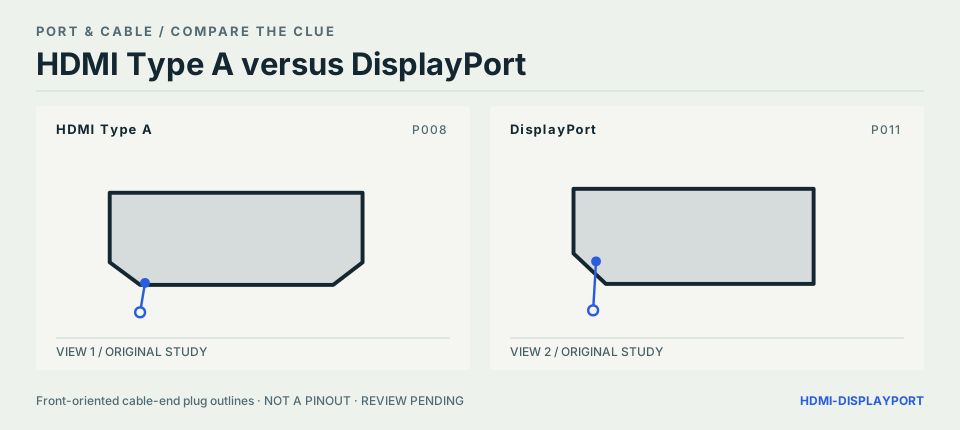 04 / Display
The differently keyed front outline is visible without assigning video capability to the port.
Open the comparison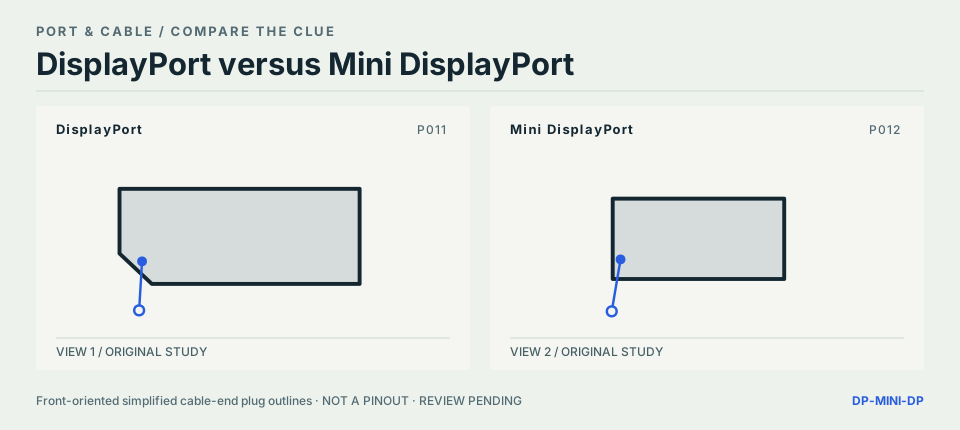 05 / Display
Mini DisplayPort has a distinct connector from full-size DisplayPort; visually similar Thunderbolt 1/2 ports add a capability question.
Open the comparison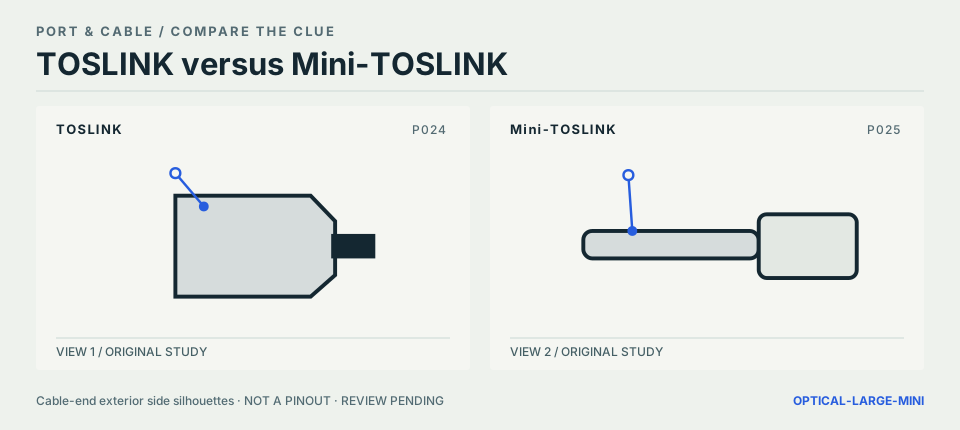 06 / Audio
A 3.5 mm-style exterior does not establish analog audio; the source and device labels determine signal type.
Open the comparison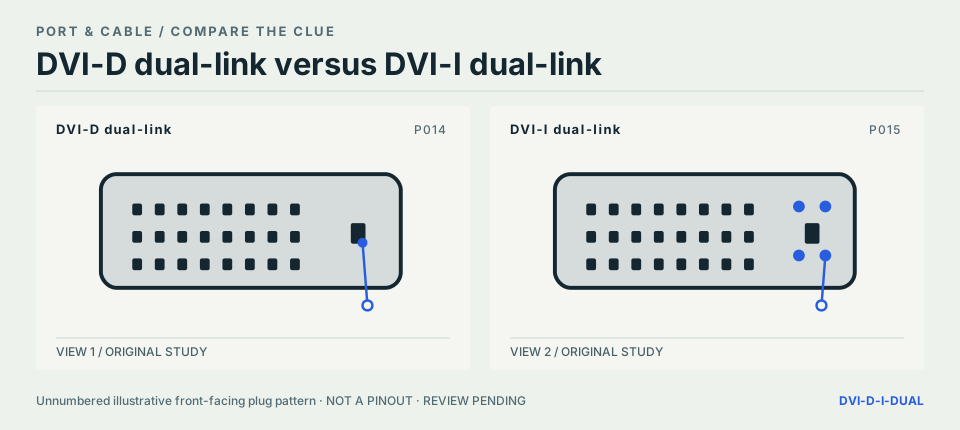 07 / Display
DVI-D and DVI-I are not synonymous, even with a dual-link grid. Four extra contact positions do not establish active conversion.
Open the comparison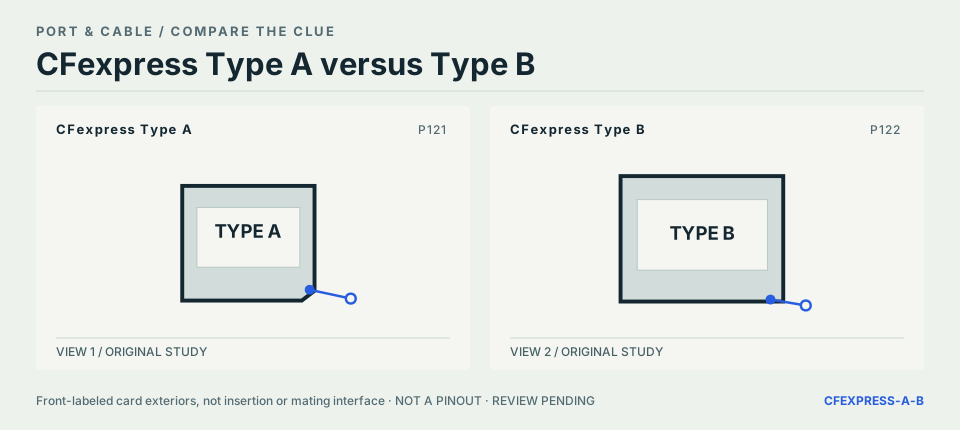 08 / Cards
CFA defines different physical Type A and Type B form factors; the drawings show front silhouettes only.
Open the comparison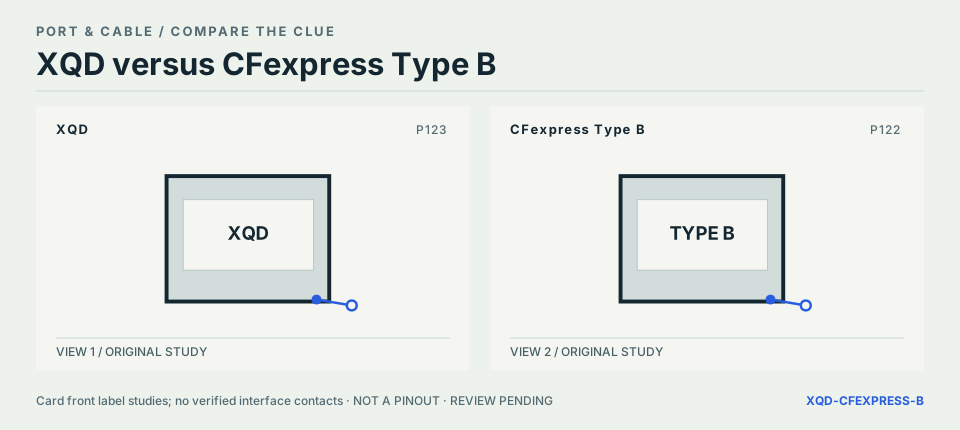 09 / Cards
The shape alone cannot distinguish these standards. Matching dimensions do not guarantee working camera firmware or reader support.
Open the comparison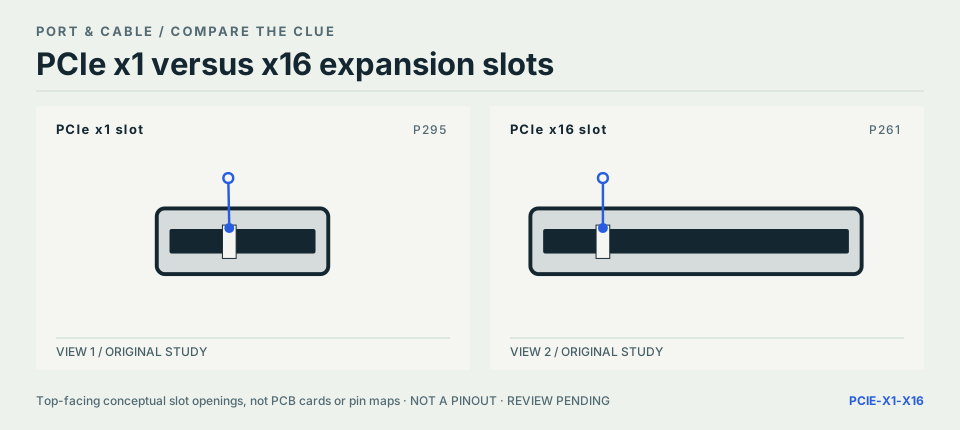 10 / Computer
Physical length identifies a slot class in this family, not its connected electrical lanes, speed or device power.
Open the comparisonAll 10 plates have textual distinctions and independently reviewed source limits pending. The two CFexpress/XQD silhouettes intentionally expose when a physical outline is insufficient.