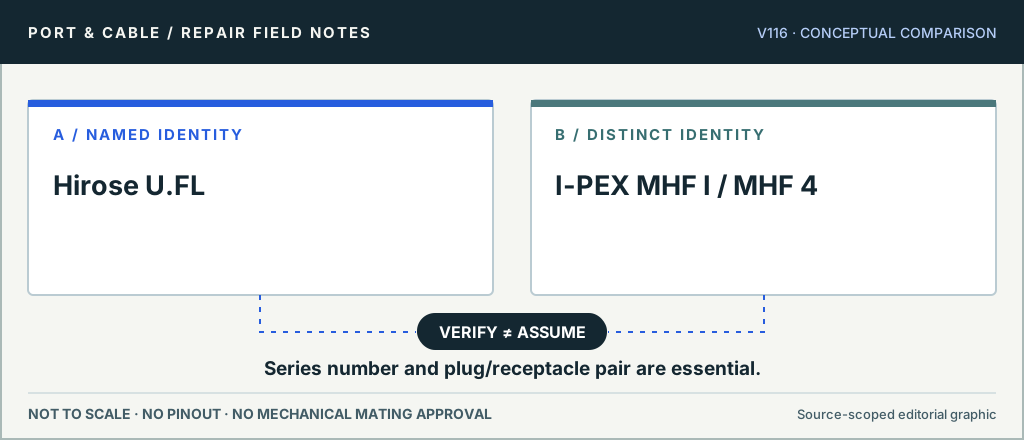
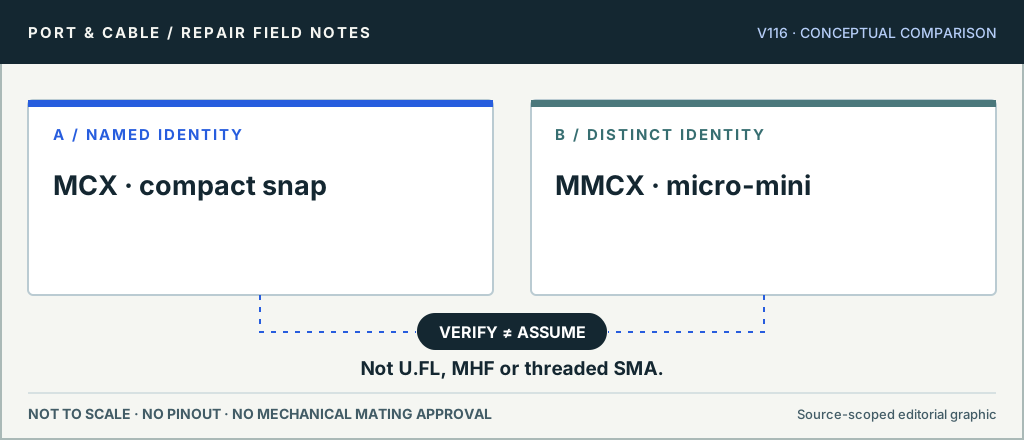
U.FL, MHF I and MHF 4 are named connector families with their own receptacles, cable assemblies and manufacturer handling procedures. MCX, MMCX and SMA are different RF connector forms again; do not bridge families by eye.
A pitch, contact count, board color or drawing silhouette is not proof that two components mate safely. The nominal descriptors apply to the named series or manufacturer example only.
02 / READ THE DIFFERENCE
Visual reminders, deliberately not CAD
U.FL / MHF — tiny does not mean equalSeries number and plug/receptacle pair are essential. Original conceptual evidence diagram only, not part-number geometry, a live-circuit test, or manufacturer-approved fit.MCX / MMCX — separate RF mate formsNot U.FL, MHF or threaded SMA. Original conceptual evidence diagram only, not part-number geometry, a live-circuit test, or manufacturer-approved fit.
03 / REPAIR DECISION GUIDE
7 real identification and replacement questions
01P353 / EXISTING CANONICAL REFERENCE
U.FL requires an actual Hirose series match
Can a tiny round antenna connector be identified as U.FL by appearance?
THE ANSWER No. Hirose U.FL is a documented miniature coaxial series with particular plug and receptacle variants, while I-PEX defines separate MHF families. Visual size alone is inadequate. Identify the device and cable part numbers and check the maker’s catalog before any mating attempt.
01 / Family
U.FL is a Hirose name, not a universal generic RF snap designation.
02 / Variant
U.FL catalog includes height, cable and connector-part variations.
03 / Safety
Tiny RF receptacles are vulnerable to off-axis or forced handling.
Before ordering, replacing or connecting
Consult the exact equipment service parts list for the antenna socket.
Check Hirose U.FL cable plug/receptacle identifiers and approved mates.
Use manufacturer-recommended handling rather than prying from the cable.
Source scope · 2 registered references
These source records support the cited series/role distinctions at their original scope. Some are comparative sources for another series, not claims directly attributed to this record. No listed source certifies a replacement assembly, pinout or safe circuit.
THE ANSWER Hirose’s documented handling instructions emphasize axial alignment and supported extraction methods for the actual series variant. The field guide does not supply a universal repair procedure: use the original equipment service instructions and the correct U.FL cable/receptacle documentation.
01 / Mechanical
The small board receptacle is not a strain-relief anchor for the cable.
02 / Tool
The catalog identifies handling tools for specified connectors.
03 / Procedure
Device vendor restrictions and access requirements still apply.
Before ordering, replacing or connecting
Make the device safe according to its service manual.
Identify the cable/board part and the recommended removal method.
Avoid pulling on the cable, twisting the connector or levering at an angle.
Source scope · 2 registered references
These source records support the cited series/role distinctions at their original scope. Some are comparative sources for another series, not claims directly attributed to this record. No listed source certifies a replacement assembly, pinout or safe circuit.
THE ANSWER I-PEX publishes MHF I as its own family with specified mating-height and cable variants, while MHF 4 is a different low-profile family. A matching antenna plug diameter or retailer synonym is not evidence of a cross-family mating pair. Match board and cable part numbers.
01 / Name
MHF I and MHF 4 are distinct I-PEX series designations.
02 / Part matrix
Cable outside diameter and chosen plug/receptacle parts matter.
03 / Device
A laptop model or Wi-Fi module may require one exact antenna assembly.
Before ordering, replacing or connecting
Find the actual printed or service-defined receptacle part.
Compare against I-PEX official product/part-number matrix.
Do not trial-fit a different MHF generation.
Source scope · 2 registered references
These source records support the cited series/role distinctions at their original scope. Some are comparative sources for another series, not claims directly attributed to this record. No listed source certifies a replacement assembly, pinout or safe circuit.
THE ANSWER I-PEX explicitly says MHF 4 and MHF 4L can intermate within the documented series scope. This limited maker-specific statement is not permission to substitute MHF I, U.FL or unverified cable-diameter/locking variants. Each selected part still needs a proper mating and installation check.
01 / Documented
I-PEX gives an MHF 4 and MHF 4L compatibility statement.
02 / Limit
The statement does not extend to MHF I, U.FL or arbitrary unbranded plugs.
03 / Assembly
Cable OD, connector height, retention and exact board receptacle matter.
Before ordering, replacing or connecting
Identify both exact I-PEX part numbers.
Read the selected cable and PCB receptacle mating matrix.
Follow correct tool/alignment specifications for the chosen assembly.
Source scope · 1 registered reference
These source records support the cited series/role distinctions at their original scope. Some are comparative sources for another series, not claims directly attributed to this record. No listed source certifies a replacement assembly, pinout or safe circuit.
THE ANSWER No generic mating is established. Amphenol identifies MCX as a compact snap-on RF coax connector family, but its mating form is not automatically an internal Hirose U.FL or I-PEX MHF family. Choose an exact manufacturer-rated adapter or cable assembly for both ends.
01 / Identity
MCX is its own documented RF connector form.
02 / Other families
MMCX is another snap-on identity; U.FL/MHF are different miniature ones.
03 / Electrical
Impedance, cable construction and RF system performance require source review.
Before ordering, replacing or connecting
Identify both ends from exact manufacturer parts.
Confirm whether the interface is MCX, MMCX or miniature antenna microcoax.
Use a suitable documented assembly rather than manipulating a connector shell.
Source scope · 2 registered references
These source records support the cited series/role distinctions at their original scope. Some are comparative sources for another series, not claims directly attributed to this record. No listed source certifies a replacement assembly, pinout or safe circuit.
THE ANSWER Amphenol differentiates MMCX, a micro-miniature RF snap-on family, from MCX, a compact snap-on family. Both are RF connectors, but the names refer to distinct mating forms. Confirm true plug/jack and specified mating parts before planning a replacement or adapter.
01 / Connector identity
MMCX is distinct from MCX.
02 / Assembly
Device and cable end must have the correct gender and form.
03 / RF
Frequency, impedance and cable design depend on the selected parts.
Before ordering, replacing or connecting
Read the assembly listing or labeled connector standard.
Check documented plug/jack family and dimensions in official part drawing.
Verify RF cable and signal requirements for the entire path.
Source scope · 2 registered references
These source records support the cited series/role distinctions at their original scope. Some are comparative sources for another series, not claims directly attributed to this record. No listed source certifies a replacement assembly, pinout or safe circuit.
THE ANSWER SMA is a threaded coax connector family rather than a micro snap-on board connector. A conversion requires a complete, specification-qualified cable/adapter assembly and the correct antenna path; a visible RF connector does not identify impedance, gain, cable loss or approved use.
01 / Coupling
SMA uses its own threaded connector system.
02 / Comparison
U.FL, MHF I and MHF 4 use different manufacturer-defined miniature interfaces.
03 / Path
RF impedance, coax diameter and radio certifications are separate.
Before ordering, replacing or connecting
Identify the device-side connector with exact maker documentation.
Choose a documented adapter/antenna pigtail, if the equipment maker allows one.
Check cable loss, band/impedance and device RF constraints before operation.
Source scope · 2 registered references
These source records support the cited series/role distinctions at their original scope. Some are comparative sources for another series, not claims directly attributed to this record. No listed source certifies a replacement assembly, pinout or safe circuit.
Unknown or unverified mating part, pin assignment, polarity, device pinout or actuation method means stop and consult manufacturer documentation. This is an educational and source-scoped private reference, not a pin assignment, repair procedure, safety certification, or permission to force a connector.