8 linked sources · 15 scoped claims · 0 sources with inspection/access flags.
Assessment 2026-10-22 · earliest scheduled source review 2027-01-01. This is a recorded-date assessment, not a live source check. Page-level independent review is not established by this panel.
Inspect 8 source scopes, access limits and dates
CompactFlash Association · Standards-organization domain · inspected 2026-10-03 · due 2027-01-01
Within inspection window
Scoped support: CF uses PATA; CFast uses SATA; CFexpress uses PCIe/NVMe; Type B and XQD share a form factor but camera support is conditional.
Not established / limitations: No copied tables, logos, numeric throughput promises, exhaustive market status or licensed normative specification. Text-only scope.
Locator: CFexpress Form Factors; Type A versus Type B; Legacy Standards
Sony · Manufacturer / product-owner domain · inspected 2026-10-03 · due 2027-01-01
Within inspection window
Scoped support: Sony CEB-G examples explicitly identify CFexpress Type B and PCI Express.
Not established / limitations: Japanese primary text inspected. Model-specific performance and dimensions are not transferred to every card.
Locator: CEB-G product information; interface row
Sony · Manufacturer / product-owner domain · inspected 2026-10-03 · due 2027-01-01
Within inspection window
Scoped support: ILCE-7M4 supports CFexpress Type A and SD families subject to recording-mode requirements; CFexpress Type B is explicitly not supported. Family support is not approval for every recording format.
Not established / limitations: Documentation-only family and port scope; no physical test, current stock or price check, measured performance, complete card list, or independent approval.
Locator: Usable memory cards; movie recording tables; notes
Canon · Manufacturer / product-owner domain · inspected 2026-10-03 · due 2027-01-01
Within inspection window
Scoped support: EOS R5 Mark II: Card 1 CFexpress Type B; Card 2 SD/SDHC/SDXC with UHS-II support. Capacity, specification and recording-mode requirements must be checked separately.
Not established / limitations: Documentation-only family and port scope; no physical test, current stock or price check, measured performance, complete card list, or independent approval.
Locator: Specifications; recording media
CompactFlash Association · Standards-organization domain · inspected 2026-10-08 · due 2027-01-06
Within inspection window
Scoped support: CFexpress 4.0 PCIe Gen4 / NVMe 1.4c context and retained form factors; public announcement only.
Not established / limitations: Not a licensed normative specification. No universal exact-device, adapter, throughput or recording-mode qualification.
Locator: Published 2023-08-28; Performance, Form Factor and Scalability paragraphs.
Sony · Unclassified publisher domain · inspected 2026-10-08 · due 2027-01-06
Within inspection window
Scoped support: MRW-G2 shared-slot alternatives, Sony card-family wording, USB interface and supplied-cable limitations.
Not established / limitations: All cards and computers are not guaranteed. Drawing interpreted for this reader only; no manufacturer artwork copied, no card geometry or current OS certification adopted.
Locator: PDF page 1, English compatible cards, precautions, specifications and illustrations A–C; printed identifier 5-019-283-B1 (1).
CompactFlash Association · Standards-organization domain · inspected 2026-10-08 · due 2027-01-06
Within inspection window
Scoped support: VPG class meaning and profile-bound compatibility distinctions, not certification of any named card.
Not established / limitations: No normative test procedure, benchmark, logo asset or copied class table. No certification lookup performed for a user card; camera mode and exact product still require checking.
Locator: Public explanation and FAQ: minimum sustained write, VPG-5 versus VPG-4, within-profile classes, dual-profile labeling and certified-card register. Inspected 2026-10-08.
Sony · Unclassified publisher domain · inspected 2026-10-11 · due 2027-01-09
Within inspection window
Scoped support: Named reader support only, not all XQD readers, all camera slots or all brands.
Not established / limitations: Named example only. No universal compatibility or publication approval. Raw-byte acquisition status is recorded separately.
Locator: Product description and FAQ: supported Sony CFexpress Type B and Sony XQD G/M series cards.
Trace 15 claims to their source records
C121A · P121
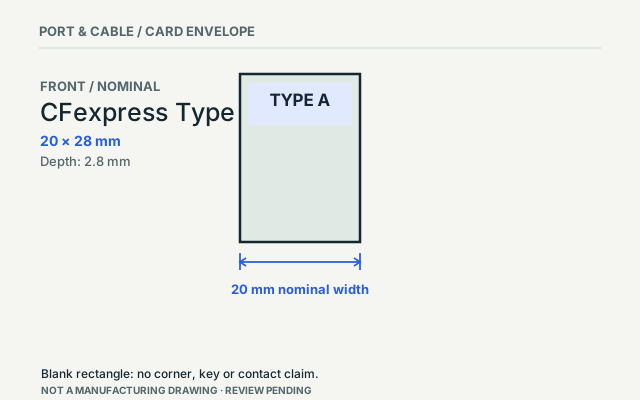
The CompactFlash Association distinguishes the smaller Type A form from Type B.
Claim scope: Identification and explicitly scoped documentation only; not an end-to-end connection approval
Source links: S096 · Evidence trail → (private workspace)
C121B · P121
CFexpress uses PCI Express with NVMe protocols.
Claim scope: Identification and explicitly scoped documentation only; not an end-to-end connection approval
Source links: S096 · Evidence trail → (private workspace)
C121C · P121
CFA describes CFexpress Type A as the smaller A/B form using one PCIe lane. The A/B type letter identifies a form factor; the separately described version-4 marking identifies a specification generation.
Claim scope: Card Types public text: Type A versus Type B and label FAQ; reinspected 2026-10-08 without changing the inherited source record.
Source links: S096 · Evidence trail → (private workspace)
C121D · P121
Sony’s MRW-G2 instructions list Sony CFexpress Type A and the stated Sony SD families, while explicitly withholding a guarantee for every memory-card type. This is named-reader scope, not support for CFexpress Type B or for all cards.
Claim scope: Printed 5-019-283-B1 (1), PDF page 1 English Compatible memory cards.
Source links: S438 · Evidence trail → (private workspace)
C122A · P122
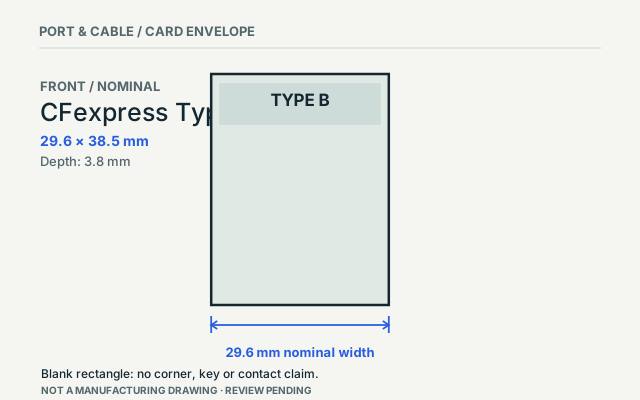
The CompactFlash Association states that Type B and XQD share a form factor and connector, with camera support conditional on implementation.
Claim scope: Identification and explicitly scoped documentation only; not an end-to-end connection approval
Source links: S096 · Evidence trail → (private workspace)
C122B · P122
Sony labels its CEB-G card examples CFexpress Type B with a PCI Express interface.
Claim scope: Identification and explicitly scoped documentation only; not an end-to-end connection approval
Source links: S098 · Evidence trail → (private workspace)
C122C · P122
CFA describes CFexpress Type B as using two PCIe lanes and retaining the same dimensions and connector as XQD. It separately makes camera support conditional on implementation or a manufacturer update.
Claim scope: Card Types public text: form-factor footnote and A/B FAQ; no dimensions or speed table transcribed.
Source links: S096 · Evidence trail → (private workspace)
C122D · P122
Sony lists its CFexpress Type B memory cards for the MRW-G1 reader.
Claim scope: Sony MRW-G1 and the specified Sony card family only. No camera or other reader approval.
Source links: S495 · Evidence trail → (private workspace)
C133A · P133
The CompactFlash Association distinguishes PATA CompactFlash, SATA CFast and PCIe/NVMe CFexpress.
Claim scope: Identification and explicitly scoped documentation only; not an end-to-end connection approval
Source links: S096 · Evidence trail → (private workspace)
C133B · P133
CFA’s CFexpress 4.0 announcement specifies PCIe Gen4 with NVMe 1.4c and retains the existing card form factors when moving from CFexpress 2.0. Its backward-compatibility and theoretical-throughput statements are not exact-card, camera-mode or file-copy guarantees.
Claim scope: 2023-08-28 public announcement; not the normative CFexpress specification.
Source links: S436 · Evidence trail → (private workspace)
C141A · P141
Sony ILCE-7M4 usable-card documentation separates card families from movie recording requirements.
Claim scope: Exact documented product and family scope; no physical test, exact-card certification or end-to-end approval.
Source links: S116 · Evidence trail → (private workspace)
C141B · P141
Canon EOS R5 Mark II specifications distinguish CFexpress Type B Card 1 from SD-family Card 2 and impose additional media requirements.
Claim scope: Exact documented product and family scope; no physical test, exact-card certification or end-to-end approval.
Source links: S120 · Evidence trail → (private workspace)
C141C · P141
CFA defines VPG in terms of minimum sustained write performance for video recording. A card’s peak read figure and a reader’s USB interface label answer different questions.
Claim scope: Public VPG explanation and MRW-G2 interface example; no benchmark or automatic camera qualification.
Source links: S441 · S438 · Evidence trail → (private workspace)
C141D · P141
CFA warns that VPG Profile 5 is not backward compatible with Profile 4: VPG800 or VPG1600 alone does not establish a mode requiring VPG200 or VPG400. Higher-class substitution is described within a profile, and dual-profile certification is a separate condition.
Claim scope: Public FAQ on VPG-5 versus VPG-4 and dual-profile labeling; no individual card certified by this reference.
Source links: S441 · Evidence trail → (private workspace)
C141E · P141
CFA maintains a certified-card register because a displayed VPG logo may be misused. Check the exact card’s certification and the camera mode rather than treating an unfamiliar label or larger number as approval.
Claim scope: VPG-Certified Media Cards section; no named-card database lookup or counterfeit identification performed.
Source links: S441 · Evidence trail → (private workspace)
Recorded evidence only. An inspection date, publisher label, source link or generated packet is not independent technical review, hardware testing, fabrication approval or a compatibility verdict.