
Applies to: Original teaching schematics; no cable, qualification or certification test performed.
| Method | Question answered | Limit |
|---|---|---|
| Continuity / basic verification | Are the expected conductors connected without obvious open/short faults? | May not detect pair integrity or target-frequency performance; features vary by instrument. |
| Wiremap with appropriate remote | Which pins reach which pins, and which supported faults are detected? | A simple1-to-1 map alone does not establish that conductors remain the correct twisted pairs. |
| Qualification | Does this tested path support a named application/rate under the instrument's method? | Does not declare compliance with every parameter of a cabling category/class. |
| Certification | Does the tested channel or permanent link pass the chosen standards-based limits? | Requires correct test configuration, instrument/calibration and retained report; it is not a certificate for an untested duplicate cable. |
Open example
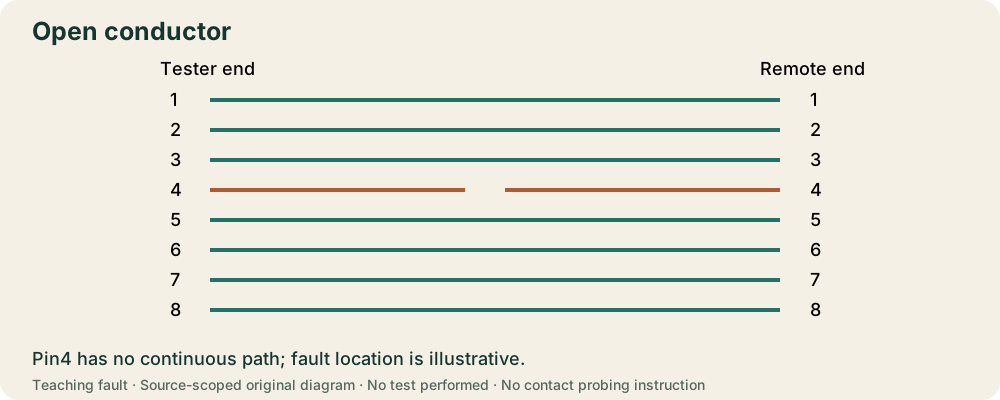
Original schematic: pin4 stops before the far end. This supports a continuity fault on that conductor/path. Without the instrument's correct remote, Fluke notes that apparent pair results can differ; do not copy a distance from an illustration as a measurement.
Verification Qualification and Certification · Twisted Pair Test Results — MicroScanner2Short example
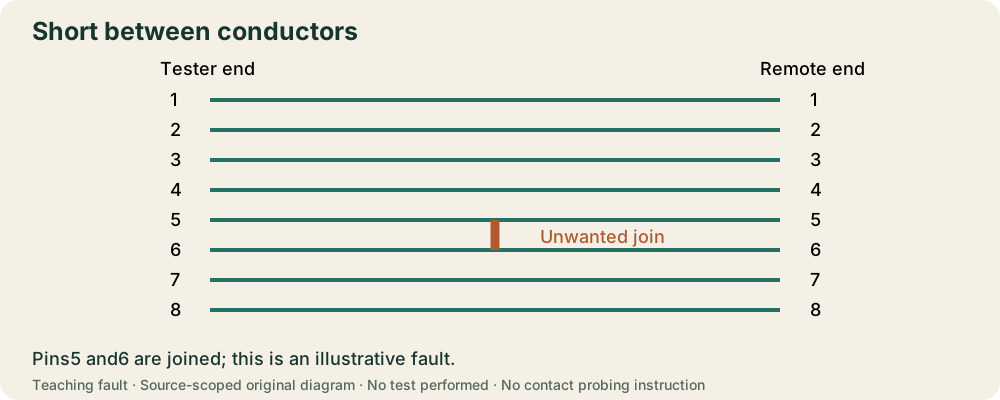
Original schematic: two expected separate conductors are electrically joined. Isolate the link and use the tester's documented procedure; never put a simple continuity tester on an unknown powered PoE/telephone circuit.
Verification Qualification and Certification · Twisted Pair Test Results — MicroScanner2Split-pair example
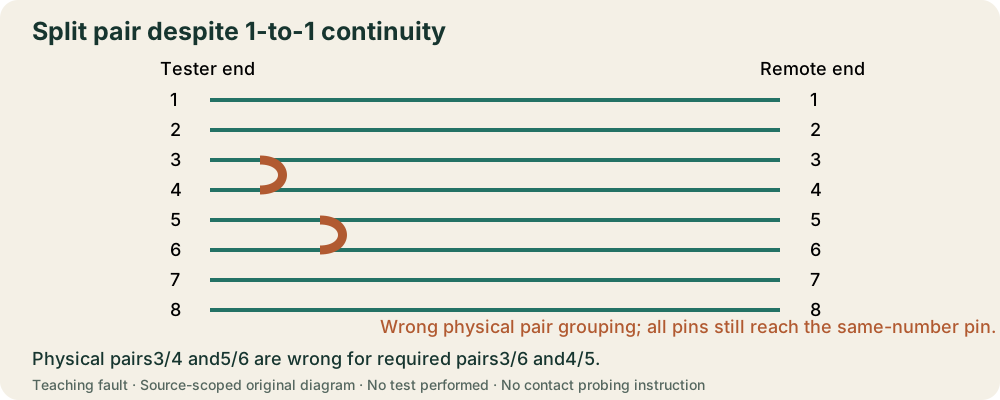
Pins can read1→1,2→2 and so on while conductors from different physical pairs are grouped together. Fluke explains that this can preserve continuity while increasing crosstalk. A pair-capable test is required; a row of eight lit continuity indicators is insufficient.
Verification Qualification and Certification · Twisted Pair Test Results — MicroScanner2Read the report
Record tester model/software, calibration status when relevant, date, test limit, cable/channel identity, remote, pass/fail and plots. Identify whether the test was on the permanent link or complete channel. One report applies to its identified path/configuration.
Verification Qualification and Certification · Twisted Pair Test Results — MicroScanner2Worked interpretation
Hypothetical: continuity passes, while an application-qualification result fails the requested10G limit but supports a lower named rate. Those statements can coexist. Request the actual report and appropriate certification when required; do not relabel the continuity result10G certified.
Verification Qualification and Certification · Twisted Pair Test Results — MicroScanner2Your next useful observation
Record the exact model, selected length, both endpoint roles and required application. Keep undocumented properties unknown.
Keep these limits
- Source-scoped examples only. No actual cable sample, link, power, qualification or certification test was performed.
Source documents, revisions and inspection methods
Verification Qualification and Certification
Fluke Networks · Article dated 2018-09-14
Three kinds of test tools; closer look at verification/qualification/certification
Inspected 2026-10-23 by public_page. AI primary-source text inspection; not independent human review or hardware measurement
Test-method distinctions only; no test performed in this implementation.
Read the original sourceTwisted Pair Test Results — MicroScanner2
Fluke Networks · Article dated 2014-02-26
Open, short, crossed wires/pairs and Split Pair sections; far-end adapter note
Inspected 2026-10-23 by public_page. AI primary-source text inspection; not independent human review or hardware measurement
Instrument-specific interpretation paraphrased into original examples. No manufacturer's screenshot copied.
Read the original sourceSource-documented education. Hardware behavior and independent human review have not been performed for these examples.